Singapore falls to 160 in 2021 World Press Freedom index; situation classified as "very bad"


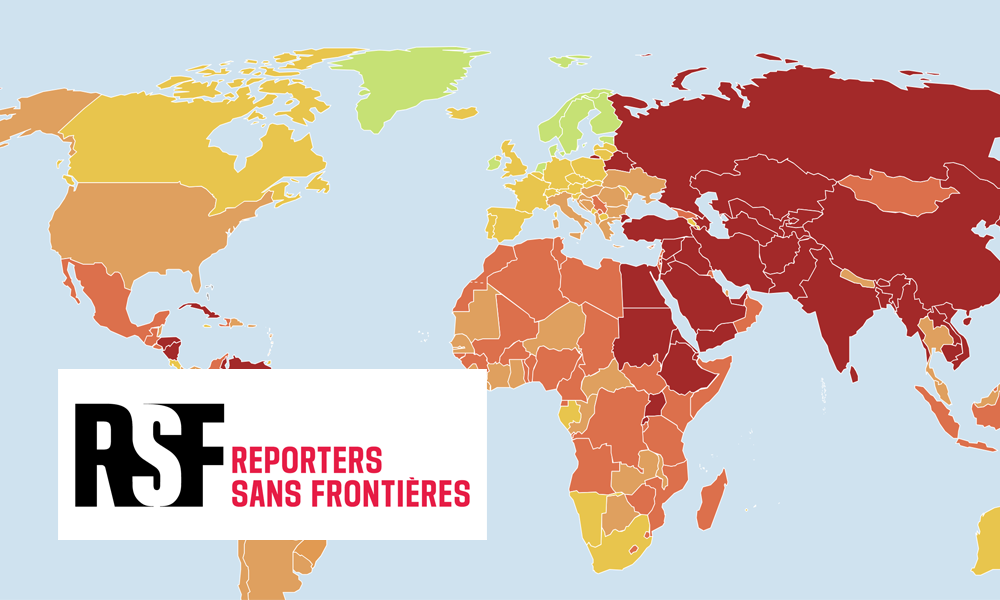
Singapore continues its descent at the World Press Freedom ranking in 2021, dropping from 158 to 160.
The index by Reporters Without Borders (RSF) is a barometer that gives an annual ranking of countries based on the organisation's assessment of the press freedom records of those countries, which is based on several categories including media independence, legislative framework, abuses against the media/reporters, infrastructure, and more.
Singapore has consistently ranked poorly on this index for the past few years. The city-state dropped to 158 in the last ranking from 151 in 2019 - a position that is below countries such as Russia, Thailand, and Indonesia.
In its ranking last year, RSF noted that Singapore had its colour on the Index changed to black, which signifies that the situation in the country is classified as “very bad”.
The color index remains in this year's ranking.
”Despite the 'Switzerland of the East' label often used in Singapore government propaganda, the city-state does not fall far short of China when it comes to suppressing media freedom," RSF explained.

Reasons for the ranking
- Prime Minister Lee Hsien Loong’s government is always quick to sue critical journalists, apply pressure to make them unemployable, or even force them to leave the country.
- The Media Development Authority has the power to censor all forms of journalistic content.
- Defamation suits are common and may sometimes be accompanied by a sedition charge that is punishable by up to 21 years in prison.
- The political control is coupled with an economic straitjacket. Two business groups control all of Singapore’s print and broadcast media. One, MediaCorp, is owned by a state investment company. The other, Singapore Press Holdings, is supposedly privately-owned but the Government appoints those who run it. As a result, self-censorship is widespread, including within the alternative independent media, which are intimidated by the judicial and economic pressure. The red lines imposed by the authorities, known by Singapore’s journalists as “OB markers” (for out-of-bounds markers), apply to an ever-wider range of issues and public figures. The authorities have also started sending journalists emails threatening them with up to 20 years in prison if they don’t remove annoying articles and fall into line.
- The Orwellian provisions of the “anti-fake news” law, "Protection from Online Falsehoods and Manipulation Act" (POFMA) adopted in 2019 forces all media outlets and digital platforms to post “corrections” to any content that the Government may arbitrarily deem to be “incorrect”. This censorship bureau 2.0 has enabled the Government to impose its own version on a range of subjects including the death penalty, the salary paid to the prime minister’s wife, and its handling of the COVID-19 crisis.
Singapore's neighbouring countries, Malaysia, ranked 119 on the index, saw a steep drop of 18 positions from its previous ranking, while Indonesia, at 113, saw an improvement of 6 from its previous year's ranking.
Top 40 countries in the World Press Ranking