Singapore issues POFMA order over Pannir Selvam article; MalaysiaNow refuses to comply
Singapore’s Ministry of Home Affairs has issued a correction direction to MalaysiaNow under POFMA, citing false claims in an article about Pannir Selvam’s execution. MalaysiaNow has rejected the directive, criticising Singapore's extraterritorial enforcement.
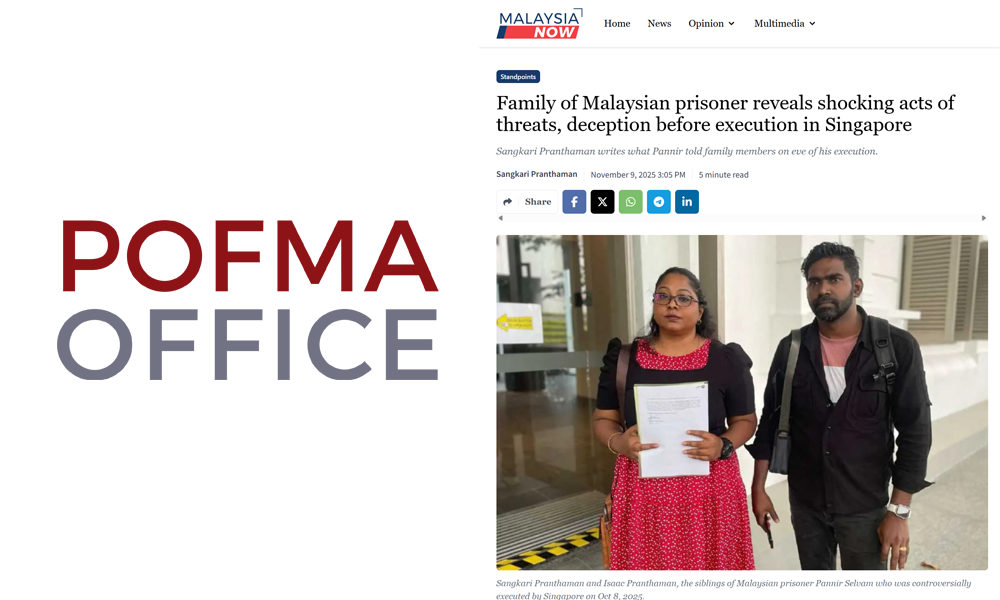

Singapore’s Minister for Law and Second Minister for Home Affairs, Edwin Tong, has issued a Correction Direction under the Protection from Online Falsehoods and Manipulation Act (POFMA) to Malaysian news portal MalaysiaNow.
The direction was issued under the Ministry of Home Affairs on 15 November 2025, targeting an article authored by Sangkari Pranthaman about the execution of her brother, Pannir Selvam A/L Pranthaman, in Singapore on 8 October 2025.
According to the Correction Direction, the article published on 9 November 2025 contained five falsehoods:
- That Pannir’s execution was carried out without regard for the rule of law.
- That the Government’s decision not to issue a Certificate of Substantive Assistance (CSA) was unlawful.
- That the Central Narcotics Bureau (CNB) secretly facilitated an interview between Pannir and the Malaysian police.
- That during this interview, a CNB officer wore a Malaysian police uniform and concealed his identity.
- That Singapore Prison Service (SPS) officers attempted to mislead Pannir’s family into signing a form falsely confirming that all of his belongings had been returned.
The POFMA directive required MalaysiaNow to place correction notices on the article and its related social media posts, including a link to the Singapore government’s version of events.
In a statement published on 15 November, MalaysiaNow rejected the compliance instructions issued by Singapore’s POFMA Office, which accompanied the Correction Direction over its article on Pannir Selvam’s execution.
Editor Abdar Rahman Koya criticised the move as an extraterritorial attempt at censorship, stating, “We do not take instructions from our own government; what makes them think we would take instructions from them?”
Describing the 18-page document as “draconian” and “littered with jargon and threats,” MalaysiaNow objected to the directive’s detailed requirements, which included placing government-approved correction notices within the article, pinning them to social media posts, and linking directly to official statements.
The outlet stated it would not comply and instead published its own rebuttal across the platforms named in the Correction Direction.
The article at the centre of the dispute, penned by Sangkari Pranthaman, made several serious allegations. It argued that the Misuse of Drugs Act in Singapore is structurally unjust and racially prejudiced, and claimed that Pannir had provided useful intelligence to the authorities but was still denied a CSA, which could have spared him the death penalty.
Sangkari also alleged that a CNB officer, Kannan Radhamani, disguised himself in a Malaysian police uniform during a covert interview, and that Malaysian police pressured Pannir into signing blank documents.
She accused Singapore Prison Service officers of attempting to manipulate the family into signing misleading forms during the handover of Pannir’s belongings and of withholding some of his final writings without justification.
While the Singapore government categorically denied the five statements listed in the Correction Direction, it did not refute several other allegations made in the article.
These include the claim that Pannir’s legal correspondence was previously unlawfully forwarded by prison authorities — a breach for which Singapore courts imposed a S$10 fine.
The POFMA notice also did not respond to broader criticisms of the Misuse of Drugs Act or to serious claims concerning the conduct of Malaysian police.
One such claim, that ASP Suresh Elumalai from Bukit Aman pressured Pannir to sign blank sheets of paper, was said to have occurred within Singapore prison premises while Pannir was in custody.
Although the officer named was Malaysian, the incident allegedly took place on Singapore soil under the control of Singapore prison authorities, raising questions about institutional oversight. Despite this, the Correction Direction did not address or deny this specific allegation.
Under Singapore’s POFMA framework, non-compliance with a Correction Direction constitutes a criminal offence.
Offenders may face fines of up to S$20,000 or imprisonment of up to 12 months, or both. In the case of online platforms, the government may also direct internet service providers to block access to the site within Singapore.
MalaysiaNow now faces the risk of enforcement under this framework. Should it continue to reject compliance, Singapore authorities may pursue site blocking and other legal action.
A similar case occurred in 2020 when the rights group Lawyers for Liberty (LFL) refused to comply with a POFMA correction order after alleging that Singapore used brutal methods during executions. The Singapore government subsequently blocked LFL’s website within Singapore.
LFL filed a civil suit in Malaysian courts against then-Minister K Shanmugam, seeking a declaration that Singapore’s correction orders could not be enforced against Malaysian entities.
The Federal Court of Malaysia later struck out that suit, ruling that actions of a foreign sovereign cannot be adjudicated by Malaysian courts. However, the court allowed a second suit—relating to LFL’s constitutional right to freedom of expression under Malaysian law—to proceed.
That ongoing case raises unresolved questions about whether foreign laws like POFMA can restrict Malaysian citizens or organisations operating within Malaysia.
With MalaysiaNow’s open defiance of the correction direction, this dispute may set the stage for renewed scrutiny of cross-border enforcement of Singapore’s laws and the legal limits of digital sovereignty.