Singapore blocks access to MalaysiaNow following non-compliance with POFMA correction direction
Singapore has blocked access to MalaysiaNow’s website after it failed to comply with a POFMA correction direction over an article on Pannir Selvam. Social media platforms have also been ordered to issue correction notices.
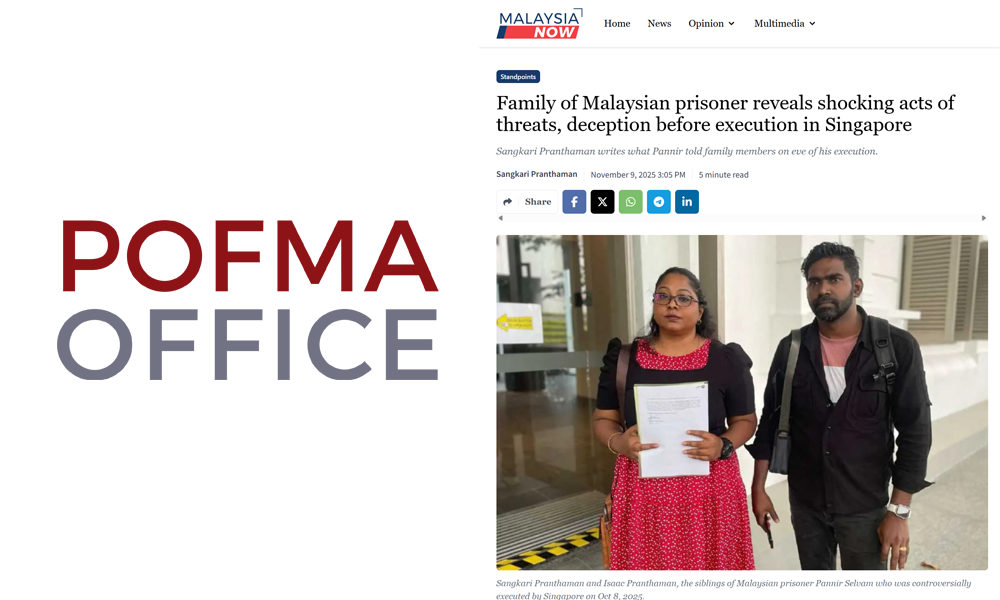

Access to MalaysiaNow’s website has been blocked in Singapore following the outlet’s refusal to comply with a Correction Direction issued under the Protection from Online Falsehoods and Manipulation Act (POFMA).
The Infocomm Media Development Authority (IMDA) was directed to implement the block by the Ministry of Digital Development and Information (MDDI) on 17 November 2025.
The Correction Direction was originally issued on 15 November by Minister for Law and Second Minister for Home Affairs, Edwin Tong.
It concerned an article published by MalaysiaNow on 9 November, written by Sangkari Pranthaman, about the execution of her brother, Pannir Selvam A/L Pranthaman.
According to the government, the article contained five falsehoods relating to the conduct of Singapore’s Central Narcotics Bureau (CNB), Singapore Prison Service (SPS), and the decision not to grant Pannir a Certificate of Substantive Assistance.
MalaysiaNow was instructed to place a correction notice alongside the article and on all related social media posts, but declined to comply.
In a statement released on 17 November, MDDI and MHA said:“MalaysiaNow has not complied. These are not actions that would be taken by any responsible media outlet with journalistic integrity.”
The IMDA has now issued Access Blocking Orders, requiring internet access service providers in Singapore to disable access to MalaysiaNow’s website. This means users in Singapore can no longer view its content directly.
Additionally, Targeted Correction Directions have been issued to Meta Platforms, Inc., LinkedIn Corporation, and X Corp, the parent companies of Facebook, LinkedIn, and X (formerly Twitter).
These platforms are now required to display correction notices to all users in Singapore who have accessed — or will access — MalaysiaNow’s posts linking to the article.
The government stated that the Correction Direction was intended to allow readers to consider both the original claims and the government’s response, stating: “The CD requires MalaysiaNow to display the facts alongside the falsehoods published, enabling readers in Singapore to read both versions and make their own assessment.”
MalaysiaNow, in a statement on 15 November, rejected the Correction Direction and the accompanying instructions, criticising the directive as “draconian” and accusing the Singapore government of attempting to control foreign media.
Editor Abdar Rahman Koya said the outlet would not comply with the directive, describing it as an overreach of Singapore’s laws.
In a statement published on 15 November, he wrote: “We do not take instructions from our own government; what makes them think we would take instructions from them?”
He also criticised the Correction Direction as “draconian” and described it as an 18-page document “littered with jargon and threats.”
MalaysiaNow rejected the POFMA Office’s detailed compliance instructions — including the requirement to post and pin correction notices on its article and social media pages — and instead published its own rebuttal on the platforms referenced.
Under Singapore law, failure to comply with a Correction Direction constitutes a criminal offence. Individuals may face a fine of up to S$20,000 or up to 12 months’ imprisonment, or both. The blocking of access is an additional enforcement mechanism provided under POFMA.
This is not the first time Singapore has blocked access to a Malaysian organisation over non-compliance with POFMA. In 2020, the rights group Lawyers for Liberty (LFL) faced a similar Correction Direction over claims about execution methods in Singapore. After refusing to comply, its website was blocked from access within Singapore.
LFL filed two suits in Malaysian courts, one of which — concerning sovereign immunity — was struck out by the Federal Court. However, a second case, concerning the group’s freedom of expression under Malaysia’s Constitution, was allowed to proceed and remains ongoing.