Framing WP’s Tampines gains as racial appeal is political misdirection
Prime Minister Lawrence Wong’s remarks about the Workers’ Party’s (WP) performance in Tampines raise inconsistencies, particularly when compared with past elections where the WP performed strongly in Chinese-majority areas.

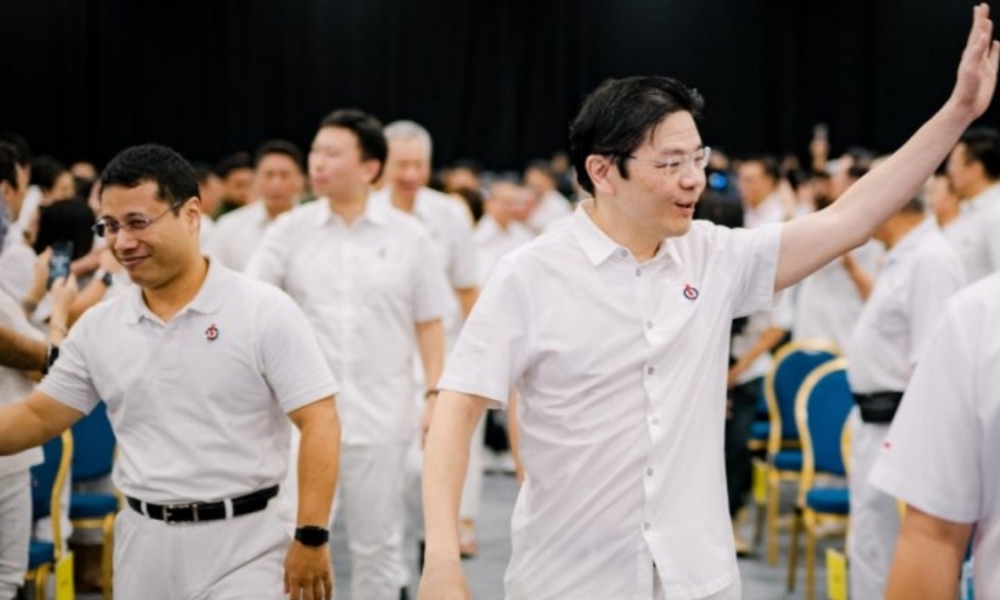
At the People’s Action Party (PAP) Awards and Convention on 9 November 2025, Prime Minister Lawrence Wong made remarks that merit urgent scrutiny for how they frame electoral outcomes through a racial lens.
Referring to the Workers’ Party’s (WP) strong showing in Tampines GRC during the 2025 General Election — where its vote share secured a Non-Constituency Member of Parliament (NCMP) seat — Wong warned that a loss there could have signalled that the WP’s “calculated appeal” to Malay-Muslim voters was effective, potentially paving the way for racially divisive politics.
His remarks appeared to allude to the WP’s decision to field Faisal Abdul Manap, its most senior Malay-Muslim Member of Parliament, in Tampines.
Formerly of Aljunied GRC, Faisal was redeployed to lead the WP’s first-ever team in Tampines—a four-corner fight that also included the PAP, the National Solidarity Party (NSP), and the People’s Power Party (PPP). Despite the crowded field, the WP secured 47.37% of the vote, firmly establishing itself as the primary challenger to the ruling party.
However, Wong’s framing has raised serious questions about consistency and logic, particularly when set against the WP’s broader electoral history.
Questioning the logic of racial appeal
To unpack the implications of Wong’s remarks, it is necessary to examine the demographic and electoral context.
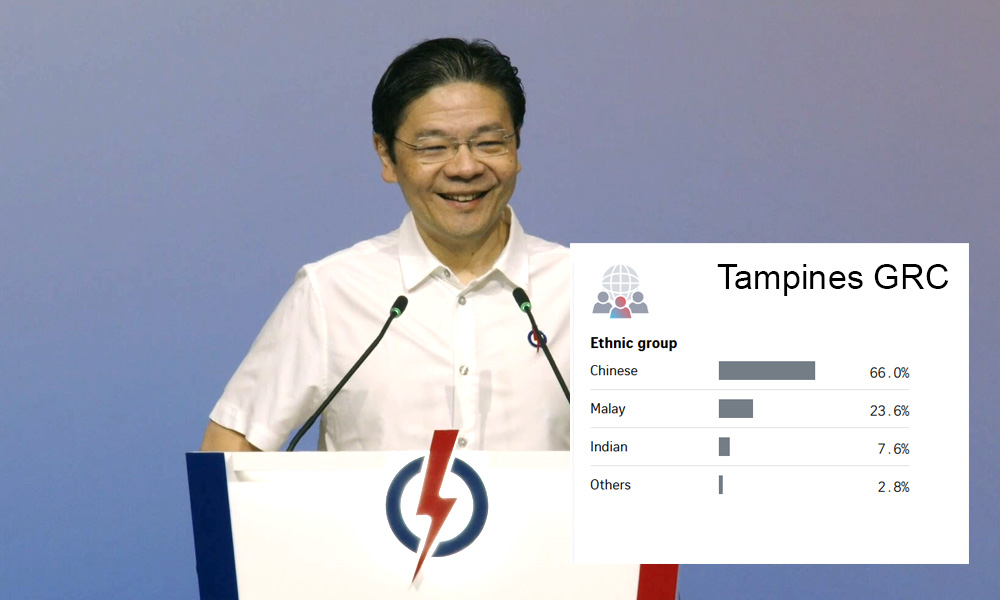
Wong’s comments appear to hinge on the racial makeup of Tampines GRC, which, according to Straits Times estimates for 2025, comprises 66% Chinese, 23.6% Malay, 7.6% Indian, and 2.8% others. While it is true that Tampines has one of the highest proportions of Malay voters in Singapore, it is by no means a Malay-majority constituency.
Even if every Malay voter in Tampines had backed the WP—an unlikely scenario—the party would still have required broad support from Chinese and Indian voters to achieve its 47.37% share.
By contrast, the WP has previously won in constituencies with even higher Chinese-majority demographics. In the landmark 2020 General Election, the WP secured victory in Sengkang GRC, which, by 2025, had an estimated racial makeup of 77.5% Chinese, 10.7% Malay, and 9.3% Indian. The party has held the GRC since then.
Similarly, the WP continues to hold Aljunied GRC, whose 2025 racial composition is estimated at 78.5% Chinese, 10.9% Malay, and 8.0% Indian.
Yet, there were no accusations in those elections that the WP had made racial appeals to Chinese voters. The inconsistency in logic calls into question why a close contest in a more racially diverse constituency like Tampines is now being framed in such terms.
Tampines: A serious contest, not a communal appeal
The PAP narrowly retained Tampines GRC with 52.02% of the vote, while the WP—contesting there for the first time—garnered 47.37%. The margin was narrow despite the PAP team being led by Minister Masagos Zulkifli, who also serves as Minister-in-Charge of Muslim Affairs.
If the WP had intended to run a racially charged campaign, Tampines would have been an unlikely choice. The GRC has been represented by Masagos since 2006, and he has held the Muslim affairs portfolio since 2018.
It defies political logic to suggest that the WP attempted to make a communal appeal in a constituency already anchored by the Government’s most senior Malay-Muslim minister. Such a tactic would have been self-defeating.
If anything, the deployment of Faisal Abdul Manap—an experienced and credible MP—signalled a strategic effort to contest the GRC on merit and expand the WP’s national footprint, not to divide voters by identity.
Yet this episode also highlights how the WP is often criticised regardless of its approach. Under the GRC system, all contesting parties are required to field at least one minority candidate.
Had the WP nominated a lesser-known figure, it might have faced accusations of tokenism. Instead, by fielding one of its most senior Malay-Muslim leaders, it now stands accused of communal politicking. This contradiction reflects how opposition parties can be placed in a bind—faulted both for doing too little and for doing too much.
Moreover, two minor parties—NSP and PPP—performed poorly, receiving just 0.18% and 0.43% of the vote respectively. The negligible impact of these candidates suggests that voters were discerning and focused on the substantive contest between the PAP and WP, rather than casting votes along racial or partisan lines.
A matter of merit, not identity
Wong’s concern that the WP’s strategy, if successful, would encourage others to adopt racially divisive approaches, rests on a deeper assumption—that the WP intentionally sought to exploit ethnic lines. Yet, this claim is not supported by any concrete evidence.
The WP’s platform has consistently emphasised governance, transparency, and policy alternatives. Its success in racially varied constituencies indicates an appeal that transcends identity politics.
The narrow result in Tampines likely reflects voter sentiment not against racial harmony, but dissatisfaction with the incumbent team—including Masagos.
If the very community he is tasked with representing voted significantly for the opposition, does that not raise legitimate questions about his effectiveness?
The PAP’s own reshuffling—appointing Faishal Ibrahim as Acting Minister-in-Charge of Muslim Affairs after the election—suggests internal recognition of the need for renewal in the face of shifting voter sentiment.
Rather than viewing the election outcome through a communal lens, it may be more constructive to ask whether voters were responding to perceived or actual policy shortcomings.
Dangerous framing in a multiracial society
The implications of such framing extend beyond a single GRC or election result. What is at stake is the integrity of Singapore’s multiracial democracy and how political leaders choose to engage with difference in the public sphere.
Singapore’s multiracial ethos depends on political leaders avoiding narratives that reduce electoral outcomes to ethnic allegiances. Suggesting that the WP’s performance in Tampines was driven by a “calculated appeal” to Malays not only contradicts past electoral data, but also risks introducing a racialised lens into future political discourse.
By that logic, strong support for any party in Chinese-majority wards would need to be scrutinised as racial alignment—yet such a narrative has never been applied to the PAP or other parties.
Rather than a neutral observation about social cohesion, Wong’s framing operates as a form of political gaslighting.
It pre-emptively recasts any future WP success in Tampines as racially driven, diverting attention from the more uncomfortable reality that the PAP is losing ground among a more discerning electorate. The result is not a defence of multiracial harmony, but a narrative shift that seeks to delegitimise electoral competition through the language of race.
To build a resilient and inclusive democracy, electoral outcomes must be interpreted with care and responsibility. By suggesting that a WP win would reflect racial mobilisation rather than voter dissatisfaction, the PAP risks planting the very seeds of distrust and division it has long warned against.
Such a narrative not only pre-empts legitimate voter concerns, but also reduces political choice to communal identity. This reductive framing underestimates the maturity of Singaporean voters, who have consistently demonstrated their ability to judge policies, leadership, and accountability on merit—not on race or religion.