When “wealth injection” becomes inequality by design
At the Bloomberg forum, Lawrence Wong praised “wealth injections” via HDB and CPF as proof even the poorest have “significant assets”. But set against GE2025’s $1 meals, grocery coupons and the surge in million-dollar flats, a harsher truth emerges: asset inflation enriches those already backed by capital, while the rest must queue at Meet-the-People Sessions and rely on partisan appeals just to get by.
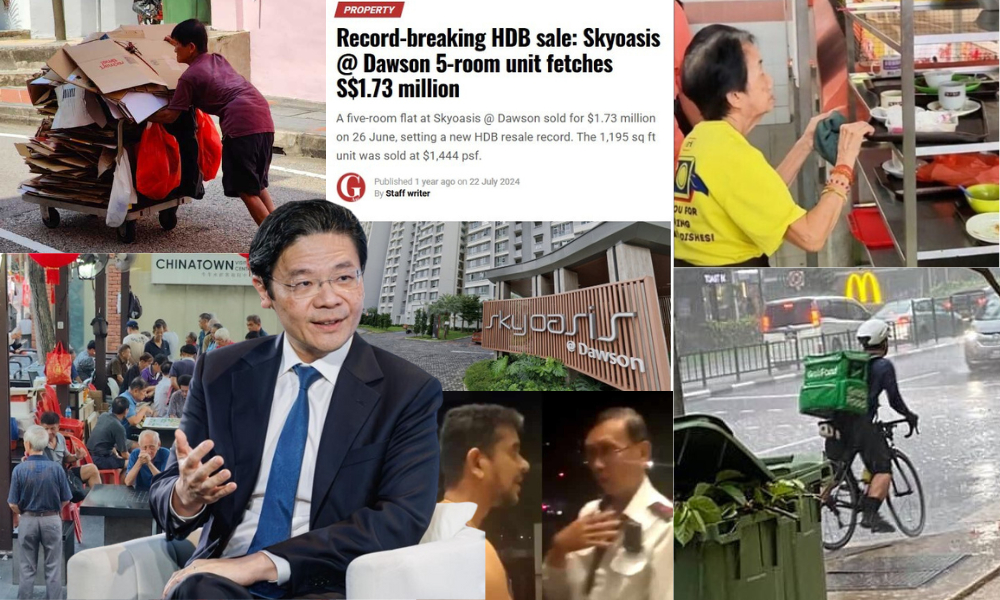

At the Bloomberg New Economy Forum on 19 November, Prime Minister Lawrence Wong offered a familiar defence of Singapore’s approach to inequality.
The Republic, he said, has “a range of levers besides taxation” to tackle wealth gaps — from “wealth injections” via public housing to occasional top-ups into CPF, the “individual’s own retirement nest egg”. That is why, he argued, even the bottom 20 per cent of households here have “significant net assets”.
On the surface, it is a reassuring story: a low-tax, high-growth city-state that manages to lift even its poorest citizens into asset ownership, while still welcoming global wealth and family offices.
But set this narrative against the backdrop of GE2025 — with its wave of $1 meals, grocery vouchers and neighbourhood “assistance” rolled out in the months before polling day in May — and a more uncomfortable picture emerges.
The problem is not that help is being given. It is how help is structured, when it is most visible, and who truly benefits from a system built on asset inflation at the top and appeals-based assistance at the bottom.
Asset-Rich, Cash-Poor – and Trapped
Mr Wong’s core claim is that public housing and CPF top-ups give Singaporeans, including the poorest, a form of wealth that reduces inequality.
Technically, this is true: an elderly cleaner living in a fully paid three-room flat appears, on paper, to have “significant net assets”. But that statement blurs a critical distinction between owning an asset and having real security or options.
A flat cannot be eaten. It cannot pay next month’s medical bill without sacrificing the roof over one’s head. Monetisation schemes, lease buybacks and downsizing all exist – but they depend on awareness, paperwork, the ability to navigate bureaucracy and, often, the painful choice of uprooting one’s life.
More fundamentally, using HDB appreciation as a “wealth injection” mechanism comes with a built-in cost: each round of asset uplift for one cohort raises the entry barrier for the next. The parents’ retirement bonus becomes the children’s housing burden.
Over time, property policy stops being a tool for equalisation and becomes a system that locks in advantage for those who bought in early or traded up aggressively, while younger and lower-income Singaporeans chase ever-rising prices with stagnant wages.
When the Prime Minister points to asset figures at the bottom 20 per cent, he is holding up a snapshot, not a diagnosis. What looks like wealth on a spreadsheet can feel like entrapment in real life.
When Public Housing Becomes a Lottery for the Able
The way public housing operates in practice shows how this supposed “transfer of wealth” often favours those with know-how and backing, rather than the genuinely vulnerable.
In 2021, then–National Development Minister Desmond Lee highlighted a young couple, “Jin Ann and Jaslin”, who received the full S$80,000 Enhanced CPF Housing Grant for their five-room BTO flat in Tengah.
To qualify for the maximum grant, their combined household income would have had to be below S$1,500 a month. Yet HDB’s own guide prices for such units started from about S$404,000 without grants.
At that income level, CPF contributions and cash savings would be minimal, raising the obvious question of where the initial downpayment and long-term monthly instalments are really coming from. In reality, such purchases are often made possible only through parental transfers or other family resources.
The story, presented as proof that grants enable low-income Singaporeans to own spacious flats, is more plausibly read as evidence of how well the system works for households with intergenerational support – a “success” many truly poor families simply cannot replicate.
The investment logic is even starker in cases where subsidised flats are treated less as homes than as chips in a property game.
In 2023, a five-room BTO flat in Yishun, completed eight years earlier, was listed for S$690,000 in almost untouched condition: toilet bowls still wrapped in plastic, no lights or fittings installed, kitchen essentially unused. The unit appeared never to have been lived in, yet was now being offloaded into a heated resale market.
Public backlash forced HDB to reiterate that BTO buyers must occupy their flats throughout the Minimum Occupation Period and that suspected abuse would be investigated.
But the episode revealed a deeper structural reality: only someone with another place to stay and substantial resources can afford to leave a subsidised flat empty for years, locking up a public asset meant for owner-occupation while waiting to cash out.
These examples do not show a neutral transfer of wealth from state to citizen. They show public housing functioning as a kind of lottery that rewards those with the right mix of income, family capital and financial literacy.
For those without such advantages, the promise of “asset-based welfare” is far more fragile than the official narrative suggests.
A System You Must Know How to Work
Alongside asset-based welfare sits another pillar of Singapore’s model: tightly targeted, means-tested transfers. From GST vouchers to U-Save rebates, ComCare schemes and periodic “support packages”, the Republic’s social assistance programmes are extensive — but heavily conditional.
To benefit fully, a person must know what exists, know how to apply, know how to fill in forms, know what documents to produce, and, in many cases, be prepared to appeal if initially turned down.
In practice, many of these higher-stakes appeals are not made directly to agencies, but channelled through Members of Parliament at weekly Meet-the-People Sessions, where residents seek letters and intervention to unlock or improve outcomes.
What began decades ago as MPs helping largely illiterate or less-educated residents to draft formal letters has, over time, evolved into a system where going through an MP is widely seen as the necessary route to get a sympathetic hearing from the state.
Official figures underline just how many Singaporeans feel compelled to petition the state for housing alone.
Between 2019 and 2023, HDB received an average of about 854,000 pieces of correspondence a year, including roughly 177,000 appeals annually on issues ranging from flat eligibility and housing loans to public rental and even parking offences.
From 2020 to mid-2022, there were more than 29,000 appeals just for priority access to new or rental flats, while MPs say housing matters make up around one-third of their Meet-the-People Session caseload. And these figures are only for HDB.
They do not include the separate streams of appeals and pleas over medical bills, social assistance, Workfare, CPF withdrawals, school fees or other everyday costs.
Taken together, they suggest that a significant share of “bread and butter” governance in Singapore now operates through an informal appeals culture — where families must repeatedly ask, explain and justify their needs, often through partisan intermediaries, just to cope with the basics of life.
Since the overwhelming majority of MPs are from the ruling PAP, the very architecture of appeals routes people’s basic needs through partisan representatives.
The more complicated a household’s situation, the more daunting this process becomes.
In theory, such targeting is about “prudence” and “sustainability”. In practice, it sorts Singaporeans into two groups: those who know how to work the system, and those who do not.
A better-educated household, or one with family members comfortable with digital portals and official language, can optimise grants, plan property purchases around eligibility, and restructure income to qualify for the maximum support. A single parent juggling shift work and caregiving might not even know a scheme exists until after it has closed.
The irony is stark. A model designed to channel finite resources to “those who need it most” ends up rewarding those best placed to navigate bureaucracy, and punishing those whose very hardship leaves them without the time, knowledge or confidence to claim help.
When Help Becomes a Favour, Not a Right
GE2025 sharpened these contradictions. In the months leading up to polling day, Singaporeans saw a familiar pattern: heavily publicised $1 meals, community grocery distributions, supermarket coupons, and various forms of neighbourhood relief, often framed as outreach or care for those struggling with costs of living.
It is impossible to measure precisely how many votes were swayed by a cheap lunch or a bag of rice. Electoral behaviour is complex, and voters are not so easily bought. Yet the timing and visibility of these gestures matter. They reinforce a deeper message embedded in the assistance model: support is not a guaranteed baseline, but something extended by those in power, at moments of their choosing.
That dynamic is amplified by the way appeals are structured. A citizen who must repeatedly queue at a Meet-the-People Session, sit across from a PAP MP or grassroots representative, recount their difficulties and hope for a letter to a government agency, experiences help as something personally dispensed.
A resident who receives a voucher or heavily subsidised meal from hands wearing party colours may feel, consciously or not, an emotional tug of gratitude.
Over time, a political culture grows in which people are encouraged to see their well-being as dependent on the continued goodwill of one party and its network, rather than on clear, stable rights as citizens. The system does not just distribute assistance; it quietly cultivates a debt of loyalty among those who can least afford to risk losing support.
This is not what an egalitarian society looks like. It is what a patronage system looks like, updated for the age of QR codes and CDC vouchers.
“Egalitarian Norms” and Ostentatious Wealth
Mr Wong, in his Bloomberg conversation, drew a careful distinction between managing inequality among Singaporeans and handling foreign wealth inflows. Family offices and global funds are welcome, he said, because they create jobs — though the government occasionally has to “remind” ostentatious newcomers that Singapore is “egalitarian” and that “our norms are different”.
The rhetoric is elegant. But an egalitarian norm cannot be sustained by gentle reminders at the top while relying on case-by-case mercy, mediated by partisan intermediaries, at the bottom.
If the Republic truly believes that extreme displays of wealth are corrosive, then it must examine the policies that enable a small domestic class to grow extraordinarily rich through state-engineered asset and financial structures, even as a large working population depends on ad hoc handouts to endure inflation and stagnant wages. It is not enough to ask wealthy foreigners to be discreet if domestic inequality is being quietly widened through design.
This tension is not new. In 2013, then–Prime Minister Lee Hsien Loong argued that attracting more foreign billionaires would ultimately leave Singaporeans “better off”, even if the Gini coefficient worsened, because these ultra-rich residents would “bring in business, bring in opportunities, open new doors and create new jobs” – a classic trickle-down promise.
More than a decade on, many Singaporeans struggle to recognise that promised “trickle-down” in their own lives, but they can see very clearly where the money has pooled.
In public housing, 2024 saw a record 1,035 HDB resale flats changing hands for S$1 million or more – more than double the year before, and about 3.7 per cent of all resale transactions.
What sits behind those headline figures is not simply “upgrading aspirations” from the heartlands, but a cascading effect from the top of the property ladder: owners who have sold private homes or condominiums, cashed out substantial gains, and then re-entered the market by bidding aggressively for larger or better-located resale flats.
Armed with private-property profits, they can afford to pay far above what ordinary salaried households can manage, setting new price anchors across mature estates.
The government’s own data points in this direction: between 1 April 2022 and 31 March 2023, about 389 resale flats were sold for S$1 million or more, and almost three in ten of those buyers (108) had previously owned or were still holding a private property at the point of their resale application.
Later, Minister for National Development Chee Hong Tat disclosed that before the 15-month wait-out rule was introduced, private property downgraders made up about 34% of buyers of million-dollar flats, a share that fell to 12% between January and November 2024 after the rule took effect — clear evidence that this group had been a significant driver of high-end resale prices.
For younger and less affluent buyers, the message is simple: the “asset wealth” that older and better-off cohorts have accumulated is not trickling down, it is bidding against them – translating into higher entry prices, heavier long-term debt, and a resale market that increasingly reflects the spending power of those monetising private property, rather than the incomes of ordinary HDB dwellers.
At the very top, the contrast is even starker. The median price of Good Class Bungalows — a niche reserved for the ultra-wealthy in a city where nearly 80 per cent live in public housing — has climbed to around S$36 million in 2024, nearly doubling since 2019, driven in part by demand from the global rich.
Among the headline deals was the S$88 million sale of Home Affairs Minister K Shanmugam’s Astrid Hill GCB in 2023 to a trust managed by UBS, a transaction that later drew public scrutiny and questions over transparency regarding the ultimate beneficiary.
Set against these figures, talk of “egalitarian norms” sounds increasingly detached. The state has actively courted billionaires and defended their presence on the basis of trickle-down benefits, yet the most visible outcomes for ordinary residents have been surging housing prices, a thickening top end of both public and private property markets, and a sense that the system bends far more easily for those whose wealth starts in the tens of millions.
The Myth of Comfort in a Low-Tax System
Defenders of the status quo often point out that Singapore is a “low tax” country and like to cite the fact that many workers pay no income tax at all.
During the GE2025 campaign, PAP candidate Poh Li San told a rally crowd that “50 per cent of Singaporeans do not pay income tax”, using this to argue that if Singapore adopted opposition proposals such as those from the SDP, many more residents would end up paying income tax.
In reality, the Government’s own Factually site has previously put the figure at about 40 per cent of workers who fall outside the income tax net because their annual income is below the S$20,000 threshold or largely offset by reliefs.
This is technically true – but a low headline tax bill does not mean the state is shouldering more of life’s basic risks. It simply means those risks are being pushed back onto individuals and their families.
Over the past four decades, Singapore has deliberately shifted from direct taxes to indirect ones like the Goods and Services Tax, now at 9 per cent, while relying heavily on compulsory personal savings in CPF and MediSave to fund healthcare and retirement.
On paper, this preserves “fiscal prudence”. On the ground, it means that even low-wage workers who pay no income tax must constantly put aside money “for the rainy day”, because they know that if a serious illness, job loss or caregiving burden hits, there is no broad, tax-funded safety net to catch them.
The result is a population that is officially lightly taxed, but increasingly afraid to spend on its own well-being.
A new study by Economist Impact, commissioned by Prudential, found that 83 per cent of people in Singapore delayed seeking medical care in the past year, most commonly because of work pressures, family responsibilities and worries about cost or burdening loved ones. In other words, people are putting off seeing a doctor in a country that prides itself on world-class healthcare — not because the clinics do not exist, but because they are unsure they can afford to fall sick.
When the state boasts that half the workforce pays no income tax, it sounds like a gift. In reality, for many households it feels like a warning: you are on your own.
You may save a few hundred dollars a year in tax, but you must squirrel away far more to insure yourself against medical bills, old age and rising living costs.
The question almost writes itself: what is the point of being “lightly taxed” if the price of that model is a lifetime of anxious saving, delayed care and perpetual fear of the next bill?
Churchill, Attlee, and the Choice Between Heroes and Systems
History offers a useful mirror. During the Second World War, Winston Churchill was the face of Britain’s survival. Yet in the 1945 election, voters turned instead to Clement Attlee’s Labour Party, which promised not wartime heroics but a peacetime system: a National Health Service, universal social security, public housing and basic protections that did not depend on who occupied Downing Street.
The lesson was simple: people who have endured crisis do not want to spend the next decades appealing to leaders for favours. They want structures that make life liveable without begging.
Singapore stands at a similar crossroads. For decades, the People’s Action Party has cast itself as both architect and guardian of the social compact. Lawrence Wong, as the first prime minister born after Independence, inherits that story.
But younger Singaporeans, and increasingly the squeezed middle and working poor, are asking a different question: not “Who will give me a voucher?” but “Why must I rely on vouchers at all in a country this rich?”
Baking Fairness Into the Foundation
If Singapore is serious about managing wealth disparity, it must move beyond the comfort of headline numbers and ceremonial top-ups.
A genuinely equalising system would ensure that no one falls below a decent, automatically guaranteed floor of income or support; that essential services like healthcare and basic old-age security are treated as rights, not lottery prizes won through successful applications or appeals via the “right” MP; and that the state’s powerful tools — land policy, housing rules, tax structures and financial regulation — do not overwhelmingly reward those already in possession of assets and capital.
In such a system, the rich would still prosper, but not primarily because public policy inflates their asset base. The poor and lower-income would be able to get by without having to ask, and certainly without feeling that their survival depends on the goodwill of any political party.
Right now, Singapore’s model does the opposite: it manufactures wealth at the top through housing and finance, manages poverty at the bottom through carefully rationed transfers, and hopes the Gini coefficient after transfers will tell a comforting enough story.
What this produces is not accidental hardship, but a perpetual rat race by design – a system where most people run harder each year just to keep their footing, while a minority rides policy-driven asset gains.
If the new Prime Minister truly wants to “leave behind a better Singapore for future generations”, as he told his Bloomberg audience, then the task before him is not to fine-tune more “wealth injections”, or to remind the rich to be discreet.
It is to build a system in which equality does not depend on appeals, handouts or electoral cycles – and where dignity is not something you have to queue up to claim.