Budget 2025: Govt injects additional S$5B into Coastal and Flood Protection Fund
Prime Minister Lawrence Wong announced on 18 February that an additional $5 billion will be injected into the Coastal and Flood Protection Fund, originally set up in 2020 to safeguard Singapore against rising sea levels and enhance flood resilience. The fund will support a range of solutions, including sea walls, tidal gates, and land reclamation, such as the development of Long Island.

SINGAPORE:Prime Minister Lawrence Wong revealed on 18 February that another $5 billion will be added to the Coastal and Flood Protection Fund.
This top-up marks a continuation of efforts initiated in 2020, ensuring that the country can safeguard its shores and enhance flood resilience in the face of climate change.
The fund, first established with an initial $5 billion injection in 2020, is intended to finance both coastal protection and drainage infrastructure projects.
These investments are necessary to address the pressing challenges posed by global warming and rising sea levels, which threaten Singapore’s low-lying coastline.
In his Budget speech, Wong emphasised the importance of planning ahead.
"It is prudent for Singapore to set aside funds now to ensure we can proceed with the investments required for coastal and flood protection in the future," he said.
The urgency of the situation was underscored as PM Wong noted the stark reality of climate risks. If the world continues along its current fossil-fuel-driven development trajectory, global temperatures will keep rising.
This would result in a mean sea level rise of over one metre by 2100, putting significant pressure on coastal nations like Singapore.
Wong warned that approximately one-third of Singapore’s land area is vulnerable to coastal flooding if such trends persist.
Coastal Protection Measures, Including Land Reclamation and Long Island Development
The Government is committed to employing a wide range of measures to protect Singapore’s coastline. These solutions will include static structures such as sea walls, alongside more specialised interventions like tidal gates, barrages, and land reclamation projects.
These efforts will not only protect against rising sea levels but also provide new spaces for urban development.
A prominent example of this vision is the planned development of Long Island, located off the southeastern part of Singapore.
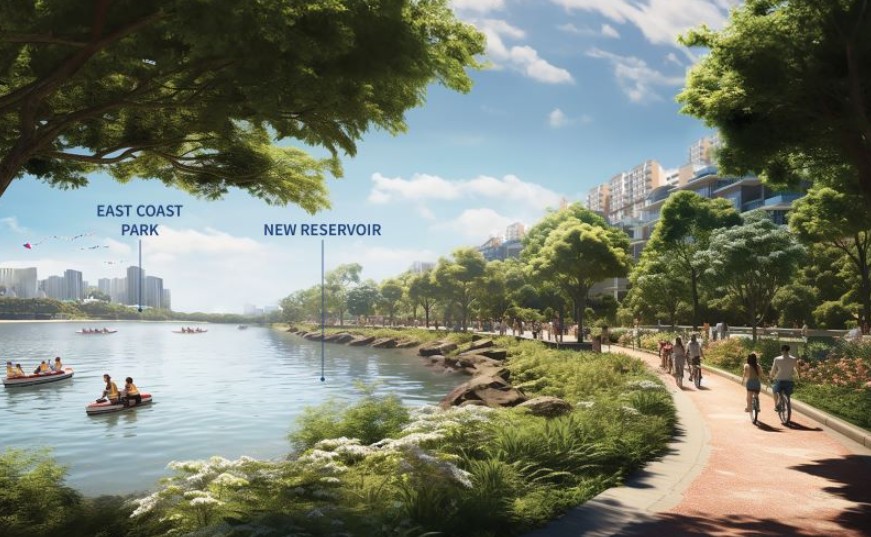
By reclaiming land from the sea, Long Island will not only raise ground levels to mitigate flooding risks but also provide additional space for housing and recreational areas, including new waterfront parks.
The reclamation of three tracts of land, collectively about twice the size of Marina Bay, will create approximately 800 hectares of new land. This will be used to build new homes, amenities, and a reservoir that will contribute to Singapore’s long-term water security.
This ambitious plan is a clear demonstration of how climate resilience can be integrated with urban development.
Additionally, Wong highlighted ongoing and upcoming studies aimed at determining the most appropriate coastal protection solutions for various regions.
The Public Utilities Board (PUB), tasked with overseeing these efforts, is set to complete site-specific studies for areas such as the Greater Southern Waterfront and Changi by 2025. Studies for other regions, including Jurong Island and the north-western coast, are also under way.
These studies form part of a broader national strategy, which involves eight islandwide site-specific assessments of Singapore’s coastlines.
The goal is to tailor coastal protection strategies to the unique needs of each coastal segment, ensuring that every part of the island is adequately safeguarded.
According to the third national climate change study, Singapore’s mean sea level is projected to rise by 23cm in the best-case scenario or by 1.15 metres in the worst-case scenario by 2100.
In the event of accelerated fossil fuel use, sea levels could rise by as much as 2 metres by 2150.
This rise in sea levels, coupled with storm surges, could result in extreme events that lead to widespread flooding in low-lying coastal areas.
Given the vulnerabilities exposed by these projections, PM Wong underscored the importance of swift and decisive action. “Our next decade will be pivotal,” he said.
“As we accelerate efforts to decarbonise our economy and enhance the climate resilience of our built environment, we must also continue investing in coastal protection.”
Wong also reaffirmed the Government’s commitment to tackling climate change and safeguarding the nation’s future.
“As long as this Government is in charge, we are committed to delivering these plans. We will ensure that our island nation survives even as the oceans rise, and we will build a better and greener future for all.”