Politics
PSP launches The Palm newsletter; urges structural reforms over multi-faceted employment challenges
The Progress Singapore Party (PSP) launched its inaugural newsletter The Palm on 25 August, using the platform to respond to Prime Minister Lawrence Wong’s National Day Rally speech. While welcoming job-related measures, PSP argued that deeper structural reforms are needed to address unemployment and underemployment.
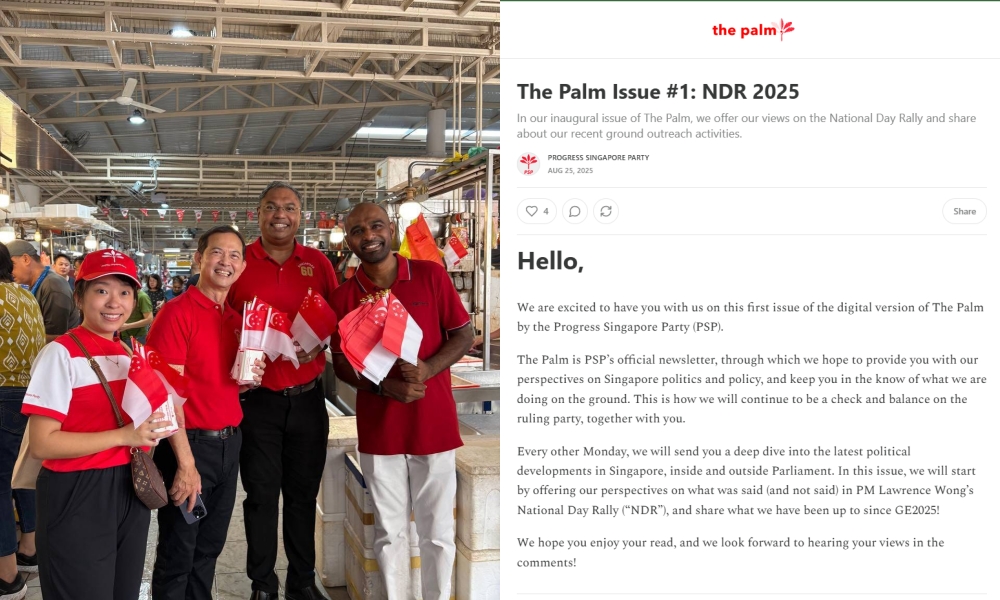
The Progress Singapore Party (PSP) has launched its inaugural official newsletter, The Palm, on 25 August.
The party used the publication to present its perspectives on Prime Minister Lawrence Wong’s National Day Rally (NDR) and to share its ongoing activities since the 2025 General Election.
PSP welcomed the government’s attention to jobs and the economy but argued that Singapore faces deeper, multi-faceted employment challenges that require structural reforms.
Welcoming job measures but questioning sufficiency
PSP acknowledged that the NDR devoted significant focus to jobs, particularly in light of Artificial Intelligence (AI) disrupting labour markets.
It noted the government’s expansion of training opportunities under the SkillsFuture Level Up programme and the new Graduate Industry Traineeship (GRIT) scheme.
While recognising these steps as positive, PSP maintained that they do not sufficiently address the root causes of unemployment and underemployment.
Three structural drivers of job displacement
The party identified three main drivers contributing to job losses and underemployment in Singapore.
First, displacement of Singaporeans by non-Singaporean workers recruited domestically.
Second, offshoring of roles to countries with lower labour costs. Third, automation and AI rendering certain jobs redundant.
PSP emphasised that tackling these issues requires more than training programmes.
Questioning the effectiveness of SkillsFuture for older workers
Since 2015, the government has invested billions into subsidised training under SkillsFuture.
PSP stated that while the enhanced Level Up programme, launched in 2024 for workers aged over 40, is an improvement, employability outcomes should be the key measure of success.
The party warned that reskilling alone may not help workers if companies continue offshoring roles or hiring foreigners in Singapore.
Retrenchments and age discrimination remain pressing
Citing Standard Chartered’s retrenchment of 80 employees in June 2025, with roles moved to India, PSP highlighted the limits of reskilling when cost-driven offshoring takes precedence.
It also pointed to entrenched age discrimination as a major barrier.
A Institute of Policy Studies (IPS) survey found ageism to be a greater workplace concern than racism or sexism.
During the pandemic, nearly half of participants over 40 in SGUnited reskilling programmes remained unemployed six months later.
PSP argued that enforcement of the Workplace Fairness Act is essential to prevent discrimination against older workers.
Graduate employment trends raise concerns
The newsletter also raised alarm over declining job outcomes for fresh graduates.
The 2024 Graduate Employment Survey found only 79.5% of university graduates securing full-time jobs within six months, down from 84.1% in 2023.
Polytechnic graduates fared worse, with just 54.6% employed full-time, compared to 59.8% a year earlier.
PSP expressed concern that many of these “full-time” roles may be temporary contracts rather than permanent positions.
PSP warned that precarious employment—including part-time, gig work, and traineeships—has been linked to poorer mental health and delayed life decisions such as marriage and family planning.
Given Singapore’s already low birth rate, the party described this trend as especially concerning.
Traineeships may not solve long-term challenges
While acknowledging that traineeships were useful during the pandemic’s temporary downturn, PSP doubted their suitability in addressing structural challenges today.
It cited an International Monetary Fund (IMF) estimate that 38.6% of Singaporean jobs may be at high risk of AI-driven automation.
GRIT traineeships, offering monthly allowances of S$1,800 to S$2,400, may even incentivise firms to rely on subsidised trainees instead of permanent hires, PSP warned.
The government’s newly assembled Economic Resilience Taskforce, with its five focus committees and 14 ministers, is set to review Singapore’s economic strategy by mid-2026.
PSP expressed hope that the Taskforce will conduct a thorough re-evaluation of Singapore’s economic structure, tackling AI disruption and offshoring challenges head-on.
Rethinking blue-collar and vocational work
The newsletter highlighted research showing that blue-collar jobs requiring physical presence or human interaction, such as nursing assistants or water treatment plant operators, are least vulnerable to AI and offshoring.
Yet Singapore has long outsourced such jobs to lower-paid foreign workers.
PSP suggested restructuring these roles into higher-skilled, better-paid positions to attract Singaporeans.
It proposed enhancing vocational pathways and working with professional associations to elevate the prestige of trades such as electricians, plumbers, and technicians.
Strengthening creativity and human skills in education
PSP also called for an overhaul of the education system to strengthen skills uniquely human, such as creativity, critical thinking, and emotional intelligence.
It noted that AI can now outperform humans in areas such as mathematical competitions, underscoring the need to rethink curricula and reinforce vocational education.
On local job placement, PSP welcomed the Prime Minister’s announcement that Community Development Councils (CDCs) will spearhead matching jobseekers with roles nearer to where they live.
The party referenced its GE2025 campaign, during which candidate Sani Ismail had proposed bringing new jobs to West Coast-Jurong West.
PSP argued that working closer to home could expand options, improve work-life balance, and reduce carbon emissions.
It urged CDCs to collaborate with Workforce Singapore and the Ministry of Manpower to improve job-matching platforms such as MyCareersFuture.
Addressing systemic health challenges
Beyond employment, PSP responded to the Prime Minister’s call for healthier lifestyles.
While PM Wong encouraged citizens to eat better and exercise more, PSP argued that systemic barriers prevent many Singaporeans from doing so.
Low-income households often rely on affordable but unhealthy processed foods.
Meanwhile, long working hours—averaging 44.6 hours per week—make regular exercise difficult.
PSP endorsed Healthier SG and Age Well SG but suggested broader socio-economic changes.
It proposed adopting manifesto pledges such as a S$2,250 minimum living wage, three additional public holidays, and reducing statutory weekly hours from 44 to 40.
The party emphasised that real progress requires a human-centred system enabling Singaporeans to live healthier lives across income levels.
Continuing role as check and balance
PSP described Singapore’s 60th year of independence as a moment for reflection on the nation’s challenges and future direction.
The party pledged to use its newsletter to inform Singaporeans about policy issues and its activities on the ground.
“This is how we will continue to be a check and balance on the ruling party, together with you,” the newsletter stated.