Survey: More graduates in Singapore jobless six months after graduation; Median salary rises to S$4,500
A survey found that more graduates in Singapore remained jobless six months after leaving school, with employment rates dropping from 89.6% in 2023 to 87.1% in 2024. However, median salaries rose by 4.2% to S$4,500. In a Facebook post, Education Minister Chan Chun Sing acknowledged the dip in employment, citing global economic uncertainties.
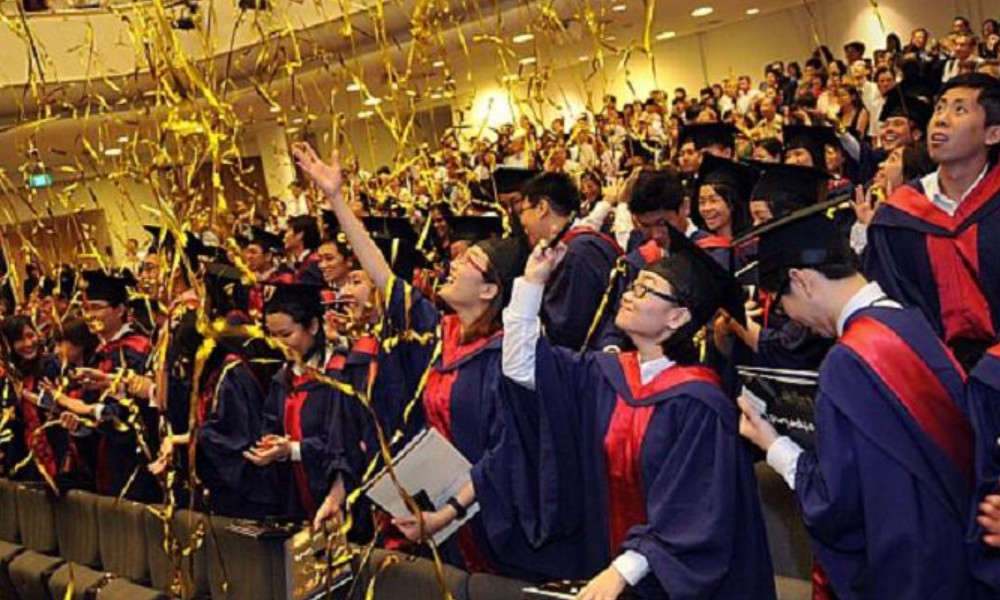

SINGAPORE: More graduates remained unemployed six months after completing their studies in 2024, even as median salaries increased, particularly in business-related jobs, according to the 2024 Joint Autonomous Universities Graduate Employment Survey.
The survey, released on 24 February, found that 87.1% of the 12,500 fresh graduates in the labour force secured employment within six months of completing their final exams, down from 89.6% in 2023.
This continues a downward trend observed since 2022.
Despite the lower employment rate, median gross salaries for fresh graduates rose by 4.2% in 2024, reaching S$4,500 compared to S$4,317 in the previous year.
The business sector saw the largest increase, with median salaries rising from S$4,150 to S$4,400.
In contrast, arts, design, and media graduates recorded the smallest salary increase, with a marginal S$60 rise to S$3,800.
Among those employed, 79.5% secured full-time jobs, a decline from 84.1% in 2023.
The share of freelancers increased slightly from 1.5% to 1.6%, while part-time or temporary employment rose to 6% from 4% the previous year.
Additionally, 2.2% of respondents reported being in involuntary part-time or temporary employment, up from 1.1% in 2023.
Survey finds 8.5% of graduates still job-hunting, while 4.4% set to start work or a business soon
The survey, conducted by the National University of Singapore (NUS), Nanyang Technological University (NTU), the Singapore Management University (SMU), the Singapore University of Social Sciences (SUSS), and the Singapore University of Technology and Design (SUTD), also found that 4.4% of respondents were unemployed but set to start work or a business soon, while 8.5% were still looking for employment.
The Singapore Institute of Technology (SIT) will release its survey results separately.
Graduates in health sciences, information and digital technologies, and business had the highest full-time permanent employment rates.
Across all fields, median salaries for those in full-time permanent employment increased in 2024.
A separate follow-up survey involving over 700 graduates from programmes requiring post-graduate practical training, such as medicine, law, and pharmacy, showed that 97.2% of those in the labour force secured employment after completing their training.
However, full-time employment rates fell slightly from 96.2% in 2023 to 94.4% in 2024, while freelance work rose from 0.4% to 0.7%.
Education Minister cites global uncertainties and lower hiring demand as factors behind declining graduate employment
In a Facebook post, Education Minister Chan Chun Sing acknowledged the dip in employment outcomes for graduates, attributing the trend to uncertainties in the global economy and reduced hiring demand.
He assured that autonomous universities (AUs) are actively providing job-matching support, personalised career coaching, and leveraging industry networks to expand opportunities.
Chan encouraged graduates to make full use of their universities’ career services and networks to strengthen their resilience in the job market.
He acknowledged that while securing a job may take longer than in previous years, meaningful opportunities remain available.
"Let us strive not just to find meaning in our jobs, but also to give meaning to our jobs," he said.
Chan Chun Sing: Poly grads face worse job prospects in 2024 as hiring demand, vacancies decline
Earlier, during Parliament on 4 February, Education Minister Chan Chun Sing responded to parliamentary queries regarding the decline in employment figures for polytechnic graduates in 2024. He attributed the drop to lower hiring demand and fewer job vacancies compared to the previous year.
He noted that the impact varied across course clusters, with graduates from health sciences and humanities and social sciences maintaining strong employment outcomes, while those from engineering and digital technologies faced higher unemployment rates.
“This could be due to cyclical sectoral changes, such as the downturn in the tech sector, which also affected hiring demand,” Chan said.
Leader of the Opposition raised concerns over underemployment, highlighting that the jobless rate for fresh polytechnic graduates had climbed to 12.5% in 2024—comparable to the 12.6% unemployment rate recorded in 2020 during the height of the Covid-19 pandemic.
He sought the MOE assessment of the progress made in improving employment outcomes for polytechnic graduates.
In response, Chan highlighted a growing trend of polytechnic graduates pursuing further studies before entering the job market, viewing this as a positive development.
He noted that among those seeking full-time jobs, the unemployment rate rose by 5% in 2024. While acknowledging the complexities of defining underemployment, he reaffirmed MOE’s commitment to supporting long-term career growth and strong salary trajectories.
He also stressed the need for polytechnics, universities, and ITE to collaborate with industries to better align education with workforce demands.