Leong Mun Wai renews call for statutory retrenchment benefits after controversy over Agoda clauses
On 18 Sept, Leong Mun Wai, Progress Singapore Party Secretary-General, renewed his call for legally binding retrenchment benefits under the Employment Act. The move followed reports that Agoda’s severance agreements allegedly restricted retrenched Singapore staff from approaching authorities or unions, raising concerns over workers’ rights and fair employment norms.
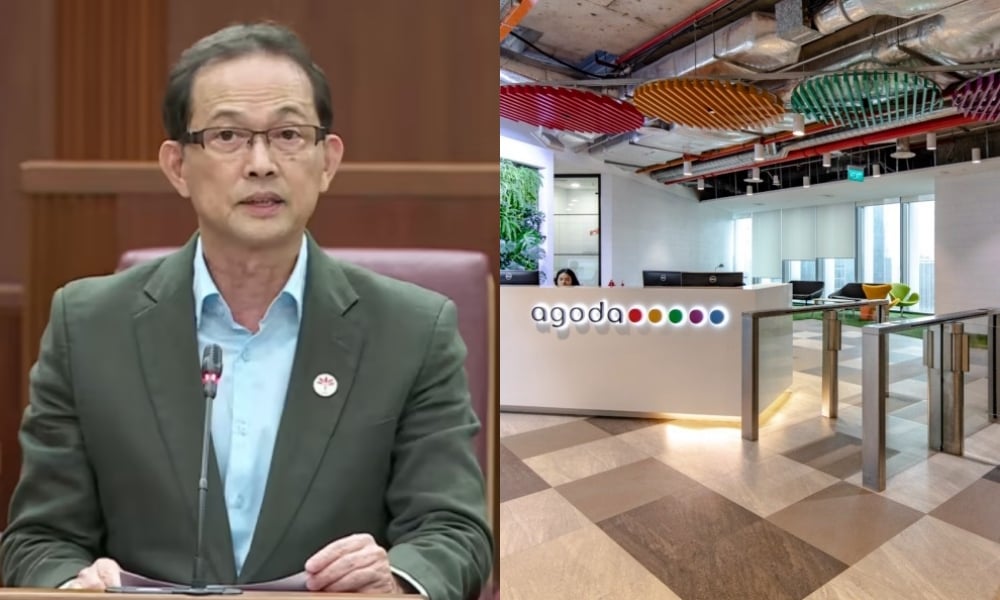

On 18 Sept, Leong Mun Wai, Secretary-General of the Progress Singapore Party (PSP) and former Non-Constituency Member of Parliament, reiterated his call for the Ministry of Manpower (MOM) to establish statutory retrenchment benefits under the Employment Act.
In a Facebook post, Leong said the change was needed to better protect Singaporean workers.
His comments followed reports that online travel agency Agoda allegedly included restrictive clauses in severance agreements for retrenched employees.
Shock over reported restrictions
Leong expressed alarm at claims that laid-off staff were allegedly instructed not to report their retrenchment to government agencies, statutory boards or trade unions.
“I was shocked to learn that Agoda allegedly instruct retrenched staff not to report the retrenchment to government agencies, statutory bodies and trade unions and threaten to revoke the severance benefits of those who do so,” he wrote.
MOM takes ‘serious view’
In response, MOM stated on 17 Sept that it took a “serious view” of such clauses.
The ministry said: “It is inappropriate for employers to include provisions that discourage or inhibit employees from approaching the authorities for all situations.”
MOM added that such clauses could breach fair employment practices.
It confirmed that it is working with the Tripartite Alliance for Fair and Progressive Employment Practices (TAFEP) to review the matter, assuring that authorities would take action when necessary.
Agoda: employees free to seek help
Agoda confirmed on 17 Sept that retrenchments in Singapore, Shanghai and Budapest were part of a restructuring exercise.
The company stated: “In line with Agoda’s continuous improvement drive to enhance operational efficiency, we have phased out customer support roles in our offices in Budapest, Shanghai, and Singapore while creating new positions in other geographic locations.”
Agoda added that it remained “committed to retaining a strong local presence in Singapore” and said all impacted staff were supported in line with industry standards.
The company rejected suggestions that staff were prevented from seeking assistance, saying: “During this time, employees were free to seek alternative legal options or engage with local authorities if they so wished.”
However, Agoda declined to comment on the specific clauses, citing employee privacy.
Proposal for statutory retrenchment benefits
Commenting on the broader issue, Leong argued that it was insufficient for the government and the National Trades Union Congress (NTUC) to merely express concern and investigate.
He said more must be done to secure the rights of retrenched workers.
Leong highlighted PSP’s 2025 General Election manifesto, which calls for statutory retrenchment benefits to be legally mandated.
The party’s proposal is for a minimum of two weeks’ pay per year of service for workers with at least two years’ tenure.
The suggested law also includes exemptions for smaller businesses and those facing bankruptcy to reduce financial strain.
Leong emphasised that such a framework would provide stronger legal protection compared to the current Tripartite Advisory on Managing Excess Manpower and Responsible Retrenchment, which is non-binding.
Alleged clauses in severance agreements
According to a retrenched employee who spoke to TOC, approximately 50 employees from Agoda’s Singapore-based Customer Experience Group (CEG) were informed of their retrenchment during a closed-door virtual town hall on 4 August 2025.
Staff in Shanghai and Budapest were similarly affected.
The meeting reportedly disabled chat and microphone functions, limiting staff interaction.
Impacted workers were offered one month of severance pay for each year of service and placed on garden leave until 3 September.
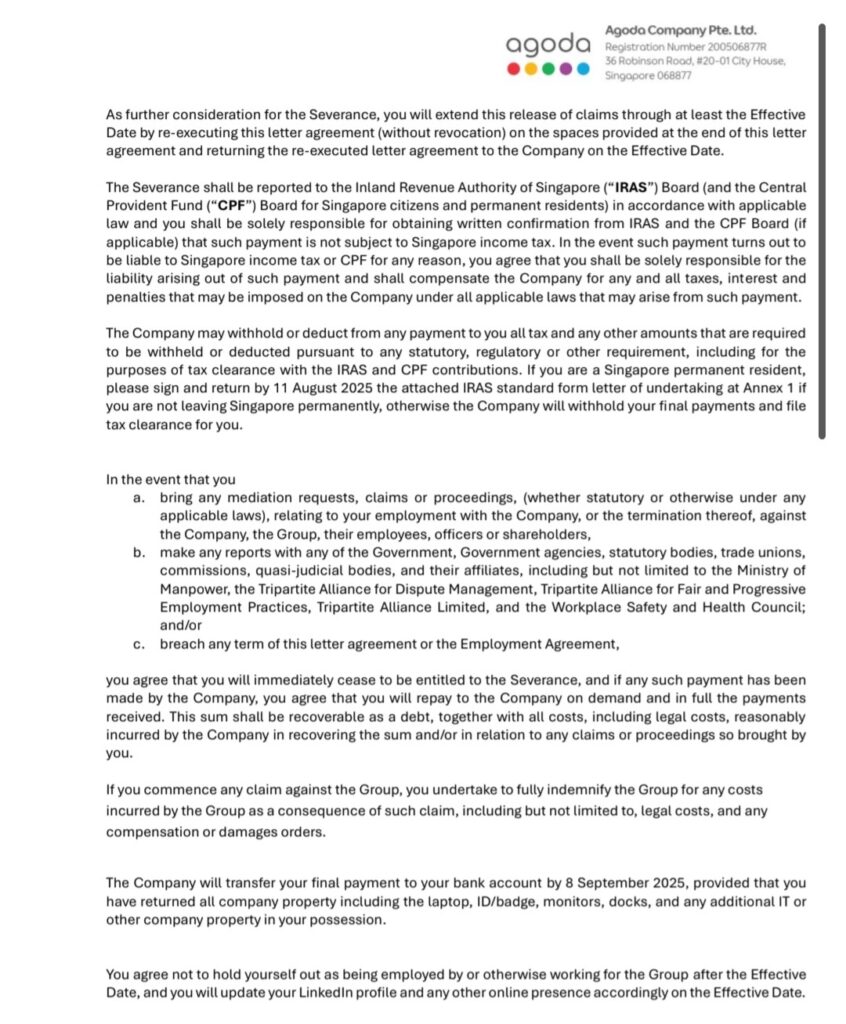
A copy of the severance agreement, seen by TOC, appeared to prohibit workers from filing complaints or contacting authorities such as MOM, TAFEP, or unions.
It further warned that breach of the clause could result in forfeiture of severance pay and legal costs.
Employees were also instructed to remove references to Agoda from LinkedIn and other public platforms.
Unions criticise alleged restrictions
The National Trades Union Congress (NTUC) and the Singapore Industrial and Services Employees’ Union (SISEU) issued a joint statement condemning the reported clauses as “irresponsible and regrettable.”
“It goes against a fundamental right of every worker – the right to seek redress when they face workplace issues,” they said.
While Agoda is not a unionised employer, SISEU confirmed that some affected staff are union members.
It is offering career coaching, job-matching, and financial support through NTUC’s Employment and Employability Institute (e2i).
Affected individuals are encouraged to reach out to SISEU via email or phone.
Operational strategy and local workforce shifts
The layoffs follow Agoda’s expansion of customer support operations into cities with lower operational costs, including Gurgaon (India), Foshan (China), and Cairo (Egypt).
Although management previously stated these new centres would not replace existing operations, the timing of the retrenchments has raised concern among employees.
An internal source told TOC that the Singapore CEG team was originally intended to fulfil local workforce requirements, which supported the company’s ability to hire foreign professionals in engineering and tech roles.
su thresholds may have impacted this approach, contributing to Agoda’s decision to scale down operations in Singapore.
Expenditure questioned amid layoffs
Despite citing cost concerns as a factor for the retrenchments, Agoda is preparing to relocate its Bangkok headquarters to the high-end One Bangkok development.
According to the same internal source, Agoda’s CEO stated during a town hall that the company would “spare no expenses for the new office.”
This has prompted questions about prioritisation of expenditure, particularly as retrenched employees were informed of cost-cutting needs.