Ukraine claims drone strike caused US$7 billion in damage to Russian bomber fleet
Ukraine’s Security Service says it inflicted US$7 billion in damage on Russia’s long-range bomber fleet in a far-reaching drone attack, just hours before peace talks were due to begin in Türkiye.

Ukraine has claimed responsibility for one of its most audacious and far-reaching attacks against Russian military infrastructure, destroying more than 40 aircraft in coordinated drone strikes across multiple Russian regions.
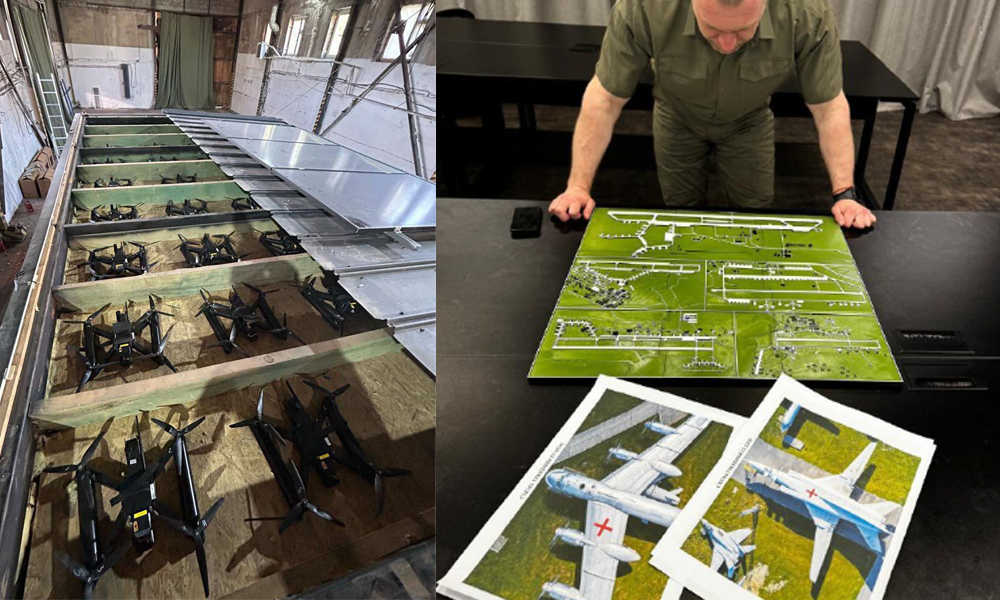
According to the Security Service of Ukraine (SBU), the attack was the result of a year-and-a-half-long clandestine operation dubbed “Web,” targeting Russia’s long-range bomber fleet.
The drone offensive, which occurred on 1 June 2025, comes just hours before planned direct peace talks between Ukraine and Russia in Istanbul.
Ukrainian President Volodymyr Zelenskyy confirmed the strike in his evening address, stating that 117 drones had been used in the operation, which was carried out independently by Ukraine.
The Associated Press cited a senior Ukrainian military official who said the operation involved first-person view (FPV) drones smuggled into Russia in modular wooden houses, then hidden under retractable roofs on mobile trucks.
At a preselected moment, the drones were remotely activated and deployed to strike Russian bombers stationed at military airfields across five regions, including Murmansk, Irkutsk, Ivanovo, Ryazan, and Amur.
Among the targeted aircraft were the Tupolev Tu-95 and Tu-22M bombers, which have been used to launch cruise missile attacks against Ukraine, and the A-50 early-warning aircraft, responsible for coordinating aerial operations.
Ukraine’s SBU stated that 34% of Russia’s fleet of missile-carrying bombers had been destroyed in the strike, estimating the damages at US$7 billion. These claims have not been independently verified.
Video footage circulating on social media, some shared by Russian sources, appeared to confirm drones launching from container-like structures and eliciting frantic responses from nearby personnel.
Russia’s Defence Ministry confirmed the attacks, noting damage and fires at multiple airbases but claimed that some strikes were repelled, particularly in the Ivanovo, Ryazan and Amur regions.
Fires were reportedly extinguished without casualties, and Russian officials said several individuals had been detained in connection with the attacks.
The Irkutsk region strike was particularly significant, given its location over 4,300 kilometres from the front lines — highlighting the range and strategic reach Ukraine has now achieved.
US Defence Secretary Pete Hegseth was briefed on the incident while visiting Nellis Air Force Base. A senior US defence official, speaking anonymously, acknowledged that Washington had not been informed in advance and described the operation as displaying a level of sophistication “not seen before.”
Retired Australian Major-General Gus McLachlan praised Ukraine’s ingenuity, noting that each drone may have cost only around US$4,000 but collectively inflicted billions in losses.
He added that such innovation using commercial technology could serve as a model for Western militaries seeking cost-effective warfare tactics.
Meanwhile, Ukrainian and Russian delegations are preparing to meet in Istanbul on 2 June 2025 for a new round of peace talks. Zelenskyy confirmed that Defence Minister Rustem Umerov would lead Kyiv’s team, reaffirming that Ukraine remains committed to protecting its sovereignty.
The Kremlin reportedly received Ukraine’s draft memorandum for a potential accord ahead of the meeting, though the contents remain undisclosed.
On the same day as the drone strike, Russia launched its largest wave of drones since the war began, according to Ukraine’s air force. A total of 472 drones and seven missiles targeted Ukrainian positions, in what appeared to be a retaliatory or pre-emptive move.
One missile strike on a training unit in Ukraine’s rear killed 12 service members and injured over 60. The unit was located far from the front, but vulnerable to reconnaissance and strike drones.
Following the deadly strike, Ukrainian commander Mykhailo Drapatyi submitted his resignation. Drapatyi had been credited with leading successful operations during Ukraine’s 2022 counteroffensive.
Elsewhere in Russia, two bridges collapsed and two trains derailed following overnight explosions. Seven were reported dead and dozens injured, although the Russian Investigative Committee later removed references to explosions from its official statement.
Analysts are now calling the aircraft strike one of the most significant setbacks for Russian aviation since the war began. Ukrainian aviation expert Valeriy Romanenko told Reuters that while satellite imagery will offer clearer assessments, the blow is already being seen as a “black day” for Russia’s air force.
“Even small, inexpensive drones can exploit weak spots such as fuel tanks,” Romanenko said. “That’s how a few kilograms of payload can destroy multi-million-dollar bombers.”
As peace talks begin in Türkiye, the scale and timing of the Ukrainian operation signal both its increasing technical capabilities and its continued determination to alter the strategic landscape — even far beyond the battlefield.