Property agent Shaik Amar opens up about POFMA ordeal: 'It greatly affected my mental health'
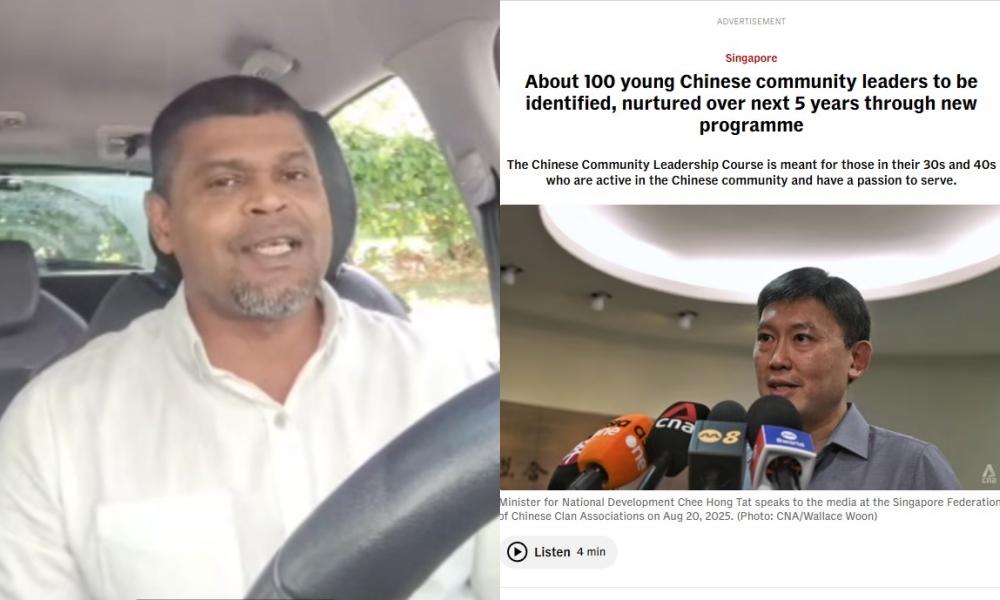
Shaik Amar, the property agent who was issued a POFMA correction direction two months ago, publicly shared the emotional and professional toll it took on him in a TikTok video on 27 September. He described the experience as traumatic and overwhelming, revealing how it impacted his mental health and his family, marking a rare instance of a non-politician discussing POFMA publicly.


SINGAPORE: Shaik Amar, the property agent who was issued a correction direction order under the Online Falsehoods and Manipulation Act (POFMA) two months ago, has spoken up publicly for the first time about the emotional and professional toll the incident took on him.
In a TikTok video posted on 27 September, Shaik shared his reflections, marking a rare instance of a non-politician Singaporean to discuss an experience with POFMA.
In the video, Shaik described the ordeal as traumatic, sad, and overwhelming, revealing how the process affected his mental health and impacted his personal and professional life.
"I do think that it was something that really affected my mental health to a great deal."
He recounted the challenges of dealing with the sudden media attention and the confusion it caused within his family.
"Just two years ago I was an absolute nobody. two years later I wake up and every single hit line at 1 PM, is my name."
He emphasised the emotional burden not just on himself, but also on his family, particularly his mother-in-law, who struggled to understand the situation, "and she has to explain to people who are calling her, asking her as if her son-in-law is a criminal."
"I think that's something that a lot of people don't talk about, the embarrassment and shame, this doesn't even end at just putting up a (correction) notice and then it's over, you can't just be quiet about it. Your family gets affected as well."
"It was very depressing because you, you have no way to really explain yourself or process it, or even understand what the hell is going on, " he said.
Mr Shaik that the incident significantly affected his career, family, and mental health, "It took me an entire month just to be even have the guts to even speak to you each and every one of you like this."
"Leave policies discussion to Parliament"
The property agent reflected on his regret regarding the video that led to the POFMA correction, acknowledging that while he intended to express his care for Singapore and its people, he underestimated the reach and influence of his platform.
"Honestly, I thought POFMA was something only people like Lee Hsien Yang would face," he remarked.
Looking ahead, Shaik stated that he would no longer produce political content or comment on Singapore's policies, leaving that responsibility to Parliament.
Despite the challenges, Shaik expressed gratitude to the hundreds of supporters who reached out to him during the difficult time. He credited their support for helping him cope with the experience.
https://www.tiktok.com/@thatproperty.guy/video/7418474446463257874?_r=1&_t=8q9o7pmi4zw
POFMA direction issued to Mr Shaik on Ethnic Integration Policy
Mr Shaik was issued a correction direction on 1 August 2024 for an eight-minute video criticizing Singapore's Ethnic Integration Policy (EIP).
In the video, he claimed that Malay and Indian homeowners face significant disadvantages when selling their HDB flats, referencing a $1.73 million sale in his neighborhood.
He suggested minority homeowners might need to offer large discounts due to the Chinese EIP limit.
The Ministry of National Development (MND) in an statement rebutted his claims, calling them false and misleading, and emphasised that the EIP benefits minorities by ensuring flat availability for them in all HDB neighborhoods.
MND also noted that focusing only on resale overlooks the policy's broader framework.
MND defended that Without the EIP, over time, fewer homeowners from minority communities would own flats in such estates, which would be detrimental in several ways, including reducing the likelihood of future owners from minority communities in these estates benefiting from future value increases.
MND highlighted that Mr. Shaik himself benefited from the Ethnic Integration Policy (EIP), as his household would not have been able to select a flat without it.
During the Sale of Balance Flats (SBF) exercise where he booked his unit at SkyOasis @ Dawson, all minority first-time applicants were invited to select a flat, compared to only 40% of Chinese applicants due to the EIP limit.
MND also noted that the value of flats at SkyOasis @ Dawson has significantly appreciated. This policy ensures that minority communities can benefit from such value increases when reselling their flats.
MND also clarified that the Ethnic Integration Policy (EIP) was introduced in 1989 to prevent ethnic enclaves in HDB estates.
Various measures have been implemented to help EIP-constrained flat owners, such as granting extra time to sell their flats or waiving EIP limits in special cases.
In 2022, the EIP buyback assistance scheme was introduced, allowing eligible homeowners to sell their flats to HDB at fair market prices. To qualify, households must have owned the flat for at least 10 years and marketed it reasonably for six months.
Special appeals can be made to HDB for exceptions. Flats bought back by HDB are sold through sales exercises, with minority buyers eligible for subsidies if Chinese EIP limits are reached, MND added.