Easy financing and private-hire vehicles impact COE demand, say used-car dealer
A used-car platform co-founder said most buyers—seven or eight in ten—take loans and register cars as private-hire or corporate vehicles, contradicting Minister Chee Hong Tat’s earlier remarks and sparking calls online for COE system reforms.
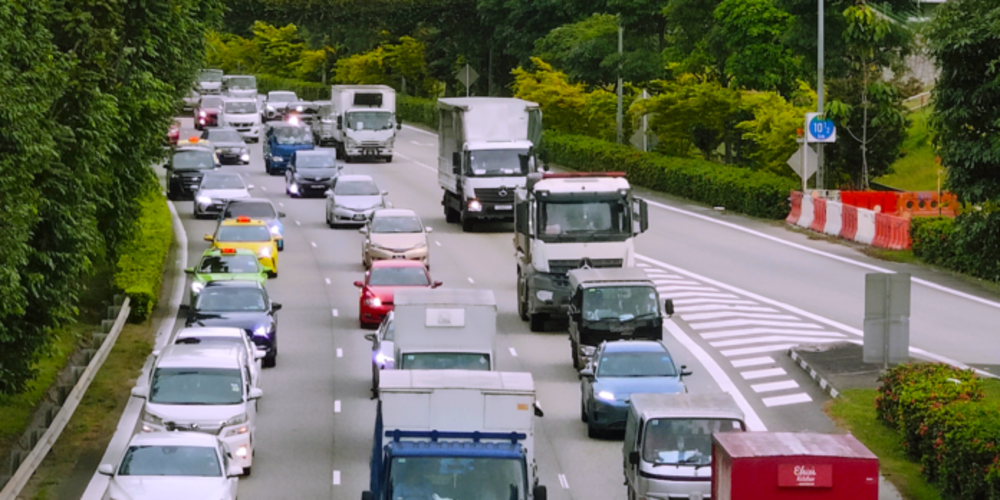

SINGAPORE: During a roundtable discussion organized by The Straits Times, a co-founder of a used-car marketplace disclosed that a significant majority—seven or eight out of ten—of their customers rely on loans for car purchases, often registering these vehicles as private-hire or corporate.
A former motor trade veteran also highlighted the rise of accessible financing for private-hire vehicles as a strategic solution to navigate stringent financing regulations in the industry.
These disclosures contrast with Acting Minister for Transport Chee Hong Tat's earlier suggestion that private-hire cars are "unlikely" to be a primary factor influencing Certificate of Entitlement (COE) prices.
Online communities have scrutinized the government's handling of easy financing for private-hire vehicles, prompting calls for a revamp of the COE system.
Concerns arise over potential disguised private-hire drivers in vehicle surge
On 23 Nov, ST hosted a discussion concerning the COE system. Mr Aaron Tan, co-founder and chief executive of Carro and Genie Financial Services, highlighted that his company is taking substantial financial risks amounting to tens of millions of dollars each month.
He explained that this situation arises because individuals purchasing privately owned cars are limited to obtaining loans ranging from only 60 to 70% of the vehicle's market value.
In contrast, businesses or private-hire car drivers can access loans covering 90 to 100% of the total vehicle cost.
Mr Tan said: “To be honest, we are not big fans of high COE prices... Because at the end of the day, the customer’s ability to pay back is the most important thing to my car-financing business.
“If push comes to shove, the private-hire vehicle driver can’t pay me because the instalments for the car are prohibitively high.”
Mr Tan highlighted that the surge in private-hire vehicles has prompted concerns about certain drivers disguising themselves as private-hire car drivers.
He further noted that among the clientele of his company, there are individuals employed in various professions, including civil service, who engage in part-time private-hire car services.
Easy financing of private-hire vehicles
Say Kwee Neng, who has been in the motor trade for more than 20 years, during the discussion highlighted how the easy financing of private-hire vehicles has emerged as a workaround for the industry to navigate stringent financing regulations.
He referenced the government's move in early 2013, wherein increased deposit requirements for car purchases led to a significant decline in COE prices.
"If you curtail demand or find ways to actually neuter easy access to demand, you may actually have taken away some of the pressure from the system and then really be able to have a more rational discussion on this topic," he said.
Mr Say cautioned against a potential oversight within the COE system, pointing out that private-hire cars, falling under Categories A and B, might be mistakenly perceived as distinct from taxis.
He emphasized that these vehicles effectively function akin to taxis, exerting upward pressure on COE prices. Notably, Category A caters to smaller, less powerful cars, while Category B covers larger, more potent ones.
Recalling the authorities’ decision to remove taxis from the COE bidding process in 2012, Mr Say said this sent a signal that Category A should be reserved for private owners.
“If it walks like a duck, quacks like a duck, looks like a duck... most likely, it’s a duck, so I think private-hire vehicles should be treated probably the same way as taxis,” he added.
27% of newly registered vehicles from January to September 2023 are private-hire cars
An examination of the Land Transport Authority's statistics from January to September this year unveiled that 20,218 cars were newly registered during this period.
Out of this figure, 2,592 were identified as private-hire (self-drive) cars, constituting approximately 12% of the newly registered vehicles, while 3,199 were classified as chauffeured vehicles, accounting for approximately 15% of the total registrations in that timeframe.
Additionally, LTA's data showcased a significant surge in the number of chauffeured private-hire cars, escalating from 614 in 2013 to a staggering 46,477 by 2022.
In contrast, the count of privately owned cars witnessed a decline, decreasing from 582,296 to 542,145 during the same period.
Netizens voice criticism over Government's oversight in COE price surge
In a Parliamentary session on 6 November, Acting Minister for Transport Chee Hong Tat stated that the rise in COE prices is “unlikely” due to car leasing companies, who bid for vehicles to lease out as private-hire cars.
Mr Chee at the time explained that the data shows that COE prices “have gone up in a period when demand from car leasing companies has come down”.
Observations from an ST's Facebook post revealed certain netizens raising questions about whether the Minister and LTA were informed about the situation highlighted by Carro's co-founder.
A netizen recalled a recent statement by the minister asserting that the surge in COE prices was not primarily driven by private-hire vehicles.

There have been criticisms regarding why the Transport Ministry and the ministers seem to be overlooking this issue, with some accusing the government of having weak policies in place to effectively regulate the surge in COE prices.

A netizen expressed concern, urging the government and relevant departments to reconsider their stance and not ignore this issue.
He highlighted that middle-income individuals have been enduring the brunt of this problem for an extended period.

"COE is not a fair system"
Another online criticism points out the inherent unfairness of the COE system.
It highlights how the system creates a divide between ordinary individuals and affluent ones who own multiple cars or run private-hire vehicle rental businesses.
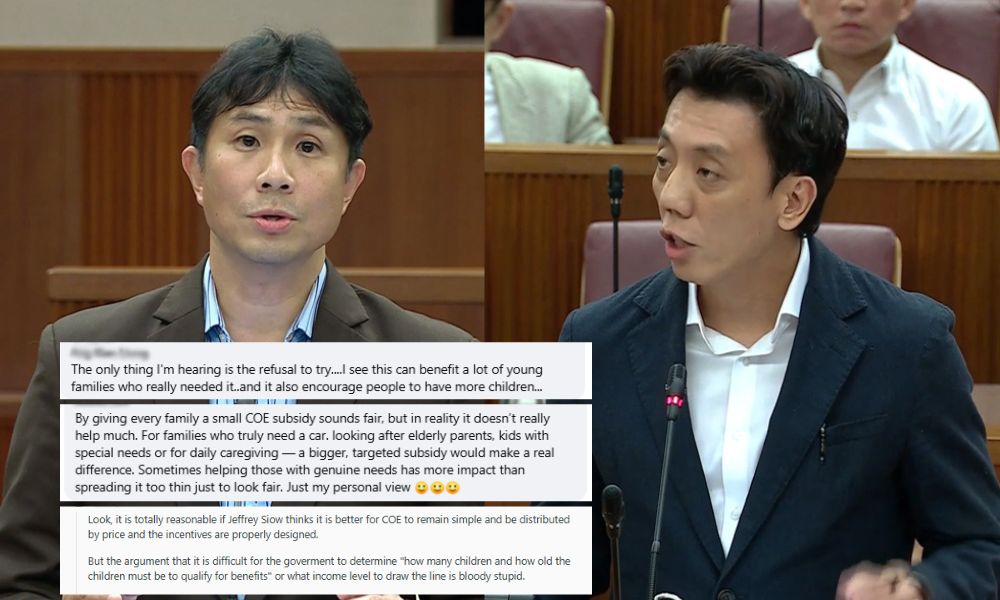
 A comment suggested that the outdated COE system requires significant reforms and expressed scepticism, implying that the system's profitability in filling the government's coffers might dissuade ministers from taking the initiative to lead the necessary changes.

Meanwhile, a netizen questioned whether Singapore's roads are optimally utilized, considering that COE's primary purpose is to manage traffic congestion.
She raised the concern that high COE prices might not be the most effective solution in such scenarios.
The comment suggested that many Singaporeans desire cars for the convenience of transporting children and the elderly, even though they might not frequently use them. This creates dissatisfaction due to the challenges posed by COE restrictions.
She advocated for reconsidering the solution to accommodate citizens' needs while managing road congestion effectively.


A comment proposes a change in the law regarding Private Hire Vehicles (PHVs), suggesting that these vehicles should not be transferable back to private ownership and should not be eligible for COE renewal after 10 years.
He view the operation of PHVs as a business decision and advocates that leasing companies should not have the advantage of converting these vehicles back into private ownership or extending their COEs.

Jamus Lim proposes differential pricing for high-use private hire cars
Notably, Associate Professor Jamus Lim, Workers’ Party Member of Parliament for Seng Kang GRC, has earlier emphasized the urgent need for reform in the current COE system.
During the motion debate on Singapore’s persistent cost of living pressures, Assoc Prof Lim particularly highlighted the escalating transport costs, honing in on COE prices, especially concerning cars.
He pointed out the limitations in the government’s efforts to address the persistent spikes in COE prices, and advocated for the balanced distribution of vehicle quotas by transferring excess quotas from high-supply years to those with lower supply, aiming to establish a more equitable quota distribution in the years to come.
Furthermore, Assoc Prof Lim suggested a reconfiguration of the COE market structure.
This includes considering the removal of the open category and establishing a specific category tailored for vehicles primarily used for commercial purposes or Electric Vehicles (EVs).
He acknowledged that while PHCs contribute positively to the country’s transport system by providing employment opportunities and diversity, they also add to the overall demand for COEs.
He highlighted that over the past decade, the number of PHCs has increased substantially, and their demand primarily stems from commercial motives.
This inclination towards commercial utilization implies a greater willingness to pay higher COE prices compared to households seeking cars for personal use, contributing to increased COE prices.
To address this issue, Lim proposed treating heavy-use PHCs similarly to taxicabs by having them draw from a different COE category (Cat E – Open) while paying prices from another category (Cat A/B).
“This keeps the demand pressure in only one category, which we can think of as a “penalty” category, ” he said.
“This is where you would also place buyers of 2nd cars. Even if this group of buyers is small, their demand can escalate prices, due to their stronger purchasing power.”
This article was first published on Gutzy Asia.