Lawyers question Ho Ching’s view of Law Society as governance concerns dismissed as “side quarrels”
Comments by Ho Ching portraying the Law Society as merely a regulatory body have prompted public rebuttals from lawyers, who say the Legal Profession Act mandates the Society to represent, protect and assist its members. The exchange unfolds ahead of an Extraordinary General Meeting on leadership selection, governance and independence.
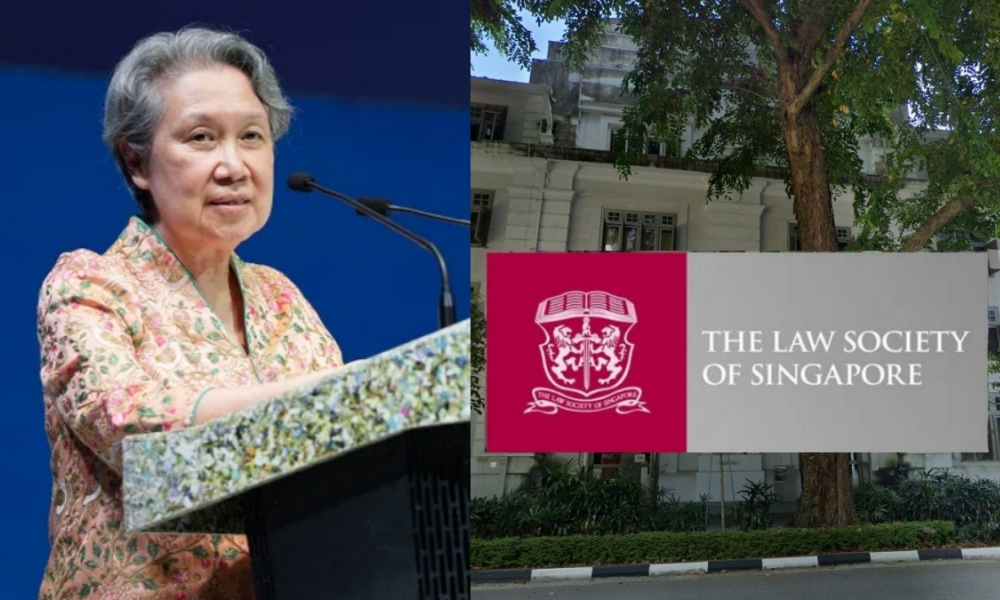

SINGAPORE: Lawyers have publicly challenged comments by Ho Ching on the role of the Law Society of Singapore (LSS), after she described the institution as primarily a professional standards body and dismissed internal disagreements as minor “side quarrels”.
The exchange has intensified debate within the legal profession over the Society’s statutory mandate, governance structure, and the balance between regulation, representation, and independence.
Ho’s remarks were made in response to an opinion article examining the Law Society’s leadership appointment process, published amid ongoing controversy surrounding the selection of its incoming president.
Ho Ching’s comments on professional standards and restraint
On 13 December 2025, Ho commented on a Facebook post discussing an opinion piece by lawyer Ben Chester Cheong in The Straits Times.
Cheong’s article examined debates over the LSS’s role and the appointment of its next president, arguing that the council’s authority to appoint the president was consistent with the Society’s institutional design under the Legal Profession Act.
The article stated that the profession encompasses diverse views and that no single president could represent all perspectives. It cautioned that attempts to politicise the Society could deepen internal divisions.
Responding to the article, Ho wrote that the Law Society is a professional body supervised by its Legal Council, rather than a trade union or political organisation.
She said it should not function as an unelected opposition force or lobbying platform for lawyers’ interests, emphasising that lawyers are tasked with upholding laws passed by Parliament.
According to Ho, the Society’s core role is to maintain professional standards so the public can trust the integrity and competence of legal practitioners.
Comparison with the medical profession
In her post, Ho compared the LSS’s function to that of the Medical Council, which supervises doctors and disciplines those who breach professional standards.
She suggested that individuals seeking to influence legislation or public policy should do so through politics, rather than by using professional bodies as vehicles for advocacy.
Ho also proposed that professional councils could consider limited lay representation, suggesting that 10 to 15 per cent of council members could come from outside the profession to encourage cross-disciplinary perspectives.
She concluded by urging restraint, stating that close votes should be respected and that the standing of a well-regarded institution should not be weakened by internal disputes she described as “side quarrels”.
Practitioners dispute analogy with medical regulators
Several legal practitioners challenged Ho’s remarks in the comments section of her post, arguing that the comparison with the medical profession overlooked key structural distinctions.
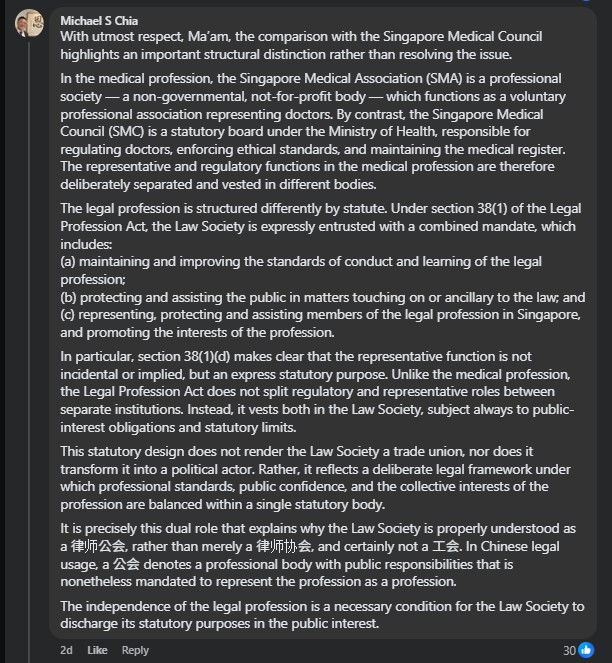
Michael Chia, founder and managing director of MSC Law Corporation and a former LSS treasurer, said the comparison with medical bodies highlighted differences rather than resolving the issue.
Chia pointed out that the Singapore Medical Association is a voluntary, non-governmental professional association representing doctors, while the Singapore Medical Council is a statutory board under the Ministry of Health with regulatory and disciplinary powers.
In contrast, he said, the Legal Profession Act deliberately vests both regulatory and representative functions within a single statutory body.
Under section 38(1) of the Act, the LSS is mandated to maintain professional standards, protect and assist the public, and represent, protect, and assist members of the legal profession.
Chia emphasised that the representative function is an express statutory purpose, not an incidental or implied role, and that this design does not render the Society a trade union or political actor.
He added that the combined mandate reflects a legal framework balancing professional standards, public confidence, and the collective interests of the profession.
Representation function described as vital
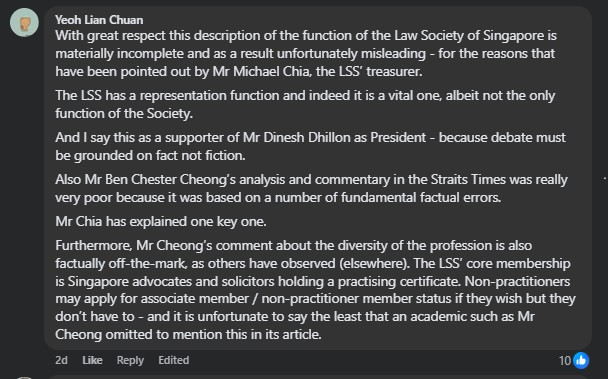
Lawyer Yeoh Lian Chuan also challenged Ho’s characterisation, describing it as materially incomplete and potentially misleading.
Yeoh said the LSS’s representative function is vital, even if it is not the only function of the institution.
He added that debate over governance should be grounded in fact, regardless of personal support for any individual candidate for leadership.
Yeoh criticised Cheong’s analysis in The Straits Times, stating that it was based on fundamental factual errors, including a mischaracterisation of the Society’s membership.
He noted that the LSS’s core membership comprises advocates and solicitors holding practising certificates, while non-practitioners may apply separately for associate or non-practitioner status.
Other comments further question why LSS members have limited influence in electing leadership, highlighting inconsistencies in treating votes as meaningful while denying full representative authority.
They also critique outdated statutory provisions, such as the small number of members required to requisition a general meeting and government-appointed council members, arguing these rules limit transparency, accountability, and the Society’s ability to act independently.
Luo Ling Ling rejects “side quarrel” framing
Separately, lawyer Luo Ling Ling addressed the issue in a LinkedIn post, rejecting the suggestion that internal disputes within the Law Society amounted to trivial “side quarrels”.
Luo said the narrative downplayed serious governance concerns, and rejecteing the portrayal of the LSS as a purely supervisory or disciplinary body similar to the Medical Council.
Luo emphasised that the Legal Profession Act expressly charges the Society with representing, protecting, and assisting its members, in addition to regulatory responsibilities.
“To suggest we should sit down, be quiet, and only focus on discipline is to ask us to ignore the law itself,” she wrote.
Governance, independence, and stewardship concerns
Luo argued that concerns raised by lawyers over leadership selection, financial prudence, and council independence go to the heart of governance and stewardship.
She said these matters affect the Society’s integrity and independence, rather than constituting personal or political disputes.
According to Luo, treating the LSS solely as a regulatory arm risks eroding its independence and reducing it to a “rubber stamp for external agendas”.
She described the upcoming Extraordinary General Meeting as a defining moment for whether the Society remains accountable to its members and its statutory mandate.
Extraordinary General Meeting scheduled
The Law Society’s Extraordinary General Meeting is scheduled for 22 December 2025.
It was convened to debate a motion concerning the method by which presidents are selected, particularly whether the president should be elected from among council members who were themselves elected by the general membership.
The motion argues that such a process is necessary to uphold good governance and confidence in the independence of the Bar.
A formal notice dated 9 December 2025 states that the motion does not seek to amend legislation or invalidate the current election process, but to record the collective view of members.
The motion was proposed by Peter Cuthbert Low and seconded by Chandra Mohan K Nair, both former presidents of the Law Society.
Background to the current dispute
The debate follows the appointment of Dinesh Singh Dhillon as president-elect for 2026.
Dhillon entered the council as a statutory member appointed by the Minister for Law under section 48(1)(b) of the Legal Profession Act.
He was not elected by the general membership, prompting concerns among some lawyers about representativeness and governance norms.
Luo previously said she publicised the EGM after weeks of inaction by the council, despite a valid requisition submitted by members.
According to the Law Society’s website, as of 31 August 2025, the Society had 6,434 practising members, all of whom are automatic members.