Interpol: Human trafficking-driven online scam centres using AI now pose global criminal threat
Interpol warns that online scam centres using human trafficking and AI are spreading worldwide from Southeast Asia. Victims are forced to commit fraud under threat. UNODC calls it a "critical inflection point" demanding urgent global action to prevent irreversible consequences.
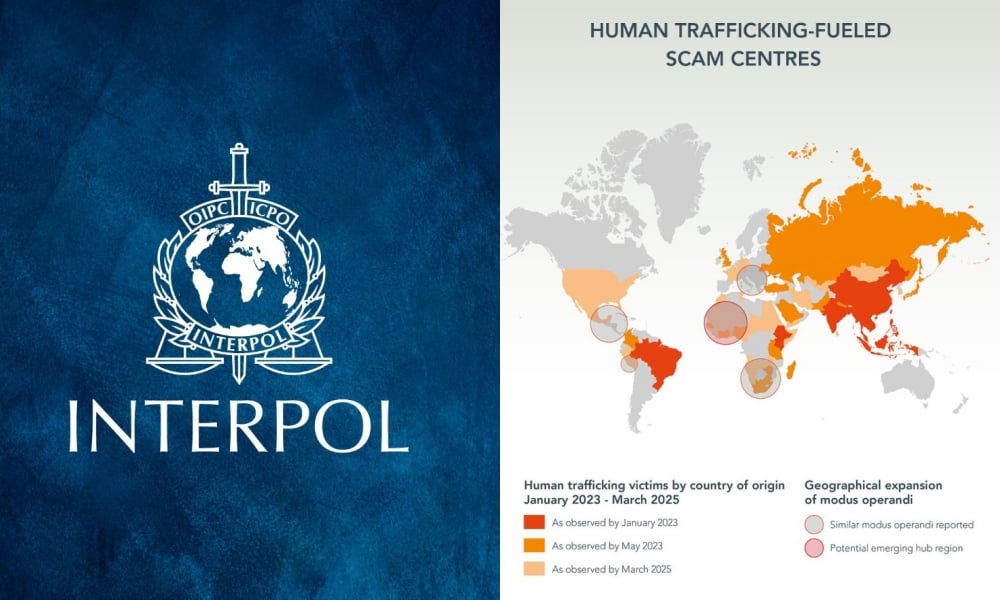

Interpol has uncovered a fast-spreading global crime trend driven by human trafficking and digital deception.
According to its March 2025 report, online scam centres powered by forced labour have expanded from Southeast Asia to West Africa, the Middle East, Central America, and beyond.
Interpol revealed that victims from at least 66 countries have been trafficked and coerced into labour within these centres.
Southeast Asia remains the epicentre, but new hotspots are emerging
About 74 per cent of the known victims were transported to traditional hotspots in Southeast Asia, including Cambodia, Laos, Myanmar and the Philippines.
However, West Africa is rapidly emerging as a potential new base for these operations.
Interpol described these centres as a “double-edged threat,” targeting both the coerced individuals operating scams and the end victims who lose money through fraudulent schemes.
Coercion, confinement and abuse: The cost of refusal
Many individuals are lured by fake job advertisements online, only to be detained and forced into criminal activity.
Inside compounds, victims are made to carry out investment scams, romance fraud, online gambling fraud, and illicit money transfers.
Those who resist are often subjected to threats, physical abuse, or even torture.
Even when not directly trafficked, workers may face immense psychological pressure and debt manipulation to continue their illegal roles.
Interpol’s operations reveal disturbing global pattern
Recent police actions have brought these operations to light.
In 2024, a major raid in the Philippines dismantled one such scam centre. In Namibia, authorities uncovered a similar operation where 88 young people were being forced to commit fraud.
Police seized 163 computers and 350 mobile phones, highlighting the scale of these centres.
AI and deepfakes: New tools for old crimes
Interpol has sounded the alarm on the increasing role of artificial intelligence in these crimes.
AI is being used to craft highly realistic fake job adverts, fabricate online personas using deepfakes, and create complex deception schemes such as romance fraud and sextortion.
This emerging technology allows syndicates to scale their scams while remaining elusive.
UN warns of critical inflection point in transnational crime
Echoing Interpol’s concerns, the United Nations Office on Drugs and Crime (UNODC) reported a rapid evolution in Southeast Asia’s organised crime scene.
According to the UNODC, scam centres located in Special Economic Zones and border areas in Southeast Asia are generating nearly US$40 billion annually.
These industrial-scale centres rely on forced labour and a mixture of scams, including cryptocurrency fraud, sextortion and money laundering.
Weak governance and corruption facilitate relocation
UNODC noted that crime syndicates shift their bases when local crackdowns tighten, exploiting weak governance and systemic corruption in emerging regions.
Operations originally rooted in Southeast Asia are now expanding into Africa, South Asia, Latin America and Pacific island nations.
Migrant workers targeted with false promises
Victims often include migrants from India, Nepal, Bangladesh, various African nations and over 50 other countries.
They are offered fake jobs abroad, only to be trapped in compounds and forced into digital fraud.
Once inside, escape is nearly impossible without international intervention.
Crime-as-a-service model enables rapid scaling
UNODC highlighted how syndicates now employ a “crime-as-a-service” model.
This includes using botnets, deepfake technology, malware, and illicit escrow platforms to generate scams and launder funds through crypto networks.
Such sophistication makes enforcement increasingly difficult, even as operations expand globally.
Call for urgent international cooperation
Cyril Gout, Acting Executive Director of Police Services at Interpol, stressed the need for global unity.
“Tackling this rapidly globalising threat requires a coordinated international response,” he said.
Interpol urges countries to enhance information sharing between police forces and collaborate with NGOs and technology companies.
The UNODC concluded its report with a warning: without urgent, unified international action, the world may face “unprecedented and irreversible consequences” due to this expanding, tech-enabled crime ecosystem.