Trump announces sweeping global tariffs in move branded as economic independence push
US President Donald Trump has unveiled a sweeping 10% minimum tariff on most imported goods, with much higher duties on over 60 nations, sparking fears of a global trade war and reversing decades of trade liberalisation.


United States President Donald Trump announced on 2 April 2025 a sweeping tariff regime that imposes a 10 per cent baseline duty on most goods imported into the United States and significantly higher levies on key trading partners.
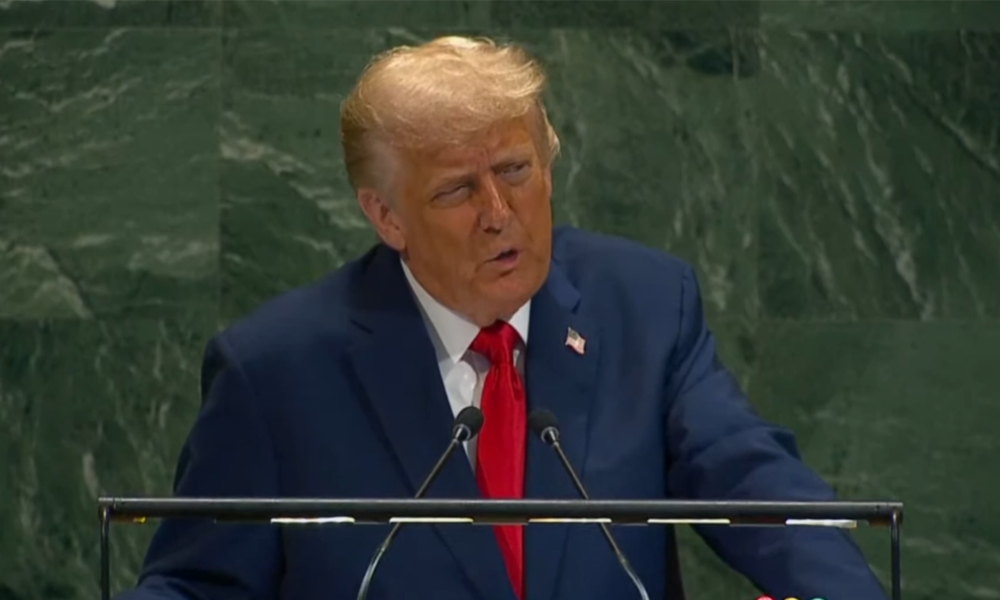
Framing the move as a declaration of “economic independence,” Trump said it would correct decades of “unfair trade” and help make America “wealthy again.”
The tariffs, enacted via executive order, mark one of the most extensive overhauls of the global trade system since World War II.
The baseline 10 per cent tariff will take effect on 5 April. A senior White House official confirmed that this minimum rate applies to all countries, including long-standing allies like the United Kingdom, Singapore, Australia, Brazil, and Saudi Arabia.
A second tier of “reciprocal” tariffs, ranging from 17 to 54 per cent, will target countries described as “worst offenders” based on tariff imbalances, non-tariff barriers, and other trade policies seen as detrimental to US economic interests. These measures take effect on 9 April.
China faces the highest tariff rate at 54 per cent. Other heavily impacted nations include Vietnam (46 per cent), Cambodia (49 per cent), Thailand (36 per cent), and Taiwan (32 per cent).
The European Union is subject to a 20 per cent rate, while key US allies like Japan (24 per cent), South Korea (25 per cent), and India (26 per cent) are also included in the reciprocal list.
Notably, Singapore—despite its free trade agreement with the US and status as a key ally—was not spared the baseline 10 per cent tariff.
Ms Wendy Cutler, vice-president of the Asia Society Policy Institute and a former acting deputy US trade representative, expressed surprise.
“Even US FTA partners in the region were recipients of new tariffs, with South Korea’s rate at 25 per cent unusually high,” she said to the Straits Times.
Singapore’s Minister for Foreign Affairs, Dr Vivian Balakrishnan, had earlier predicted Singapore would avoid direct tariffs, citing the US trade surplus with the country.
But he acknowledged that indirect effects from broader trade disruptions would still impact Singapore’s open and export-driven economy.
Beyond the general and reciprocal tariffs, the Trump administration also announced a 25 per cent tariff on all foreign-manufactured automobiles, to be implemented from midnight on 3 April.
This automotive tariff is expected to significantly affect German, Japanese, and South Korean automakers, many of whom export vehicles to the US market.
Meanwhile, Canada and Mexico have been excluded from the latest tariff orders. Their trade relations with the US will instead be governed under previous executive orders related to border security and fentanyl control.
President Trump said these nations had agreed to pause tariffs for 30 days in exchange for concessions.
He argued that the measures would incentivise foreign firms to relocate manufacturing to the US. “Foreign nations will finally be asked to pay for the privilege of access to our market,” he said.
Economists and trade analysts, however, have raised concerns over the potential fallout. Dr Marcus Noland of the Peterson Institute for International Economics warned that tariffs would make the US a higher-cost manufacturing location.
“Our modelling shows that instead of revitalising manufacturing, these tariffs may reduce its role in the economy,” he said.
Dr Philip Luck, former Deputy Chief Economist at the US State Department, said any manufacturing resurgence would not translate into job growth due to automation. “You can bring back production, but not the jobs,” he said.
Many economists have drawn parallels with the Smoot-Hawley Tariff Act of 1930, which triggered retaliatory tariffs and deepened the Great Depression.
Already, China has retaliated with new tariffs of 10 to 15 per cent on selected US goods, effective from 10 February.
The Trump administration maintains that the reciprocal tariffs are not fully retaliatory but are intended to close the perceived gap between US tariffs and those of its trading partners.
A senior official told reporters in a background briefing that reciprocal rates were derived from multiple factors, including tariff schedules, VAT regimes, subsidies, and currency practices.
The policy, while popular among Trump’s core supporters, has generated concern among US allies and multilateral institutions. Critics argue that the tariffs could worsen inflation, disrupt global supply chains, and damage longstanding diplomatic relationships.
As the international response unfolds, the coming weeks may shape a new chapter in global trade relations—with the potential for escalation into a full-blown trade war.
Legal and policy foundation of the tariffs clarified in executive order
The tariff regime announced by President Trump was formalised through an executive order invoking emergency powers under the International Emergency Economic Powers Act (IEEPA) and the National Emergencies Act (NEA).
The order declared that the US$1.2 trillion goods trade deficit in 2024 posed an “extraordinary threat” to national and economic security, warranting the use of tariffs to rebalance trade.
The document argues that decades of trade liberalisation failed to produce reciprocity, allowing US trading partners to impose disproportionately high tariffs and non-tariff barriers such as currency manipulation, weak labour standards, and value-added tax regimes that disadvantage US exports.
It also noted that countries with suppressed domestic consumption—including Singapore, China, Germany, and South Korea—create systemic demand gaps that hurt US producers.
The order introduces a provision allowing tariffs to apply only to non-US content of imported goods, provided at least 20 per cent of the value is US-originating, and outlines exemptions for sectors such as pharmaceuticals, semiconductors, critical minerals, and energy.
Goods already in transit by the tariff implementation dates are exempt, and Foreign Trade Zones are now subject to stricter tariff processing rules.
Finally, the order reserves the right for future tariff escalation or relief, depending on foreign retaliation or concessions.
Trump argues the tariffs are essential to rebuilding the country’s manufacturing and defence-industrial capacity, as well as restoring military readiness in light of global supply chain vulnerabilities.