Crew of Basset reports attack by six to seven intruders in Singapore Strait, says PCG
The Singapore Police Coast Guard has provided new details about the "unauthorised boarding" of the chemical tanker Basset on 28 February. This follows an initial statement by the Maritime and Port Authority of Singapore (MPA), which did not elaborate on the circumstances. Six to seven suspects had reportedly boarded the vessel but fled before police arrived.
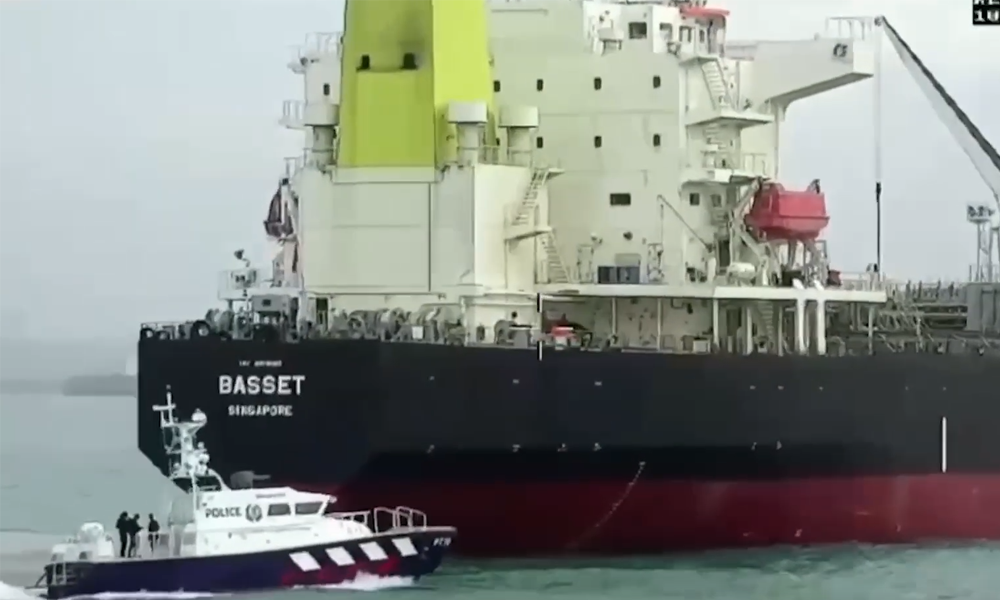

The Singapore Police Coast Guard (PCG) has provided details about the "unauthorised boarding" of the Singapore-registered chemical tanker Basset on 28 February, following an initial statement from the Maritime and Port Authority of Singapore (MPA), which did not elaborate on the circumstances of the incident.
MPA had announced on the day of the incident that Basset was boarded without authorisation in the Singapore Strait at approximately 6.50am, about 2 nautical miles outside Singapore’s territorial waters.
PCG was said to have been alerted at around 7am, and officers boarded the vessel at 8.20am after it had entered Singapore's territorial waters. However, MPA did not provide information about the nature of the boarding or those responsible.
Speaking to The Straits Times, Inspector Muhammad Rasidi Suriade of the PCG revealed that the tanker’s crew reported six to seven unidentified individuals had boarded the vessel before police arrived.
By the time PCG officers reached the scene, the perpetrators had already fled.
Upon boarding the Basset, officers found a 29-year-old Indian national lying on the main deck, bleeding from his right eye. Recognising the severity of his injuries, Inspector Rasidi instructed two officers to remain with the crew member while the rest of the team secured the vessel and searched for any remaining unauthorised individuals.
Before searching for the perpetrators, PCG officers had to ensure all crew members were accounted for and rule out the possibility that a suspect was disguising themselves as part of the crew.
Officers verified the passports and identities of more than 20 crew members while a PCG patrol boat remained stationed beside the tanker.
To assist with surveillance, Sergeant Muhammad Zukhairie Khairudin and his colleague deployed the Seaborne Electro Optics System (SEOS), a camera system mounted on the PCG vessel.
The SEOS, which has thermal imaging capabilities and a 360-degree view, allowed officers to monitor surrounding waters for any signs of movement.
“The crew members told us the perpetrators had already left the tanker, but we could not be certain until our officers had fully swept the area,” said Sgt Zukhairie.
The officers conducted a full sweep of the vessel, which took about two hours. No unauthorised individuals were found on board.
The injured crew member was later evacuated by the Singapore Civil Defence Force (SCDF) and transported to the National University Hospital, where he was treated and has since been discharged.
Sergeant Zukhairie noted the unpredictability of such operations. “Every time we enter a vessel, there will be a level of threat that cannot be ascertained from the get-go. If I open this door, what is behind it? We have to be quick, efficient, and the decisions made need to be spot on.”
Inspector Rasidi, who has over 20 years of experience, highlighted the challenges officers face in such situations.
“In cases such as these, we have to stay focused at all times. Fatigue will set in and dealing with anxiety can be tough. So, we need to count on our decision-making skills to ensure we deal with each dynamic situation as best as we can,” he said.
MPA has not classified the incident as piracy but has assured that all crew members were accounted for and that there were no Singaporean nationals among them.
It also stated that the incident had not affected navigation safety in the Singapore Strait.
The Basset, a chemical tanker built in 2019, sails under the Singapore flag and is now in Australian waters.