Singapore court sets high bail for three men accused of US$390 million Nvidia chip fraud
Three men, including two Singaporeans and a Chinese national, are accused of fraud totalling US$390 million over Nvidia chip movements. Bail was set as high as S$1 million. Prosecutors allege they defrauded Dell and Super Micro, with the Singaporeans falsely claiming in 2024 that the items procured would not be transferred to unauthorised parties.
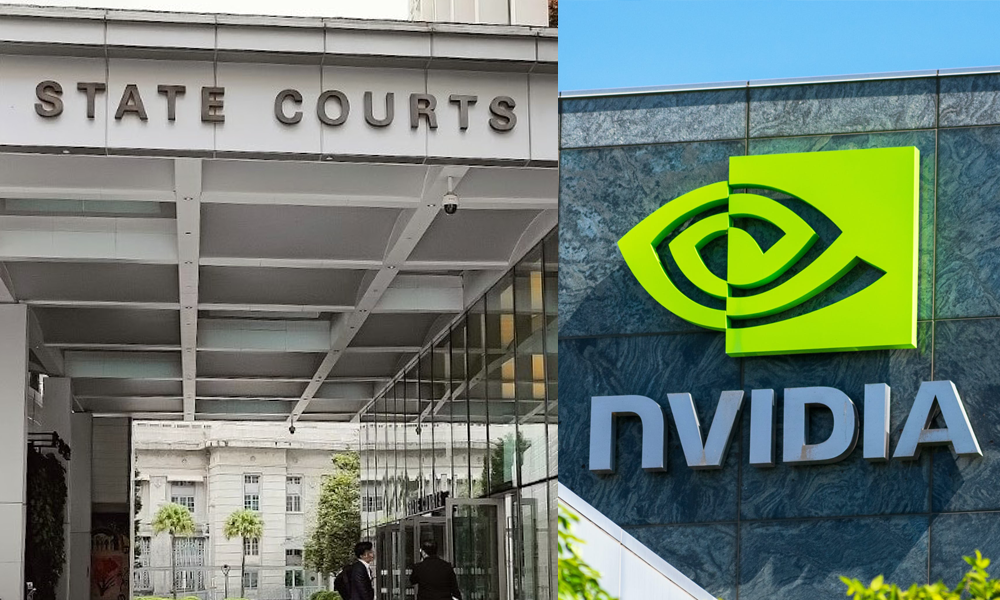

SINGAPORE: Investigations in Singapore have revealed that three men accused of fraud in connection with the movement of Nvidia chips are allegedly involved in offences totalling US$390 million (S$519 million).
The prosecution disclosed these figures during a court hearing on 13 March, where bail was set as high as S$1 million, as per reported by state media CNA.
The accused are Aaron Woon Guo Jie, 41, Alan Wei Zhaolun, 48, and Chinese national Li Ming, 51.
They were arrested in February following raids by the Singapore Police Force and Singapore Customs.
The arrests came after reports suggested that intermediaries in Singapore were involved in illegally exporting Nvidia chips to China, bypassing US export controls.
Alleged offences and fraud amounts
According to the prosecution, Woon and Wei were allegedly part of a criminal conspiracy to defraud two server suppliers, Dell and Super Micro, amounting to about US$250 million.
The two Singaporeans are said to have falsely claimed in 2024 that the items they procured would not be transferred to unauthorised parties.
Li, meanwhile, is accused of separate fraudulent activities involving Super Micro and allegedly accessing a corporate bank account without authorisation to facilitate transactions for the company Luxuriate Your Life.
The total sum linked to his offences is approximately US$140 million.
Since their charging, all three men have remained in remand and appeared in court via videolink.
Bail conditions and legal arguments
On 13 March, the prosecution proposed bail amounts of S$600,000 for Woon, S$800,000 for Wei, and S$1 million for Li. It justified these figures by highlighting the large sums involved in the offences.
Prosecutors also requested that Li be electronically tagged and prohibited from visiting immigration points such as Changi Airport and the Woodlands and Tuas checkpoints.
Li's lawyer, Wendall Wong, did not object to the bail conditions. However, the defence teams for Woon and Wei argued that the bail amounts were excessive.
Sanjiv Kumar Rajan, representing Woon, proposed that his client’s bail be reduced to S$400,000, emphasising that he had no prior offences and strong ties to Singapore.
Wei’s lawyer, Shashi Nathan, also challenged the prosecution’s request, arguing that the high bail was unjustified.
He noted that unlike Li, his client was a Singaporean with family in the country.
"The case has some sensitivity and publicity, but that alone should not justify such a high bail amount," he said.
Nathan added that Wei had cooperated with authorities and already had his passport impounded.
The judge upheld the prosecution’s bail recommendations
Deputy Public Prosecutor Kang Jia Hui defended the bail amounts, stating that Woon and Wei faced serious charges and that investigations were still in the early stages.
She stressed that the total amount involved for both Singaporeans was already estimated at US$250 million, making it a significant case.
While the fraud amount tied to Li was lower, the prosecution took his foreign nationality and other risk factors into account. Kang also revealed that Wei had reportedly paid himself an eight-digit dividend from the company, while Woon received a seven-digit bonus.
The judge ultimately upheld the prosecution’s bail recommendations, but allowed the defence to challenge the decision in a bail review hearing.
The three cases have been scheduled for further mention in court on 2 May.
International concerns and enforcement efforts
The investigation into the Singapore-based operation began after an anonymous tip-off suggested that computer servers with Nvidia AI chips were being exported to Malaysia, with the possibility of a different, unknown final destination.
Home Affairs and Law Minister K. Shanmugam stated on 3 March that some of the servers likely contained components subject to US export controls.
Since 2022, the US government has imposed strict regulations on the sale of high-performance AI chips to China, seeking to limit Beijing’s access to cutting-edge technology.
Singapore has since engaged with both Malaysian and US authorities to exchange relevant information and support investigations.
Officials in Malaysia are determining whether their laws were breached by the shipments, while US authorities are probing whether Nvidia’s chips have been unlawfully diverted from Singapore to China.
Nvidia has issued a statement asserting that there is no evidence to suggest DeepSeek obtained any export-controlled products from Singapore.