National Solidarity Party criticises EBRC report, intends to contest seven constituencies
The National Solidarity Party (NSP) has criticised the EBRC report, calling it gerrymandering that disadvantages the opposition. Announcing plans to contest seven constituencies, NSP may face three-cornered fights with the Workers’ Party and Singapore Democratic Party in key battlegrounds.


The National Solidarity Party (NSP) has strongly criticised the latest Electoral Boundaries Review Committee (EBRC) report, calling it an act of continued gerrymandering that disadvantages opposition parties.
In a press statement issued on 11 March 2025, the party also condemned the Group Representation Constituency (GRC) system, arguing that it undermines the principles of nation-building.
Despite these concerns, NSP reaffirmed its commitment to contest in the 2025 General Election (GE2025), announcing its intention to field candidates in seven constituencies, including five GRCs and two Single Member Constituencies (SMCs).
The party will finalise its detailed election strategy after its General Elections Committee convenes on 13 March 2025.
NSP calls out “unfair and unlevelled” political playing field
NSP stated that it was deeply disappointed and perplexed by the boundary changes, arguing that they create an uneven playing field for opposition parties.
The party said it has long opposed the GRC system, asserting that it disadvantages smaller parties and limits true political competition.
“More disturbing is the persistent adoption of the outdated GRC system, which violates the spirit of our nation-building principles,” said NSP Secretary-General Spencer Ng.
Ng also highlighted that the structural disadvantages imposed on opposition parties have not deterred NSP’s resolve.
“Despite the grossly unfair and unlevelled political grounds for opposition parties, NSP will continue to plough forward through the obstacles placed to prevent a true representation of the people's voices,” he added.
NSP’s intended constituencies for GE2025
NSP intends to contest in the following seven constituencies:
- Tampines GRC
- Sembawang GRC
- Marsiling-Yew Tee GRC
- Jalan Besar GRC
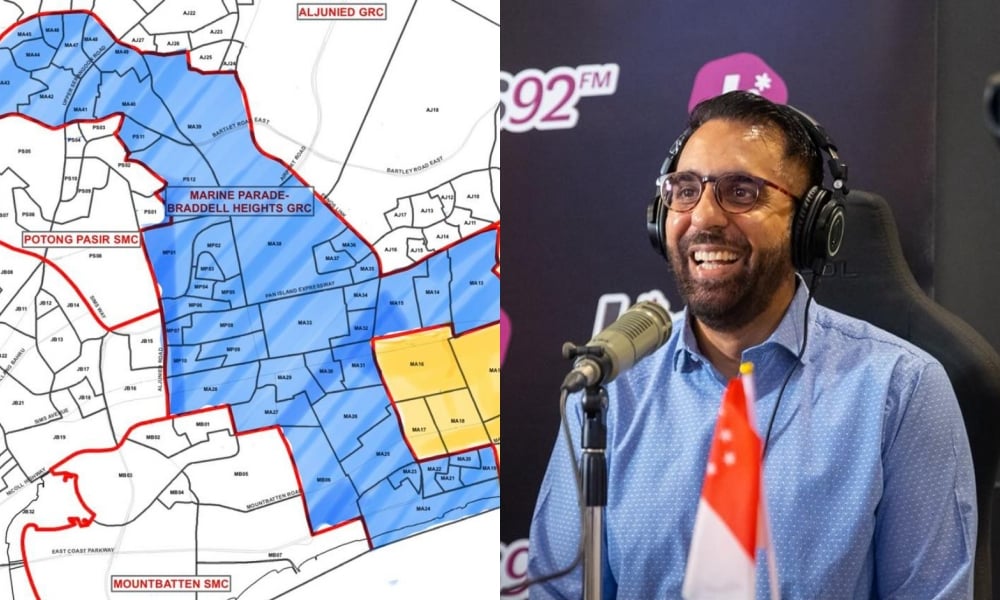
- Marine Parade GRC
- Tampines Changkat SMC
- Sembawang West SMC
With this announcement, NSP is set to overlap with other opposition parties in multiple wards, potentially leading to three-cornered fights.
Potential three-cornered fights with SDP and WP
NSP’s electoral strategy places it on a collision course with the Singapore Democratic Party (SDP) and the Workers’ Party (WP), both of which have expressed interest in contesting some of the same constituencies.
- SDP has historically contested Marsiling-Yew Tee GRC and is expected to challenge NSP’s claim to the constituency in GE2025, where Prime Minister Lawrence Wong is based.
- WP has fielded candidates in Jalan Besar GRC and Marine Parade GRC in past elections, potentially leading to a three-way contest with NSP in these wards.
- WP has also stepped up its presence in Tampines GRC through increased walkabouts and outreach efforts, indicating its intention to contest there.
Three-cornered fights often weaken opposition parties by splitting the alternative vote, making it easier for the People’s Action Party (PAP) to retain its seats.
To avoid this, opposition parties typically negotiate seat allocations. However, with multiple parties eyeing the same constituencies, it remains to be seen whether agreements will be reached before Nomination Day.
In the 2020 General Election, NSP fielded 10 candidates, contesting Sembawang GRC and Tampines GRC.
On polling day, 10 July 2020, the party did not win any constituencies but improved its popular vote share by 25.27% and its overall vote share by 3.53%, reaching 33.15% and 3.76%, respectively.
Given its past contestation in GE2020, NSP’s announcement to contest seven wards in GE2025 is likely a strategic move to position itself for potential seat negotiations with other opposition parties.
Broader electoral landscape
The EBRC report, released on 11 March 2025, introduced significant boundary changes, increasing the total number of constituencies from 31 to 33 and adjusting electoral divisions to reflect population growth.
Key changes include:
- The introduction of six new SMCs, including Tampines Changkat SMC and Sembawang West SMC, which NSP has declared interest in.
- The redrawing of several GRCs, including Marine Parade and Jalan Besar, where opposition parties are expected to contest.
With the General Election expected to be called within months, NSP's decision to publicly commit to multiple battleground constituencies signals an aggressive electoral strategy.
However, the party will only release a detailed election roadmap after its General Elections Committee meeting on 13 March 2025.
As the opposition landscape takes shape, the question remains whether NSP, SDP, and WP will reach an understanding to avoid three-cornered fights—or if a fractured opposition vote will once again work in PAP’s favour.