Electoral Boundaries Review 2025: Major changes with only 5 GRCs, 4 SMCs left unchanged
Singapore’s electoral map has been redrawn, with only five GRCs and four SMCs unchanged from the last election. The EBRC announced on 11 March three new GRCs and six new SMCs, increasing constituencies from 31 to 33. There are now 18 GRCs, including five new ones. Notably, opposition-held Aljunied GRC has been redrawn for the first time since 2011.


SINGAPORE: Major changes have been made to Singapore’s electoral map, with only five Group Representation Constituencies (GRCs) and four Single Member Constituencies (SMCs) remaining unchanged from the last election. The Electoral Boundaries Review Committee (EBRC) announced these revisions on Tuesday, 11 March, nearly seven weeks after it was convened.
The changes include the creation of three new GRCs and six new SMCs, increasing the total number of constituencies from 31 to 33.
The next parliament will have 97 elected Members of Parliament (MPs), up from 93, with each MP representing 28,384 voters—slightly fewer than in the previous election.
Adjustments due to population growth
The EBRC cited significant voter growth in certain areas as a key reason for the changes.
Additionally, some boundary lines have been adjusted to align with geographical features such as major roads.
Six new SMCs have been introduced:
Six new SMCs: |
| Bukit Gombak |
| Jalan Kayu |
| Jurong Central |
| Queenstown |
| Sembawang West |
| Tampines Changkat |
Meanwhile, five existing SMCs—Yuhua, Bukit Batok, Hong Kah North, MacPherson, and Punggol West—have been absorbed into GRCs.
There are now 18 GRCs, including five newly established ones:
five new GRCs |
| Pasir Ris-Changi |
| Punggol |
| Jurong East-Bukit Batok |
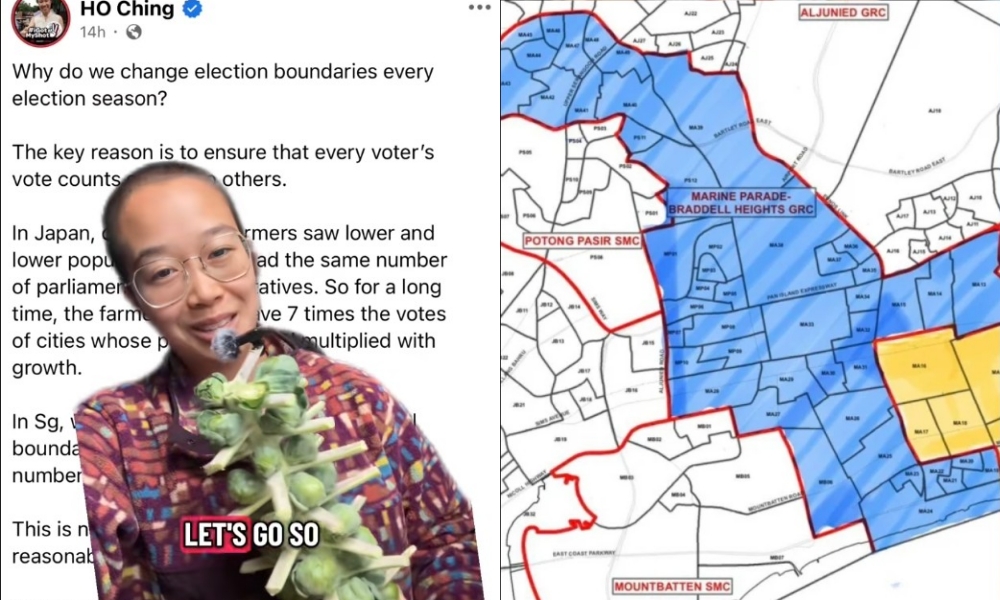
| Marine Parade-Braddell Heights |
| West Coast-Jurong West |
Of these, 10 will have five MPs while eight will have four.
Notably, the opposition-held Aljunied GRC has seen its boundaries redrawn for the first time since 2011.
The EBRC’s mandate was to maintain the average GRC size, the proportion of MPs elected from SMCs, and the average ratio of electors to MPs at levels similar to those in the last election.
This has resulted in 82 seats being contested in GRCs, with an average of 4.56 MPs per GRC, continuing a downward trend from 4.65 in 2020, 4.75 in 2015, and five in 2011.
Reshaping constituencies in response to voter increases
The EBRC report noted that voter growth has been uneven across constituencies.
As of 1 February, there were 2,753,226 registered voters, an increase of 101,791 from the previous election.
Pasir Ris-Punggol GRC experienced the largest increase, growing by 18,037 voters, or 10.8 per cent.
This led to the formation of a new four-member Punggol GRC by merging Punggol West SMC with Punggol estates from Pasir Ris-Punggol GRC.
Similarly, Hong Kah North SMC, which exceeded the upper voter limit for an SMC, has been absorbed into Chua Chu Kang GRC.
In response, Bukit Gombak SMC was carved out from Chua Chu Kang GRC to maintain a four-member team and accommodate future population growth in Tengah.
Other changes include the creation of Sembawang West SMC from Sembawang GRC, Tampines Changkat SMC from Tampines GRC, and Jalan Kayu SMC from Ang Mo Kio GRC.
The latter had the highest number of electors among all constituencies, with 190,800 voters.
To balance population shifts, Pasir Ris-Punggol GRC was merged with parts of East Coast GRC to form Pasir Ris-Changi GRC, while East Coast GRC took in districts from Marine Parade GRC.
Similarly, Potong Pasir SMC, MacPherson SMC, and parts of Mountbatten SMC have been absorbed into Marine Parade GRC.
Jurong GRC has expanded by incorporating areas from Hong Kah North, Bukit Batok, and Yuhua SMCs, leading to the formation of a new Jurong East-Bukit Batok GRC.
To maintain balance, Jurong Central SMC was carved out, while parts of Jurong West and Taman Jurong were moved to West Coast GRC, which has been renamed West Coast-Jurong West GRC.
Other shifts include Harbourfront and Sentosa estates moving from West Coast GRC to Radin Mas SMC, while parts of Dover and Telok Blangah were absorbed into Tanjong Pagar GRC.
In turn, a new Queenstown SMC was formed to keep Tanjong Pagar GRC at five members.
Realignments based on geographical features
Some boundary changes were made to align with natural and infrastructural landmarks.
For instance, new Housing Development Board (HDB) projects in Chua Chu Kang were reassigned from Holland-Bukit Timah GRC, with Woodlands Road now serving as the dividing line.
Tampines GRC has also absorbed polling districts from Aljunied GRC, while Holland-Bukit Timah GRC has incorporated a portion of Upper Bukit Timah Road that was previously under Jurong GRC.
Among the 33 constituencies, nine remain unchanged from 2020, including Bishan-Toa Payoh, Jalan Besar, Marsiling-Yew Tee, Nee Soon, and Sengkang GRCs, as well as Bukit Panjang, Hougang, Marymount, and Pioneer SMCs.
Electoral process moving forward
The EBRC, chaired by Secretary to the Prime Minister Tan Kee Yong, comprises five senior public servants, including officials from the Singapore Land Authority, Housing Board, Department of Statistics, and the Elections Department.
The government has accepted the committee’s recommendations, setting the stage for the upcoming general election, which must be held by 23 November.
The next step will be for President Tharman Shanmugaratnam to dissolve parliament upon the advice of Prime Minister Lawrence Wong. The election must then be held within three months.
The government will continue functioning during the transition period, with public services operating as usual. While there is no fixed timeline between the release of the EBRC report and the election announcement, historical precedents vary.
In 2020, the election took place 14 weeks after the boundaries report was published, while in 2001, the gap was just one day.