Healthcare workers unite in call to ban lorry transport for migrant workers
More than 300 healthcare workers in Singapore have signed a petition demanding an immediate ban on transporting migrant workers in lorries. Their call has gained renewed urgency after a lorry accident on 1 March left five workers hospitalised, highlighting ongoing concerns over worker safety and government inaction.
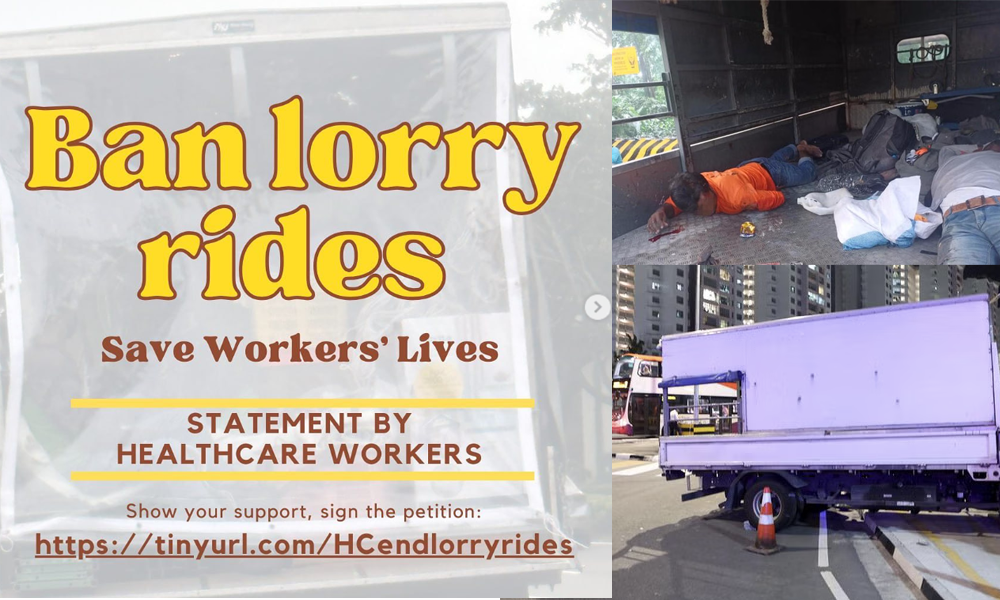

A collective of healthcare workers in Singapore has renewed calls for a ban on transporting migrant workers in the back of lorries, following yet another accident that left five workers hospitalised.
The petition, signed by over 300 healthcare professionals, was submitted on 28 February and directly challenges the government’s continued defence of the practice.
On 1 March, a lorry carrying migrant workers was involved in an accident with a car at the junction of Punggol East and Punggol Central. Five male passengers, aged between 25 and 45, were taken to the hospital, while two others declined medical assistance.
The 41-year-old lorry driver was arrested for dangerous driving, and police investigations are ongoing.
The petition, organised by the healthcare collective Sick & Tired, was submitted just days before the accident.
It directly responded to comments made by Senior Minister of State for Transport Amy Khor in Parliament on 26 February, where she argued that banning lorry transport for workers was impractical due to financial burdens on small and medium-sized enterprises (SMEs) and a shortage of bus drivers.
The healthcare workers strongly rejected this position. “We too often see migrant workers in the emergency department, intensive care unit, surgical and orthopaedic wards, and sometimes even in mortuaries—as a result of injuries from unsafe lorry transport,” the petition stated.
Their frustration was further fuelled by recent cases, including the death of 40-year-old Shohag Mohammad in December 2024. He was killed in a lorry accident, leaving behind a six-year-old daughter. With the latest incident on 1 March, calls for immediate government intervention have intensified.
View this post on Instagram
Between 2011 and 2020, 58 workers died in road accidents involving lorries, and 4,765 others sustained injuries.
Rights groups and advocacy organisations have repeatedly called for the government to adopt safer alternatives, such as shared buses and goods-cum-passenger vehicles, which have already been implemented in other countries.
The petition also highlighted the financial aspect of the issue, pointing out that in 2020 alone, at least S$1.1 billion was collected in foreign worker levies from industries that rely on lorry transport.
Healthcare workers questioned why these funds were not being used to help companies transition to safer alternatives.
Public pressure to ban lorry transport has been mounting.
In 2023, over 50 community organisations signed a joint statement calling for a ban. More recently, students across Singapore joined the movement, signing a joint statement that emphasised the dangers and lack of dignity in transporting workers in lorries.
Despite these efforts, the government has maintained that a full ban would be challenging. Authorities have instead introduced safety measures such as speed limiters and encouraged firms to transition to buses where feasible. However, advocacy groups argue that these steps are insufficient.
The healthcare workers’ petition ends with a stark warning: “How many more workers will be injured while the government continues to have ‘difficult conversations’? Migrant workers’ lives matter, and their safety must be prioritised over business concerns.”
With repeated accidents and growing public outcry, the debate over lorry transport for migrant workers is intensifying. Advocates continue to push for urgent action, stressing that further delays could result in more preventable injuries and deaths.
Statement by Healthcare Workers
On the early morning of 18 July 2023, three lorries piled up in an accident on Kranji Expressway. 26 migrant workers who had been riding in them were taken to three different hospitals after sustaining injuries. The very next day, a car collided with a lorry on the KPE. 11 people were taken to the hospital, including 10 migrant workers from the lorry.
Following the spate of accidents, multiple petitions and calls were launched by community and civil society groups seeking an end to the practice of lorry transportation for workers. Yet, on 2 August 2023, the Senior Minister of Transport Amy Khor rejected these calls, insisting that there are “practical and operational constraints” and that the ministry would continue to look into suggestions.
Some of us and our colleagues have been responsible for the medical care of workers involved in lorry-related accidents. We have seen the devastating consequences of being flung out of a moving vehicle, at high speeds: trauma–broken bones, bleeding organs, ICU admissions, at times death. These serious injuries are costly. To compound their difficulties, migrant workers may end up being repatriated home. With work permits canceled, they return to their home country with a significant debt to pay–both financially and in their health.
We have laws that protect our citizens: motorbike riders must wear helmets, car passengers and drivers must put on seat belts. Rightfully, these laws ensure the safety of those on the road. Somehow, at the same time, our country holds laws that allow workers to be transported on the back of lorries, which were never designed to transport people in the first place.
In the discussion around lorry bans, there have been various parties concerned about the ‘costs’ it could incur. What ‘costs’ could possibly amount to more than the suffering by workers and their families with each injury sustained and life lost? We believe strongly in the sanctity of life, and that a life should not be placed on a scale for cost benefit analysis.
Earlier in July 2023, a week before the accidents, the Minister said in response to MP Louis Ng’s motion that a timeline for a ban was not meaningful without first understanding “the varied concerns of all parties involved”. We, healthcare workers, are a party to this issue. And we urge the state to immediately ban the transportation of workers on the backs of lorries, before any more damage is done.
Between 2011 and 2020 alone, 58 workers on-board lorries died in road traffic accidents, and 4765 were injured.
How many more workers do we need to see in our emergency departments before a ban is finally placed upon this practice? We are sick and tired of seeing our migrant brothers, in hospitals, for devastating injuries which we know are preventable. Migrant workers’ lives matter; stop transporting them on the back of lorries now.
#HumansNotCargo