Banning lorries for worker transport not viable for SMEs, says Senior Minister of State Amy Khor
Senior Minister of State Amy Khor stated that banning lorries for worker transport is impractical for small businesses due to cost and logistical challenges. While safety concerns exist, she highlighted government efforts to improve transport conditions. A joint statement by over 50 community groups, however, continue to push for a ban, citing safety and dignity concerns.
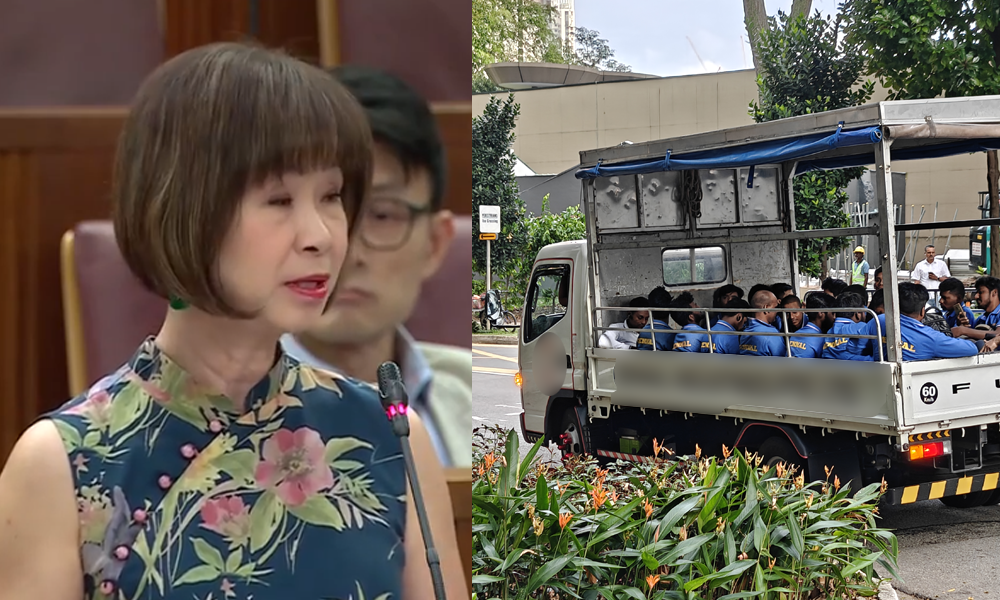

Senior Minister of State for Transport Amy Khor has stated that banning lorries from transporting workers is not a feasible solution, particularly for small and medium-sized enterprises (SMEs).
Speaking in response to a parliamentary question from Member of Parliament Louis Ng on Wednesday (26 Feb), Dr Khor explained that prohibiting the use of lorries would severely impact businesses and projects dependent on such transport.
Dr Khor noted that the government has received feedback on improving safety measures for workers transported on lorries.
However, completely banning the practice would be impractical due to a shortage of bus drivers across the public transport, tour bus, and school bus sectors.
While acknowledging safety concerns, Dr Khor emphasised the economic challenges of a ban. Many micro, small, and medium-sized contractors rely on lorries to transport both workers and equipment to multiple sites within a day.
Requiring separate vehicles and drivers would significantly increase costs and reduce efficiency, potentially leading to business closures and job losses.
She highlighted that such a ban could delay critical projects such as housing, schools, and hospitals, ultimately increasing costs for Singaporeans.
Dr Khor explained that the government is taking a multi-pronged approach to improving transport safety instead of enforcing an outright ban.
According to Dr Khor, efforts are being made to reduce the need for lorry transport by co-locating worker dormitories closer to worksites.
Authorities have also been encouraging companies to transport workers via buses where possible. Additionally, measures are being introduced to enhance lorry safety, such as ensuring dual-role drivers receive sufficient rest and working with the Traffic Police to install speed limiters on lorries with a maximum laden weight between 3,501kg and 12,000kg.
Dr Khor reaffirmed the government’s commitment to working closely with stakeholders to improve worker and road user safety in a practical and effective manner.
Despite these efforts, calls for a complete ban on transporting workers in lorries continue to grow.
In 2023, a joint statement endorsed by over 50 community groups strongly criticised the practice, stating that lorries were never designed to carry human passengers and expose workers to dangers such as heat stress, heavy rain, and the risk of serious injury in the event of an accident.
The statement pointed out that between 2011 and 2020, 58 workers lost their lives in lorry-related road accidents, with 4,765 others injured. It argued that Singapore should adopt safer transport alternatives, such as shared buses, minibuses, and goods-cum-passenger vehicles, similar to measures implemented in other countries.
The statement also highlighted that in 2020 alone, the government collected at least S$1.1 billion in foreign worker levies from industries that transport workers in lorries.
It argued that a portion of this revenue should be allocated to helping smaller companies transition to safer transport options.
Pressure on the government to take immediate action has intensified, with rights groups, health and safety experts, MPs, and migrant workers themselves calling for change.
The joint statement questioned how many more workers would be injured or killed before action is taken, urging the government to implement new legislation under the Ministry of Transport to phase out lorry transport.
It concluded by stating that migrant workers’ lives should take priority over business profits.