Record rise in permanent jobs masks deeper concerns over shrinking resident workforce
Singapore’s record-high share of permanent jobs appears positive, but declining participation and unclear employment numbers raise concerns about longer-term labour resilience.

Singapore’s Ministry of Manpower (MOM) reported a record high in the share of resident workers in permanent employment in 2025, with 90.8% of Singapore citizens and permanent residents (PRs) in such positions.
While this suggests increased job stability, the underlying figures in MOM’s Advance Labour Force Report 2025 point to persistent structural challenges that shape the resident workforce.
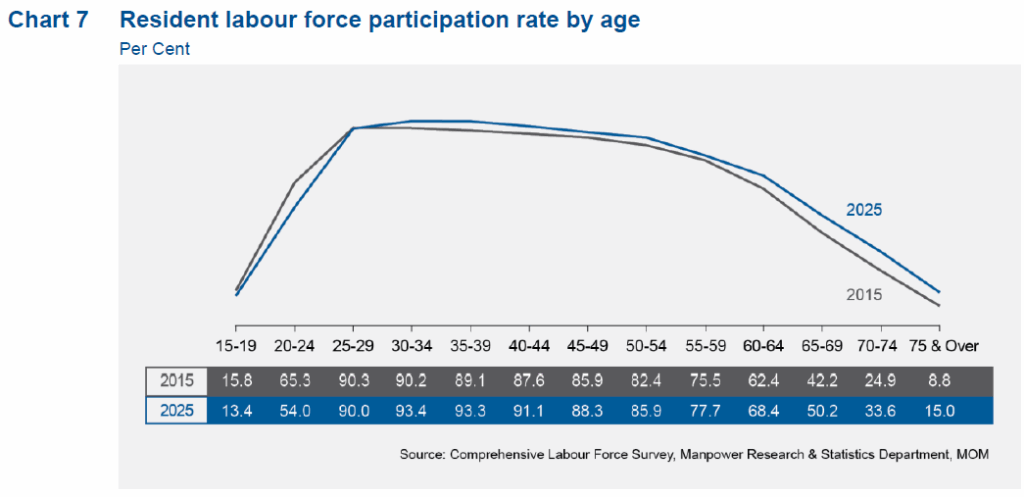
Most notably, the resident labour force participation rate (LFPR) declined for the fourth consecutive year, falling to 67.9% from 68.2% in 2024.
This continued contraction contrasts sharply with the headline optimism around permanent employment and low unemployment rates.
Decline in labour force participation amid ageing pressures
The fall in LFPR is largely attributed to Singapore’s ageing demographics. In 2025, residents aged 55 and above made up 37.9% of those aged 15 and over, up from 30.2% in 2015.
As a result, more older workers exited the workforce through retirement.
The resident old-age support ratio declined from 5.7 in 2015 to 3.3 in 2025, and is projected to fall to 2.7 by 2030.
Although participation among seniors rose to 19.3%, this increase does not offset the broader ageing trend.
Meanwhile, the youth segment under 30 continues to shrink in the labour force, now accounting for just 13.6%, down from 19.1% in 2015. This is due to declining birth rates and more pursuing higher education.
A worrying decline in potential workforce
Residents outside the labour force increased to 1.16 million in 2025, 20,000 more than in 2024.
Retirement was the top reason at 30.1%, followed by family responsibilities at 22% and housework at 15.8%.
The number of potential entrants—those intending to seek work within two years—declined to 8.7% of those outside the labour force, down from 10.4% in 2024.
This suggests fewer residents plan to return to work, raising long-term labour supply concerns.
The increase in permanent jobs: more stability, less flexibility?
MOM reported that permanent job holders now make up 90.8% of resident employees. Younger workers saw the largest shifts, with those aged 15 to 24 recording an almost 8‑percentage‑point rise in permanent employment and steep declines in fixed-term and casual roles.
However, this increase reflects the proportion of job types—not necessarily an increase in actual employment numbers.
The report does not state how many residents were employed in 2025, nor how many jobs were created or lost. As a result, the rise in permanent employment could also stem from slower hiring, contraction in casual roles, or shifts in job structure.
This uncertainty matters because the prime-age employment rate fell slightly from 87.7% to 87.5%.
Such declines suggest that while contract types have stabilised, hiring momentum may have weakened.
At the same time, Singapore’s low female part-time employment rate—5.9% versus the OECD average of 13.7%—raises questions about whether current work arrangements meet diverse needs.
Real income growth does not guarantee inclusivity
Workers at the 20th percentile saw a 3.8% real income increase, while median earners saw 4.3%. Over a decade, workers at the 20th percentile experienced faster growth, supported by the Progressive Wage Model.
However, productivity growth in 2025 lagged behind income gains, narrowing the productivity–income gap and raising questions about the sustainability of these improvements.
Unemployment stable but may mask undercurrents
The resident unemployment rate remained low at 2.8% for both PMETs and non-PMETs, with long-term unemployment also declining.
Yet this stability may be partly due to a shrinking labour force rather than strong job creation. When fewer people participate in the labour market, unemployment can appear low even if hiring is weak.
Discouraged workers remained low at 0.3%, mostly among seniors, reflecting continued barriers to re-entry despite improving education profiles.