Balakrishnan’s call for balance misses the overwhelming reality of Gaza’s suffering
Foreign Minister Vivian Balakrishnan’s appeal for Singaporeans to seek balance and dialogue in the Israel-Palestine war ignores the scale and clarity of atrocities unfolding in Gaza, where nearly 70,000 have been killed and the UN has declared a genocide.
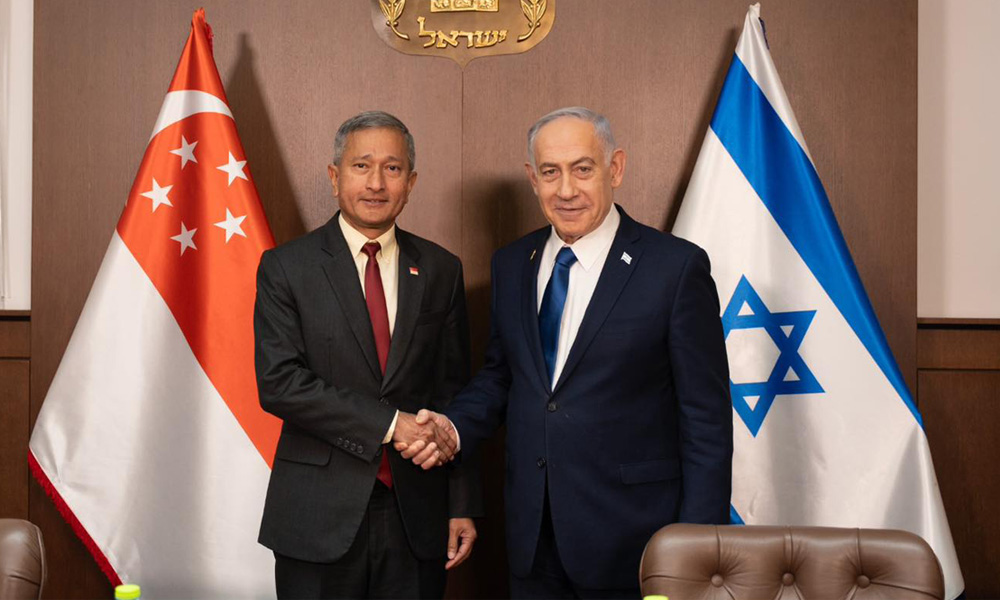

Foreign Minister Vivian Balakrishnan’s recent comments urging Singaporeans to engage “honestly and politely” with differing views on the Israel-Palestine conflict risk misrepresenting the situation as morally ambiguous or unclear.
In truth, the scale and nature of the atrocities unfolding in Gaza are no longer disputed by credible international bodies.
In September 2025, the UN Independent International Commission of Inquiry concluded that Israel is committing genocide in Gaza. It urged Israel and all states to fulfil their obligations under international law, to end the genocide and prosecute those responsible.
This conclusion was further reinforced by the International Association of Genocide Scholars, who affirmed that Israel’s actions meet the legal definition of genocide.
Yet, when questioned in Parliament on 22 September, Balakrishnan declined to affirm this, stating:
“On genocide, as I said earlier in the Statement, I would leave this to be determined by the International Court of Justice. Proceedings are in place, are underway... but we will have to wait for that and to act accordingly.”
While this position may appear legally cautious, we believe it reflects a narrow interpretation of Singapore’s responsibilities under the Genocide Convention, to which it has been a party since 1995. That Convention obliges signatories not only to punish genocide after the fact but to take action to prevent and condemn it when credible evidence emerges.
That threshold has long been crossed.
Since the start of Israel’s assault on Gaza in October 2023, 68,875 Palestinians—the majority of them women and children—have been killed. At least 170,679 have been injured. Entire residential blocks have been flattened. Aid convoys have been blocked. Medical facilities have been bombed. Water, electricity, and fuel have been systematically cut off.
As a direct result of the siege and restrictions on aid, Gaza is now experiencing a UN-recognised famine.
According to multiple humanitarian organisations and UN bodies, the deliberate denial of food, medical supplies, and clean water has led to widespread hunger, particularly among children. Infants have died from malnutrition. Families queue for hours to receive meagre rations, if aid reaches them at all.
The famine is not accidental—it is manufactured. It is the consequence of policy decisions to cut off life-sustaining resources to an already besieged population, and has been condemned by humanitarian bodies as a form of collective punishment
Despite the announcement of ceasefires, Israeli airstrikes, ground incursions, and targeted killings have continued, often in areas where civilians had been told to evacuate “for safety.”
Even during so-called “pauses,” the bombing of shelters, refugee camps, and food distribution centres has persisted. These are not signs of peace in progress, but of a continuing campaign of destruction.
Eyewitnesses—doctors who volunteered in Gaza—have shared accounts that are among the most horrifying in recent memory. Children have reportedly been shot by Israeli snipers in the head, chest, and groin — in what one doctor described as “systematic and deliberate executions of minors.”
These are not battlefield accidents. They are not collateral damage. They are acts of inhumanity so stark that they demand an unequivocal response.
This is not about Hamas.
Much of the killing has occurred in places with no combatants, including refugee camps and hospitals. In the West Bank and East Jerusalem, where Hamas has no control, Palestinians face daily raids, forced evictions, settler violence, and mass arrests. The pattern is one of broad, sustained, and state-enabled dehumanisation.
The targeting of those who report on these crimes is equally appalling.
As of 11 August 2025, a consolidated count by the Committee to Protect Journalists (CPJ) and the International Federation of Journalists (IFJ) found that 274 journalists have been killed by Israeli forces since the war began—269 of them Palestinian.
These are not accidents of war. They are attempts to silence witnesses and destroy the record of atrocity.
Yet despite all of this, Balakrishnan, during his 6 November media interview, reiterated Singapore’s posture of diplomatic balance, saying:
“We cannot alter the course of history… But we can do good if we can save lives with humanitarian assistance... That is not symbolic, that's real.”
Singapore’s contribution—a US$500,000 donation to the World Food Programme and capacity-building courses—is commendable in isolation. But in the face of genocide, charity is not a substitute for justice.
To frame such acts as “real” while declining to name the crime that necessitates them is, in our view, deeply inadequate.
Singapore prides itself on being a principled small state that champions a rules-based international order. But principles are only meaningful when they are upheld at the most difficult moments, not simply in abstract discussions or multilateral settings.
We believe Singapore must recognise that what is happening in Gaza is not a distant political disagreement, but a legally defined crime—one that demands moral clarity, not neutrality.
In the face of genocide, there is no middle ground.