HOME revisits Parti Liyani case, highlighting systemic gaps in police probes and legal proceedings
The Humanitarian Organisation for Migration Economics (HOME) has launched a video series revisiting Indonesian domestic worker Parti Liyani’s case, questioning systemic lapses that led to her wrongful conviction, the impact on Singapore’s justice system, and whether true justice can exist without accountability.
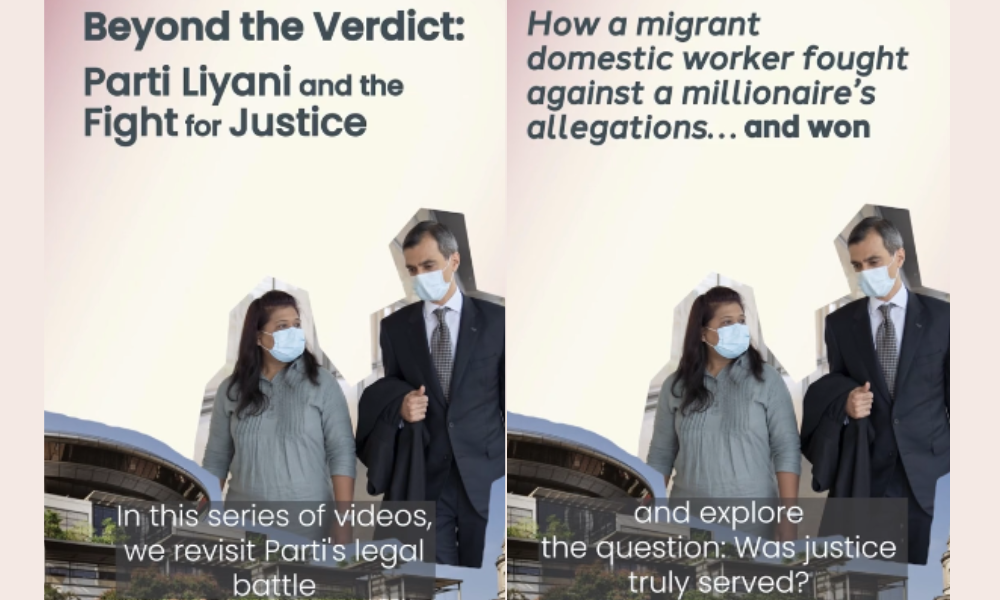

SINGAPORE: The Humanitarian Organisation for Migration Economics (HOME) has released a new video series revisiting the case of Indonesian domestic worker Parti Liyani, highlighting concerns over systemic lapses in Singapore’s criminal justice system.
HOME noted that her case remains significant as it revealed major gaps in how migrant workers experience police investigations and court proceedings.
HOME revisits the case to ask: What systemic lapses led to Parti’s conviction? What were the consequences? How is Parti doing now? And what impact has this case had on Singapore’s justice system? Ultimately, it raises the question: is justice possible without accountability?
The first episode, uploaded to YouTube on 23 September 2025, revisits Parti’s four-year legal battle and questions whether justice was truly served.
Stephanie Chok, HOME’s executive director, opened the video by recalling that five years ago, Parti was acquitted at the High Court after being accused of stealing more than 140 items from the family of former Changi Airport Group chairman Liew Mun Leong.
While Parti was eventually cleared, the case attracted significant public criticism and raised concerns about perceptions of the system favouring the wealthy and well-connected.
Events Leading to Her Arrest
On 28 October 2016, Parti was abruptly dismissed by Karl Liew, son of Liew Mun Leong, in the presence of two employment agents. When she asked for a reason, none was provided.
Parti, who had served the family for nine years, was given only two hours to pack her belongings. She packed them into three jumbo boxes, leaving some items outside. After two hours, Karl and the employment agents returned, and Parti had to leave for the airport.
The boxes were left behind, with the Liews agreeing to send them back to her in Indonesia.
However, the following day, Mrs Liew, Karl, and Karl’s wife Heather opened the boxes and alleged they contained items belonging to the family.
Mr Liew subsequently filed a police report accusing Parti of theft.
When Parti returned to Singapore on 2 December 2016, she was arrested at Changi Airport.
HOME noted that between the filing of the police report on 30 October and her arrest, police had not visited the Liew residence to inspect the scene of the alleged offences.
By the time officers attended on 3 December, the items had already been removed from the boxes, with some reportedly in use by the Liew family.
Police did not seize the items until six months later in April 2017, creating a significant break in the chain of custody that would later prove central to her acquittal.
Charges and Alleged Stolen Items
In August 2017, eight months after her arrest, Parti was formally charged with stealing from four members of the Liew family: Liew Mun Leong, his son Karl, Karl’s wife Heather, and Liew’s daughter May.
According to the charge sheets, Parti had allegedly taken:
- a damaged Gerald Genta watch with a broken strap valued at S$25,000;
- two white iPhone 4s with accessories valued at S$2,056;
- 120 pieces of male clothing at S$150 each;
- a S$500 blanket;
- three S$100 bedsheets;
- a S$150 Philips DVD player;
- S$300 worth of kitchenware and utensils;
- a S$250 black Gucci wallet;
- a S$250 black Braun Buffel wallet;
- a S$50 Helix watch; a S$1,000 Prada bag; a pair of S$500 Gucci sunglasses with red stains;
- a S$1,000 Pioneer DVD player; two S$200 Longchamp bags;
- a Vacheron Constantin watch of unknown value;
- a S$75 Swatch watch;
- S$775 worth of jewellery and fashion accessories; and
- a S$250 pair of Gucci sunglasses.
Parti maintained her innocence, asserting that some items had been purchased by her or given to her, some were discarded and found by her, and some were not packed by her at all.
Her trial began in April 2018 and concluded in January 2019, spanning 20 days and involving 16 witnesses.
During proceedings, State Court Judge Olivia Low amended the second charge, removing seven items alleged by Karl Liew to have been stolen by Parti.
The judge found reasonable doubt over whether these items belonged to Karl, including four pieces of women’s clothing, a quilt cover, and two ladies’ wallets.
"In other words, the judge chose to amend the charge and remove items that discredited Karl rather than acquit Parti of stealing those items," Chok said.
State Court Judge Olivia Low eventually convicted Parti on all four charges, sentencing her to a total of 26 months’ imprisonment on 25 March 2019.
High Court Acquittal
Parti filed an appeal against her State Court conviction and sentence, which was heard at the High Court in November 2019.
High Court Judge Chan Seng Onn found that the prosecution had not proven its case beyond a reasonable doubt and acquitted Parti on all four charges.
Judge Chan highlighted several key issues that undermined the original conviction.
He noted that Mr Liew and his son Karl appeared to have an improper motive in filing the police report, seemingly to prevent Parti from complaining about being illegally deployed to clean Karl’s office and home.
The judge also pointed to a break in the chain of custody of evidence.
After the Liew family opened the boxes and filed the police report, items were removed and used by the family, creating a real possibility of mix-ups.
Some allegedly stolen items could not be located for the trial, and the items listed in Mr Liew’s original police report differed from those eventually included in the charges.
Translation and procedural issues further cast doubt on the case.
Two police statements were subject to reasonable doubt over the accuracy of translation between Bahasa Melayu and Bahasa Indonesia.
For three of the four statements, no Bahasa Indonesia-speaking interpreter was present, and Parti was questioned using only black-and-white photocopies of the items rather than the originals.
Judge Chan also questioned the credibility of Karl Liew as a witness.
He noted that Karl was internally inconsistent, contradicted by other witnesses, and failed to take the process of giving testimony seriously.
The judge concluded that Karl’s dishonesty not only undermined the second amended charge but also affected convictions based solely on his testimony.
Following Parti’s acquittal, public backlash against Liew Mun Leong intensified, with calls for him to resign from his corporate and public roles.
In September 2020, Liew announced his retirement from positions at Changi Airport Group, Surbana Jurong, Temasek Foundation, and Temasek International.
In the wake of her acquittal, Parti filed a court application on 23 September 2020 seeking disciplinary proceedings against the prosecutors involved in her case.
She is also pursuing a S$71,000 compensation order against the Attorney-General’s Chambers over the criminal proceedings brought against her.
In June 2021, the High Court dismissed Parti’s application for compensation against the Deputy Public Prosecutors (DPPs) involved in her case, under Section 359(3) of the Criminal Procedure Code.
Chok emphasised that while Parti’s acquittal brought relief, the systemic failures that led to her wrongful conviction in the State Courts remain unaddressed.
In upcoming episodes, the series will revisit the events that followed Parti’s acquittal and pose the question: has justice truly been served?