Singapore renovation company slams BTO toilet floor trap design as “nonsense”
Local renovation firm Reno Scout has slammed the design of BTO toilets in a YouTube video, calling it “nonsense”. The host criticised poor floor trap placement. Netizens agreed, with some commenting that the designers or approvers likely do not live in HDB flats.

SINGAPORE: Local interior design and renovation company Reno Scout has taken aim at the design of Build-To-Order (BTO) toilets, calling them “nonsense” and questioning the competence of the architects involved.
In a YouTube video uploaded on 12 September, the host opened with a sharp remark: “This time is another video to complain about the structure of the house being illogical.”
The host began by criticising vinyl flooring, which he said was prone to scratches and generally disliked by homeowners.
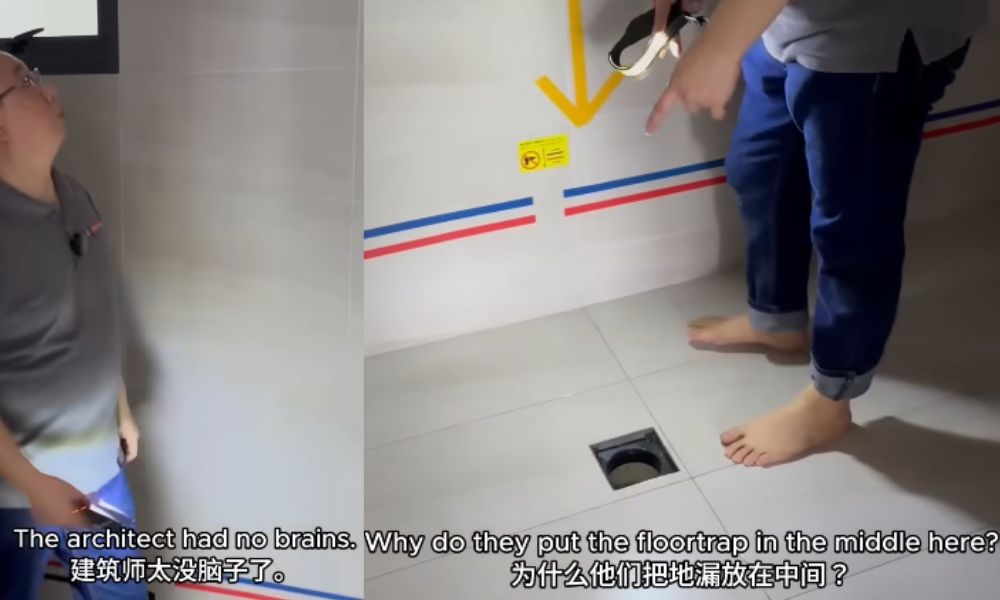
He then moved on to the toilet, highlighting what he described as the “main problem”: the placement of the floor trap.
While the toilet itself was large, with an additional two feet of space between the shower area and the washbasin, the host argued that this extra space was unusable because of the trap’s location.
According to him, the trap positioned in the middle between the shower and the washbasin was intended for the dry area, while the trap beneath the shower was meant for the wet area.
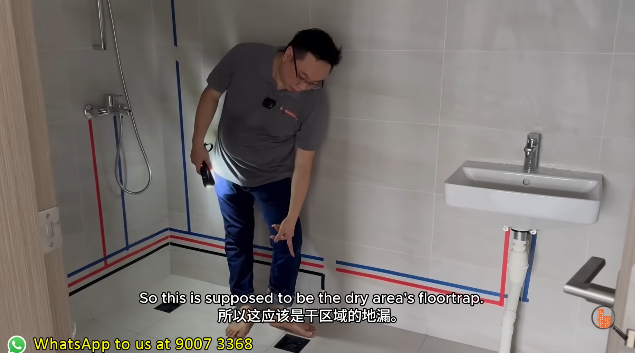
He argued that if the middle trap had been shifted closer to the washbasin, a shower screen could have been installed further from the shower, allowing the extra space to be utilised and resulting in a larger shower area.
“So this one is no brains. The architect got no brains,” he said, adding that the trap could have been placed in the corner to allow proper sloping and drainage.
He also suggested that placing the trap nearer to the washbasin would have created an additional 600mm of usable shower space.
“But no, you decided—or rather someone up there decided—to build the shower area so tiny.”
“Another Nonsense Case” in Second Toilet
Moving to the second toilet, the host described it as “another nonsense case” and claimed that whoever designed it “never built an HDB before.”
He criticised the placement of the second floor trap, again located in the middle, this time between the shower and the toilet.
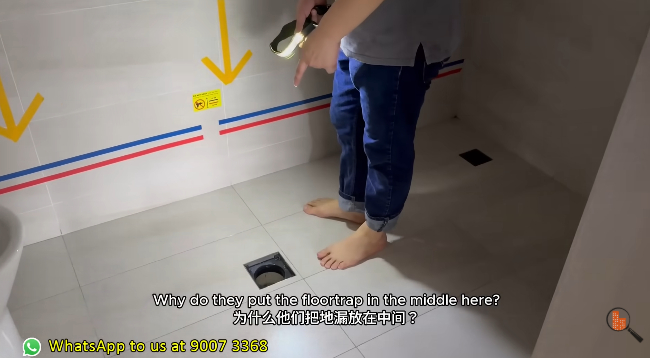
He argued that this design would lead to two problems: unsightly aircon drainage pipes that would need to loop awkwardly around the toilet bowl, and water ponding in the corners once a shower screen was installed.
The host suggested that the design was likely the work of a very new or young architect, remarking: “If it’s an old one or someone who has done HDB before, they won’t do this.”
The host noted that the kitchen design had no significant problems and described it as “very standard.”
“It’s a Bad Design,” Netizens Agree with Reno Scout’s Criticism
The video received acknowledgement from viewers and gained traction on the HardwareZone forum, where many netizens agreed with Reno Scout’s assessment of the floor trap placement.
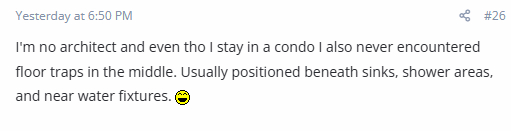
One user noted that the two floor traps in the user’s HDB toilets were located at the corner and under the sink, adding that Reno Scout was right to highlight the illogical placement.
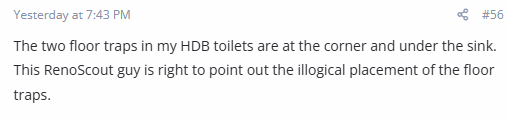
Another commented: “I’m no architect, and even though I stay in a condo, I’ve never encountered floor traps in the middle. Usually, they’re positioned beneath sinks, shower areas, and near water fixtures.”
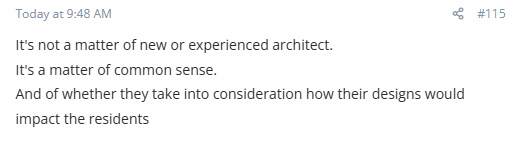
Some felt that the issue was not about architectural experience but rather about common sense. One commenter argued that what mattered was whether the architect took into consideration how the design would impact residents.
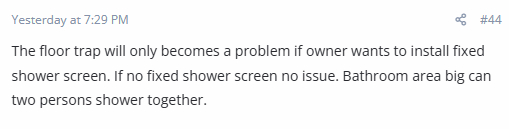
Others, however, argued that the problem might not be serious, saying it may only affect homeowners who want to install fixed shower screens.
“If no fixed shower screen, then no issue,” one user suggested.
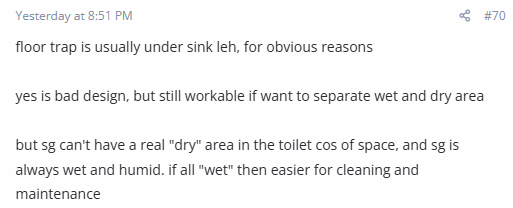
Another added that the placement was still workable if the aim was to separate wet and dry areas.
Netizens Doubt Designers’ Familiarity with HDB Living
Some netizens argued that the designer—or those approving the design—probably do not live in HDB flats.
One suggested that the architect was not Singaporean and came from a background where living spaces were designed without consideration for practical usage.
“The people who approve this design either don’t stay in HDB, are not local, or do not bother to check—just rubber stamp and go.”