A decade on, Sonny Liew reflects on Charlie Chan Hock Chye at Kinokuniya
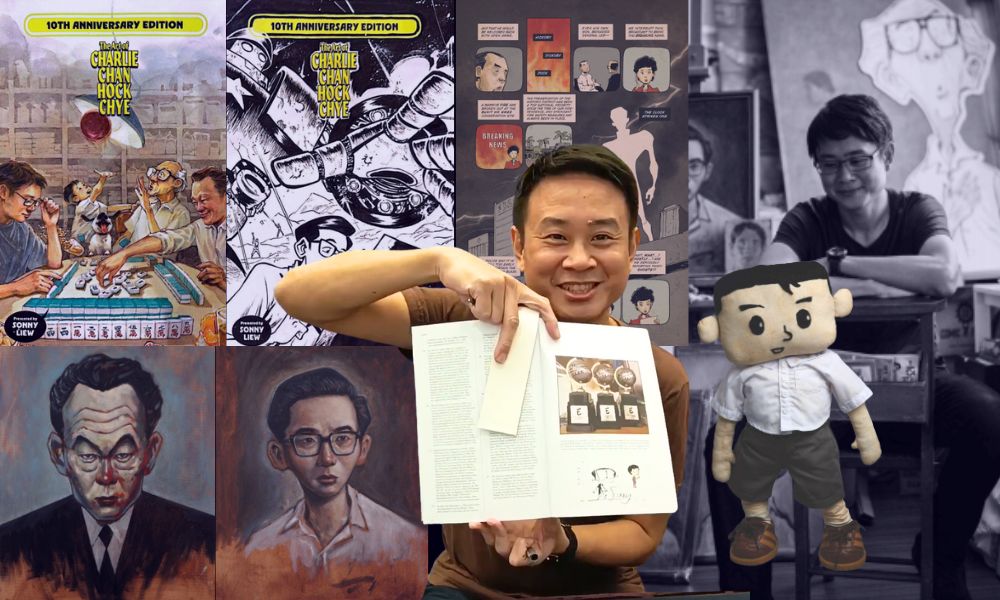
On 6 September 2025, Kinokuniya hosted a talk with Sonny Liew on The Art of Charlie Chan Hock Chye. The session explored the novel’s award-winning journey, research-driven art, translations, censorship challenges, and lasting legacy in Singapore and beyond.
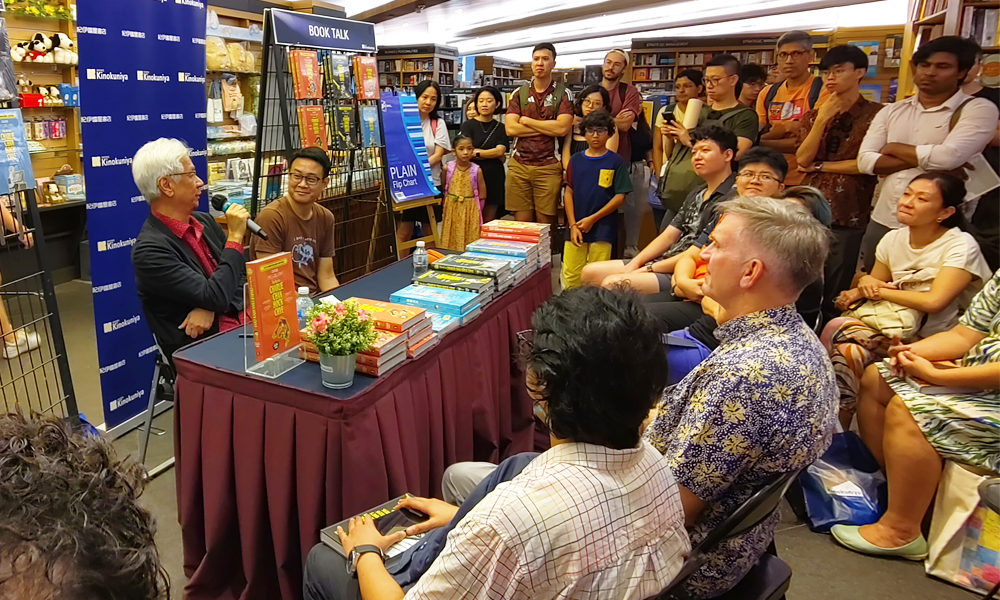

On 6 September 2025, Kinokuniya Singapore hosted A Decade of Charlie Chan Hock Chye, a public conversation with graphic novelist Sonny Liew.
The session was moderated by Kenny Chan, the bookstore’s former store director and now advisor, and joined by Edmund Wee, founder of Epigram Books.
The talk revisited the landmark graphic novel’s creative origins, international reception, and continuing legacy, drawing an audience of readers, students, and comics enthusiasts.
Awards and recognition
Publisher Edmund Wee reminded the audience of the novel’s global recognition. He noted that no single work had won more than three Eisner Awards, the American comics industry’s most prestigious honours.
In 2017, Liew’s book was nominated in six categories and won three:
- Best Writer/Artist
- Best U.S. Edition of International Material–Asia
- Best Publication Design
It was also nominated for Best Graphic Album–New, Best Coloring, and Best Lettering.
The Eisners were part of a cascade of honours that made the novel Singapore’s most awarded work of graphic literature.
It became the first graphic novel to win the Singapore Literature Prize (English Fiction Category) and was named Book of the Year at the Singapore Book Awards.
Internationally, it won the Pingprisen Prize for Best International Comic (2017), the Special Jury Prize at Romics Festival (2018), and the Salón del Cómic de Barcelona Best Foreign Author award (2017). French magazine Lire selected it as its Bande dessinée of 2017.
Major publications also placed it on their annual “Best of” lists. The Economist named it a Book of the Year 2016. Publishers Weekly, The A.V. Club, NPR, The Washington Post, The New York Post, South China Morning Post, and San Francisco Chronicle all included it among the year’s standout titles.
Specialist comics outlets echoed the acclaim: Comics Beat, Book Riot, Comicosity, Comic Book Resources, Comics Alternative, and Panel all highlighted it among their favourites of 2016.
It was also selected by the Junior Library Guild and featured in Print Magazine’s list of the *13 Best Graphic Novels of 2016.
These accolades underscored the novel’s unusual trajectory: a Singaporean graphic novel that crossed over from national bestseller to global literary recognition, circulating in both mainstream cultural press and dedicated comics communities.
Asked how the recognition felt, Liew told the Kinokuniya audience: “Charlie Chan, I had a sense that it was a good book. It was different from other books that I had read myself. I had hopes that it would do well, but the extent to how well it did is surprising to some extent. I never thought it would have reach outside of Singapore.”
A research-driven creative process
The novel is widely praised for its stylistic range, from Jack Kirby’s superhero dynamism to gegika (independent Japanese comics with more mature themes). Kenny Chan remarked: “You can see everything from manga to Jack Kirby style and more… How much of it is actually inspiration compared to research?”
Liew responded that the project leaned heavily on historical study: “It was mostly research, in the sense I would draw a timeline of Singapore history and a timeline of comics next to it, whether it was American, British, or Japanese. And then I would find a comic or style that would fit the particular story about Singapore that I wanted to tell."
"So, for example, World War II, the Singapore experience was easily mapped onto war stories — EC Comics, mostly Harvey Kurtzman.”
He clarified that not every style was drawn from one artist: “Not all the style is based on one artist, certain styles are based on imagining Charlie Chan being influenced by certain artists at his time in that period.”
The accuracy of these visual pastiches convinced many readers that Charlie Chan was a genuine historical figure. Liew said that more than once, people approached him to ask about Chan’s real-life work. “If he was real, it would have been easier — I could just have taken his comics for reference,” he joked.
At a Kinokuniya launch event years back, he recalled a woman asking why the artist Charlie Chan himself was not present to sign copies of the book. Liew said he had to explain that Chan was an entirely fictional creation.
The exchange underscored how persuasively the novel blends Singapore’s real history with imagined artistic trajectories.
Translations and censorship
The book has been translated into multiple languages, including Thai and Spanish, with a Japanese edition forthcoming.
In response to the moderator’s question on the challenges faced on dealing with translation and particularly preparing the mainland Chinese edition for the Chinese and Taiwanese market. “You know, China has censorship issues. So whenever you mention communism in the book, you know, some of the negative connotations — you have to take out the word ‘communism’."
"And there’s also a map somewhere in there of Southeast Asia, and because the area is disputed, there are territorial disputes. We had to adjust the map in order not to conflict with the Chinese version."
"But we wanted to still let readers know that were changes made, so the solution was to put a disclaimer at the back to say that this version of the book is not the same as the original one. If you have read carefully, you know that there is some censorship going on but it is not too obvious.”
When asked which languages surprised him, Liew replied: “Czech was surprising? Portuguese, also.”
He also mentioned an offer for a Russian edition. Questions arose over the absence of a Malay translation, despite the book’s coverage of the Malayan Emergency.
Liew answered that readers most interested in the subject would likely be able to read English, and compared this to Germany, where English proficiency is strong.
Wee added that the Thai edition had to be produced in a larger format, as its script did not fit into the speech bubbles, and speculated that German could pose the same difficulty.
Who should read the book?
Asked who the intended readership was, Liew replied: “It’s about Singapore history. So if you live in Singapore, or you might be interested in looking at history and different versions of the narrative… I suppose at some level every country has its own dominant narratives and counter-narratives.”
Kenny Chan expanded on this point: “I think everyone should read this book, not only from the viewpoint of, of the narrative of Singapore, but because people talk about Singapore from before 1965, the fishing village, that kind of mindset, of course, Singapore's history dates back 700 years, in that kind of, reasoning is the art of Charlie Chan Hock Chye offers an alternative narrative to the official narrative. And it's a lot of research and it's entertaining. And even if you don't like comics, you may end up liking comics.”
Controversy and cultural support
When the book was first published in 2015, the National Arts Council (NAC) withdrew an S$8,000 publishing grant, citing “sensitive content.” This coincided with public debate about whether the comic’s satirical portrayals of historical figures overstepped accepted bounds.
An audience member asked Liew about the positives that came from the controversy.
He replied: “Most people will talk about the Streisand effect. They will say because the government got involved, the news of this became viral."
"But virality can only get the book so far, and the book’s content is what sells the book. I think in a way the controversy helped the book to a certain degree in the short term — maybe because people heard the news and they might buy the book.”
Liew contrasted how cultural works are promoted in different countries. He observed that governments in places such as Korea and Japan actively support their creative industries, while in Singapore, Charlie Chan did not receive the same kind of backing.
He also mentioned that the book had not been displayed at the Frankfurt book fair because of the NAC sponsors the Singapore Pavillion there.
Sales and reprints
According to Epigram, in the first year alone there were three print runs, followed by annual reprints until 2018. A fifth-anniversary edition appeared in 2020, with later editions in 2022, 2024, and now 2025.
In Singapore, around 35,700 copies have been sold — possibly more, as sales of the U.S. edition are not tracked by Epigram but are also available locally.
This sustained performance is unusual for a local graphic novel. It also underscores the book’s resonance not only with comics fans but also with readers of history, literature, and cultural commentary.
A decade later
Reflecting on the journey, Liew noted that some readers had told him the book inspired them to create comics, though he could not measure its wider influence.
The moderator suggested that the title’s endurance lies in how it offers a counterpoint to dominant historical narratives, combining rigorous research with compelling artistry.
Ten years after its release, The Art of Charlie Chan Hock Chye continues to circulate internationally, provoke discussion at home, and stand as one of Singapore’s most acclaimed works of works of art.
The Art of Charlie Chan Hock Chye 10th Anniversary Edition is available at the Epigram online bookstore for S$48.90. An optional 5th-anniversary poster (594 x 841mm) is also available for S$10 (U.P. S$52.90), while stocks last.