Yeoh Lam Keong questions Singapore govt’s reluctance to provide basic income for absolute poor
Former GIC chief economist Yeoh Lam Keong has questioned why Singapore’s government resists giving basic income to the absolute poor. Citing a U.S. pilot in Austin that gave low-income families US$1,000 a month, he argued that schemes such as Workfare Income Supplement, Silver Support and ComCare are insufficient, urging policymakers to adopt bolder, permanent programmes that ensure dignity for the most vulnerable.
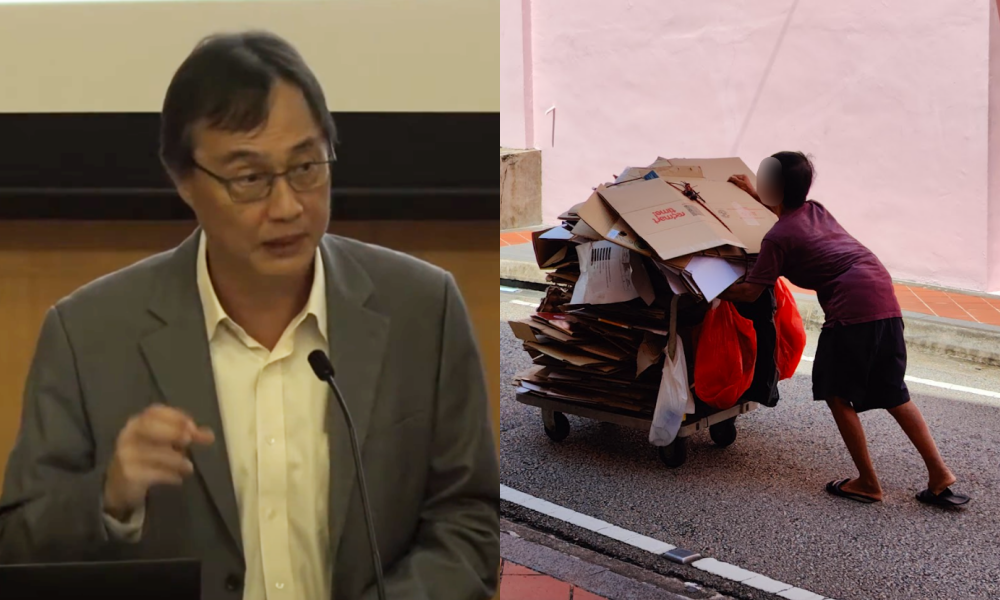

Former GIC chief economist Yeoh Lam Keong has questioned the Singapore government’s reluctance to provide a form of basic income for the absolute poor, highlighting international evidence that such support can be transformative. In a Facebook post on 22 August, Yeoh referred to an article published by VICE titled “Austin Gave Poor Families a Basic Income. It Changed Their Lives.” The piece reported on a pilot programme launched by the City of Austin, Texas, which provided US$1,000 per month for one year to 135 low-income households. Participants reportedly used more than half of the funds on housing costs such as rent, mortgage payments, and avoiding eviction. This substantially improved their housing stability. The article also claimed that the programme did more than stabilise finances—it empowered families, allowing some to secure better housing, find new jobs, and gain financial confidence.
Comparisons to Singapore’s social safety net
Drawing a comparison, Yeoh noted that Singapore already has targeted assistance for the working poor through the Workfare Income Supplement (WIS). He argued that WIS has shown to incentivise employment while boosting income. “Why then do we shy away from automatically giving our absolute poor the S$800 to S$1,000 cash a month they need to live a decent life via the WIS or Silver Support Scheme to the elderly poor?” Yeoh asked. Yeoh stressed that while WIS and Silver Support provide important support, their payouts remain badly insufficient to meet basic cash needs. Permanent components of the GST Voucher scheme were also described as relatively small. He further noted that ComCare payouts may add another S$200 to S$300, but only after what he described as onerous applications, assessments, and periodic reviews. These requirements, he suggested, often hamper access for the resource-strapped extremely poor. This, Yeoh argued, is especially problematic in the context of rising living costs after the Covid pandemic, the war in Ukraine, and knock-on price increases from the GST hike. He contended that such pressures have not been fully alleviated by one-off vouchers or relief programmes.Call for more affordable permanent support
According to Yeoh, expanding support through permanent schemes is fiscally viable. “This proposed increase in WIS and Silver Support is eminently affordable and costs less than half the S$6.4 billion budget surplus we ran last year,” he wrote. He urged policymakers to consider bolder, more efficient and permanent programmes to help Singapore’s most vulnerable citizens live with dignity.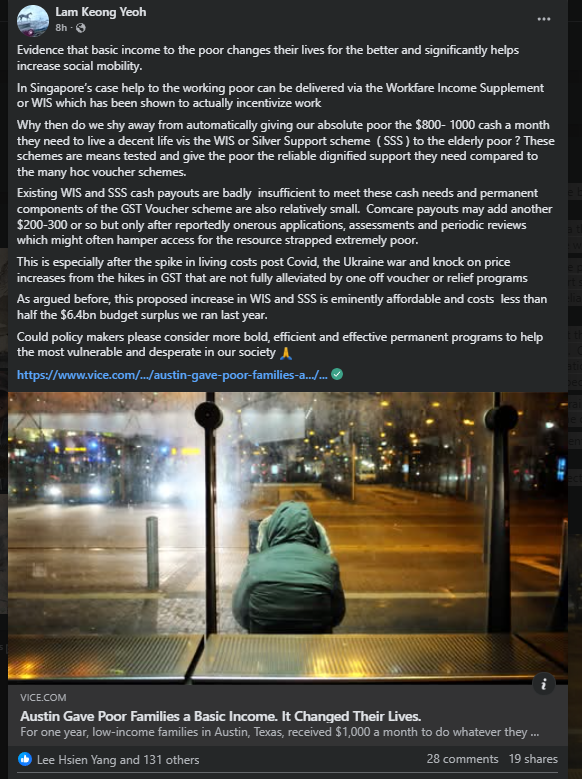 The WIS was introduced in 2007 as a permanent measure to support lower-wage Singaporean workers with both cash and CPF top-ups, aiming to supplement income and strengthen retirement savings.
The Silver Support Scheme, legislated in 2015 and implemented in 2016, provides quarterly payouts of between S$300 and S$750 to low-income elderly Singaporeans who have little CPF savings.
ComCare, administered by the Ministry of Social and Family Development, provides a range of assistance depending on need, including short-to-medium-term financial aid, long-term support for those permanently unable to work, and subsidies for childcare and student care.
The WIS was introduced in 2007 as a permanent measure to support lower-wage Singaporean workers with both cash and CPF top-ups, aiming to supplement income and strengthen retirement savings.
The Silver Support Scheme, legislated in 2015 and implemented in 2016, provides quarterly payouts of between S$300 and S$750 to low-income elderly Singaporeans who have little CPF savings.
ComCare, administered by the Ministry of Social and Family Development, provides a range of assistance depending on need, including short-to-medium-term financial aid, long-term support for those permanently unable to work, and subsidies for childcare and student care.