Singaporean-funded polyclinic in Gaza treating up to 100 patients daily amid healthcare crisis
A Singaporean-funded polyclinic by Love Aid Singapore in Gaza’s Al Bureij refugee camp is now fully operational, treating 80 to 100 patients daily with free medical and psychological care, including rehabilitation for war-related injuries and support for displaced residents.
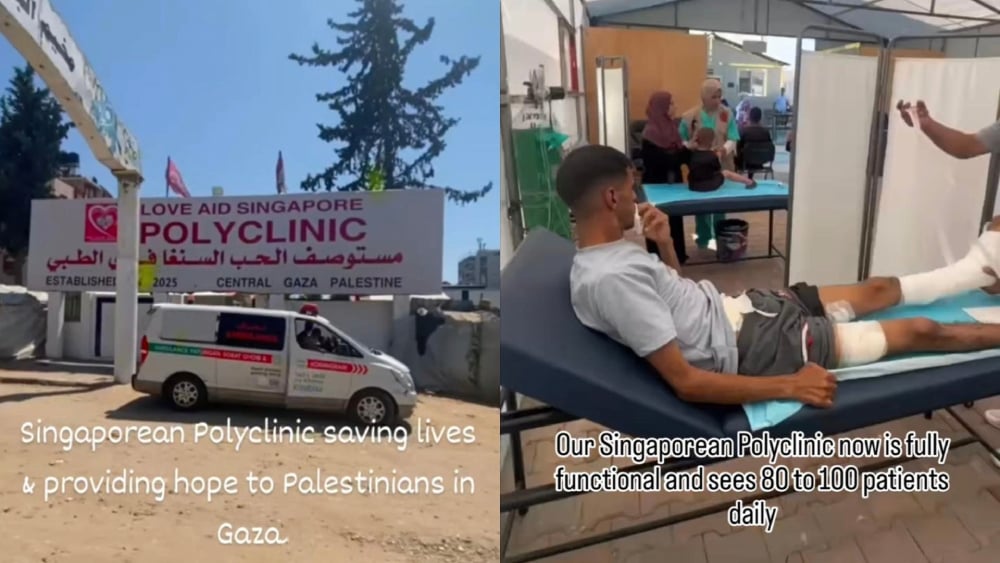

A polyclinic funded by Singaporeans, located in the Al Bureij refugee camp in central Gaza, is now fully operational, serving approximately 80 to 100 patients each day.
The update was shared by Singaporean activist Gilbert Goh, founder of the humanitarian group Love Aid Singapore, via Instagram on Thursday (3 July).
Goh emphasised that the facility was built from the ground up using funds donated by members of the Singaporean public, in partnership with the organisation’s NGO counterpart in Gaza.
He clarified that the Singaporean government is not involved in the initiative.
“Our Singaporean Polyclinic is now fully functional and sees about 80 to 100 patients daily,” he wrote.
The clinic primarily focuses on providing rehabilitation therapy for individuals suffering from mobility issues caused by injuries sustained during the ongoing bombardment — which Goh described as part of a “genocidal war”.
In addition to rehabilitation, the polyclinic provides general medical care for children and other patients with common ailments such as flu, fever, and cough.
All treatments are currently offered free of charge.
Mental health support is also a key component of the clinic’s services.
A psychologist conducts regular sessions for residents of the Al Bureij camp, which is home to nearly 10,000 displaced individuals.
According to Goh, women and children have been attending weekly socio-psychotherapy workshops consistently over the past two months.
Looking ahead, Love Aid Singapore is exploring the possibility of opening a second polyclinic in North Gaza, where the need is reportedly “acute and pressing” due to the widespread destruction of medical infrastructure.
Operating the Al Bureij clinic requires between $500 and $600 per day for medication and treatment alone, with salaries for medical personnel amounting to nearly $8,000 per month.
“Thanks to the many who have donated for our polyclinic all this while,” Goh said in appreciation.
In addition to the polyclinic, Love Aid Singapore also funds two community kitchens in Gaza, which together provide daily meals for around 1,000 Palestinians.
View this post on Instagram
WHO: Gaza’s Health System on the Brink of Collapse
The World Health Organization (WHO) has warned that Israel’s intensified military operations continue to critically undermine Gaza’s already shattered health care system, according to a report released in May 2025.
Four major hospitals — Kamal Adwan Hospital, Indonesia Hospital, Hamad Hospital for Rehabilitation and Prosthetics, and the European Gaza Hospital — have been forced to suspend services within the past week.
The suspensions are due to their proximity to active hostilities, newly declared evacuation zones, and direct attacks.
The WHO recorded 28 attacks on health care facilities during this period alone, bringing the total number of documented attacks in Gaza to 697 since October 2023.
Currently, only 19 of Gaza’s 36 hospitals remain partially operational. Of these, 12 continue to offer a range of services, while the remaining seven are limited to basic emergency care.
At least 94% of all hospitals in the Gaza Strip have been damaged or destroyed.
The remaining facilities are operating under extreme conditions — facing severe shortages of medical supplies, a critical lack of health workers, constant insecurity, and a surge in casualties.
The WHO described the working conditions for medical staff as “impossible”.
Across Gaza, only 2,000 hospital beds are currently available for a population of more than two million — a number WHO says is “grossly insufficient” to meet current needs.
Of these, at least 40 beds are at immediate risk, located in hospitals within newly declared evacuation zones. A further 850 could be lost if nearby facilities are forced to shut down.
WHO also reported that continued hostilities and the presence of Israeli military forces are preventing patients from accessing care, obstructing medical staff from providing treatment, and hindering WHO and its partners from delivering essential supplies.
Since the conflict escalated on 7 October 2023, Gaza’s Health Ministry reports that at least 56,500 Palestinians have been killed — including 17,400 children — and more than 133,000 others injured.