Former editor-in-chief proposes Straits Times become global alternative to ‘biased’ western media
Former Straits Times editor Cheong Yip Seng proposed transforming the paper into a global publication, citing Western media bias. However, many netizens criticised the idea, accusing ST of local political bias and questioning its credibility, independence, and reliance on government funding.
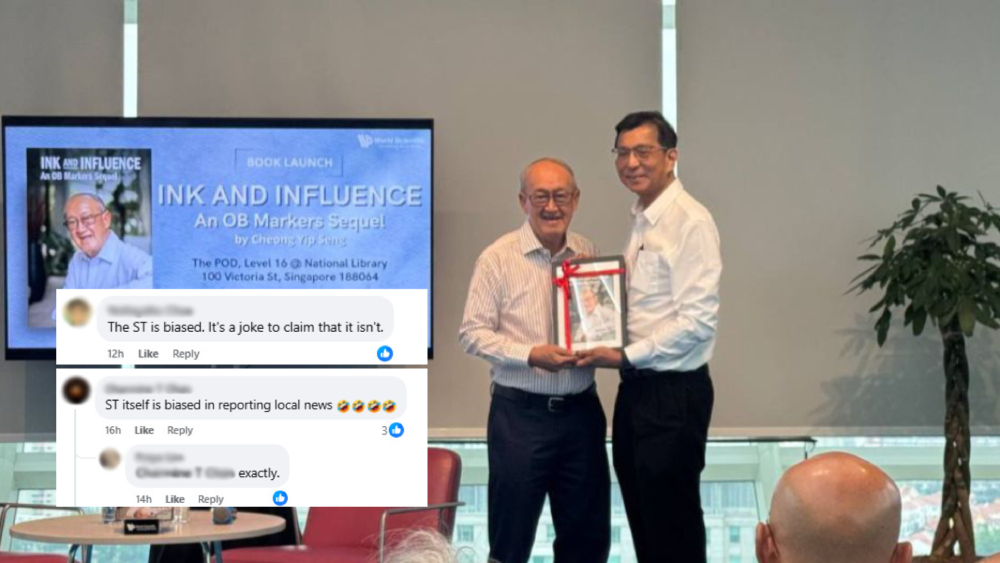

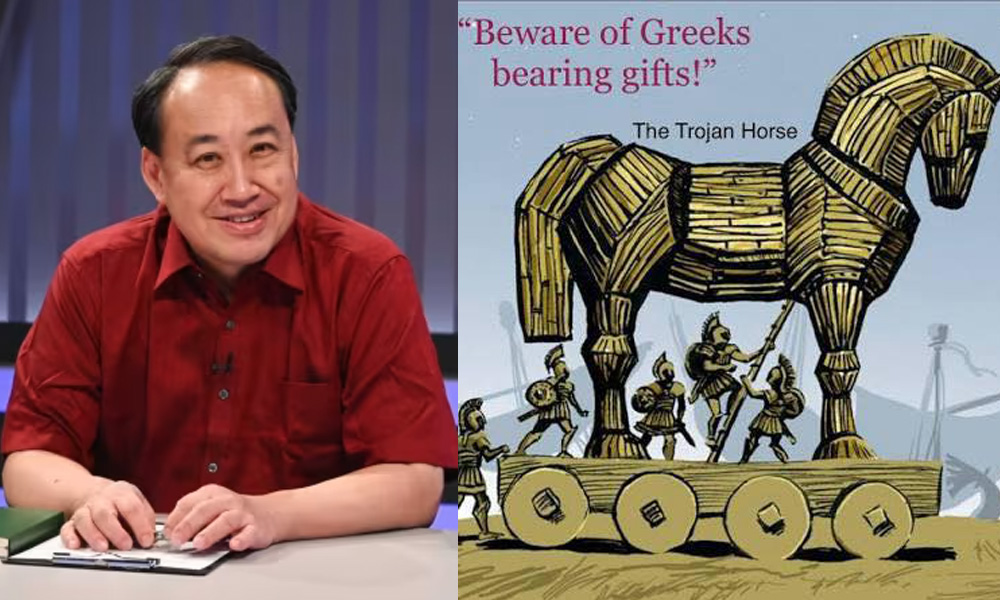
SINGAPORE: The former editor-in-chief of The Straits Times (ST), Cheong Yip Seng, has proposed the national broadsheet to transform into a global newspaper, capitalising on what he describes as the “bias” and “hypocrisy” of Western media.
Speaking at the launch of his new book Ink and Influence: An OB Markers Sequel on Wednesday (2 July), Cheong argued that ST should pivot away from local and municipal coverage and instead cater to a global, upmarket, English-speaking audience with a strong focus on geopolitics.
Other local outlets already provide community news, he said, leaving ST to “fill a niche in the market”.
The 82-year-old veteran journalist, who helmed ST from 1987 to 2006, said the concept of a global Singapore newspaper was not new.
He credited the late S Rajaratnam, Singapore’s first Foreign Minister, as having floated the idea in the 1960s, followed by former Prime Minister Goh Chok Tong.
Goh once described the paper as “schizophrenic”, noting that while its foreign coverage was upmarket and respected, its local pages resembled a mass-market product.
Western ‘Double Standards’
In his book, Cheong criticises the Western media’s dominance in global news, highlighting what he sees as glaring inconsistencies in coverage.
He pointed to the wars in Ukraine and Gaza, noting that while Western media champion human rights in some conflicts, they are silent or complicit in others.
“For a long time, many countries, including Singapore, would witness a US-led crusade for human rights. But when Palestinians are being starved and slaughtered in Gaza, the Western human rights crusaders were found wanting,” he wrote.
He added that while the US called for a more humane approach in Gaza, “they were mere words”.
Cheong also cited contrasting reactions to the storming of the Hong Kong Legislative Council in 2019 and the US Capitol in 2021.
Then-US House Speaker Nancy Pelosi had described the Hong Kong protests as “a beautiful sight”, yet condemned the Capitol riots.
“If she had been consistent, she should have also reacted the same way when an American mob stormed the US Capitol,” he wrote.
A Paper for a Global City
Cheong argued that a globally focused ST would better match Singapore’s world-class standing in finance, aviation, and trade.
He pointed to figures like ambassador-at-large Tommy Koh and diplomat Rena Lee, as well as thought leaders such as George Yeo, Bilahari Kausikan, and Kishore Mahbubani, who regularly appear on international panels.
“Singapore may be a little red dot on the world map, but it has a financial centre, port, airport, airline, and commodities trading hub that are all world-class,” he said.
“Why not add to the list a global Singapore newspaper to match?”
He added that many international events have a local angle.
For example, attacks on ships in the Red Sea by Houthi militants, linked to the Israel-Hamas war, disrupted supply chains and caused port congestion in Singapore.
Cheong acknowledged that shifting away from local news might result in some loss of domestic readership.
However, he believes this would be offset by gains in international influence. He also noted that ST is no longer the most-read news site in Singapore.
“With the heartlands no longer being its main market, the ST can fill its news space more productively with a more robust examination of the country’s policy choices,” he said.
Singapore, he added, “needs and deserves such a paper” that reflects its maturity as a global city.
“A global Singapore newspaper would strengthen the country’s competitive edge and help establish it as a major news hub,” he concluded.
“Straits Times not biased?” Netizens respond
The comments section under CNA’s Facebook post saw a mix of responses to Cheong’s proposal.
While a few supported the idea in theory, many netizens expressed scepticism, pointing to The Straits Times’ (ST) perceived bias in its coverage of local political issues.
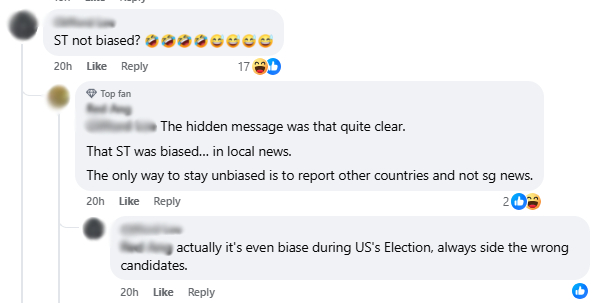
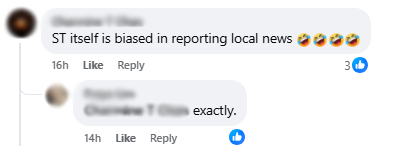
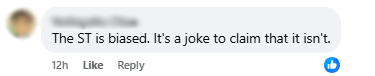
One user remarked, “Respectfully, all news outlets are ‘biased’. It’s just where the bias lies.”

Another commented that ST is ‘biased’ and shows ‘blatant hypocrisy’ in its reporting of local political news.

Criticism of ST’s political bias has also surfaced on Reddit, where a user questioned the paper’s extensive coverage of the ruling People’s Action Party (PAP) ahead of GE2025.
According to Media Bias Fact Check, an independent website that evaluates news credibility, The Straits Times is rated as “Right-Centre Biased”, with editorial leanings that tend to favour right-wing positions.
The site also rates ST as “Mostly Factual”, citing proper sourcing and a clean fact-checking record, but notes that its credibility is limited by government censorship and the promotion of state propaganda.
“Try Independence First”: Public Notes ST’s State Funding
Cheong’s vision of transforming The Straits Times (ST) into a respected global paper was met with ridicule by many commenters, who viewed it as detached from the paper’s current reality.
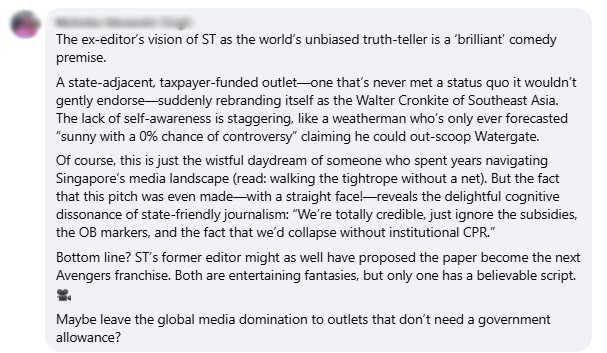
One described the proposal as a “brilliant comedy premise,” calling ST “a state-adjacent, taxpayer-funded outlet—one that’s never met a status quo it wouldn’t gently endorse.”
“Maybe leave the global media domination to outlets that don’t need a government allowance?” the user added.
This sentiment was underscored by significant government funding for SPH Media Trust, which was allocated up to S$900 million over five years beginning in 2022.
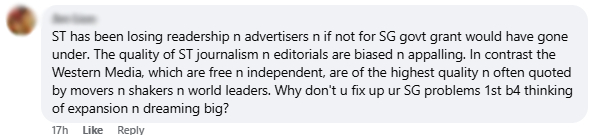
A separate user remarked that ST has been steadily losing readers and advertisers, and would likely have collapsed without state support.
“The quality of ST journalism and editorials is biased and appalling,” the user wrote, comparing it unfavourably to the independence and quality of Western media.
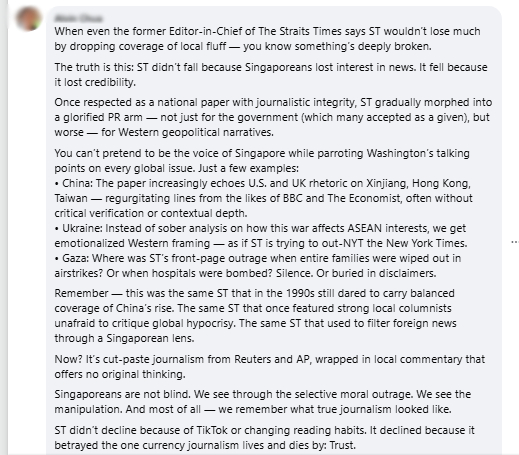
Another user offered a deeper critique, suggesting that when even the former Editor-in-Chief acknowledged The Straits Times could drop local coverage without much loss, it signalled a deeper issue within the organisation.
"ST didn’t decline because of TikTok or changing reading habits. It declined because it betrayed the one currency journalism lives and dies by: Trust."
Former ST Editor Questions Paper’s Ability to Go Global
A former editor of The Straits Times (ST), Bertha Henson, who attended the book launch, also commented on Cheong's proposal to take the paper upmarket and focus on geopolitics.
Henson noted that Cheong’s vision seemed to reflect The Straits Times of two decades ago — a time when the paper had strong foreign coverage supported by an extensive network of overseas bureaus.
“Not so sure about now,” she added, expressing doubt that ST still has the same capacity today.
She was also critical of the paper’s current local reporting, suggesting that ST might be better off giving up that segment due to declining standards.
“ST is so lousy on local coverage that it would be better for ST to give up that part,” she wrote.
“It doesn’t do local commentaries anymore. In fact, can’t even sustain a daily editorial — whether on local or foreign news!”
Reflecting on the launch event, Henson said she was surprised by Cheong’s strong praise for CNA.
She noted that the former editor-in-chief praised CNA as a better product than ST and highlighted that both CNA and Mothership outperformed ST in a Reuters Institute survey.