Iran launches massive missile assault on Israel after deadly strikes on nuclear sites and top commanders
Iran fired hundreds of missiles at Israel in retaliation for deadly Israeli strikes on Iranian nuclear facilities and top commanders, marking a dangerous escalation in Middle East tensions.
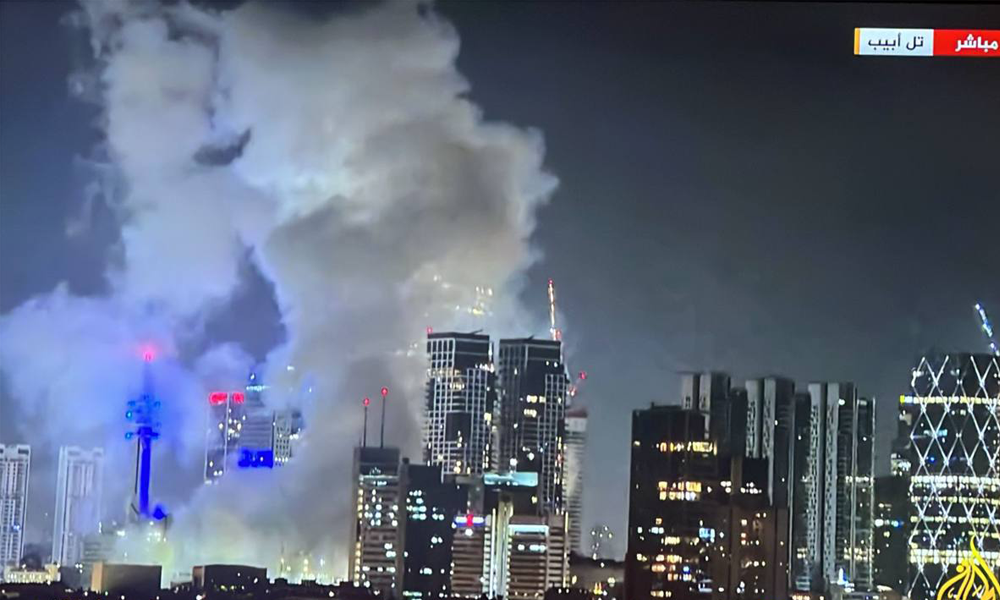

Iran launched a massive retaliatory missile assault on Israel on 13 June 2025, firing hundreds of ballistic missiles at multiple targets, including the cities of Jerusalem and Tel Aviv, according to Iran’s state news agency IRNA.
The attack followed Israel's largest-ever military strike against Iran, which targeted its underground Natanz nuclear facility and killed several of Iran's top military commanders.
Air raid sirens blared across Israel as authorities urged residents to take shelter. The Israeli military confirmed that Iran fired two salvos of missiles, with many seen streaking across the Tel Aviv skyline.
Iran's Supreme Leader Ayatollah Ali Khamenei accused Israel of starting a war, while a senior Iranian official warned that "nowhere in Israel would be safe" and that revenge would be "painful."
Israel's operation came after what Prime Minister Benjamin Netanyahu described as intelligence indicating that Iran was days away from producing enough fissile material for multiple nuclear bombs. Speaking on national television, Netanyahu declared, “Our operation will continue for as many days as it takes to remove this threat.”
Netanyahu, who has long warned of Iran’s nuclear ambitions, said the strike was necessary to prevent Iran from building nuclear weapons. Israel and Western allies maintain that Iran seeks to develop nuclear arms, a claim Tehran has consistently denied, insisting its programme is purely for civilian energy purposes.
According to the head of the U.N. nuclear watchdog, Rafael Grossi, the Israeli strike destroyed the above-ground pilot enrichment plant at Natanz. The International Atomic Energy Agency (IAEA) is still assessing damage to two other major facilities — the Fordow fuel enrichment plant and the complex at Isfahan.
Iran's U.N. envoy, Amir Saeid Iravani, reported that 78 people, including top military officials, were killed in the Israeli strikes, and over 320 people were wounded, most of them civilians. Iravani also accused the United States of complicity, saying Washington shared full responsibility for the consequences.
Among the senior Iranian officials killed were Major General Mohammad Bagheri, chief of staff of Iran's armed forces, and Hossein Salami, commander of the elite Revolutionary Guards. Salami's successor, Major General Mohammad Pakpour, vowed revenge, stating on state television: "The gates of hell will open to the child-killing regime."
Two regional sources cited by Reuters stated that at least 20 senior Iranian commanders were killed in the strike, calling it a stunning decapitation reminiscent of Israeli attacks that previously crippled Hezbollah’s leadership in Lebanon.
In addition to the direct military assaults, Israeli security sources revealed that Mossad agents had conducted covert operations deep inside Iran ahead of the attack. Israel also established an attack-drone base near Tehran to support its operations, successfully targeting numerous radars and surface-to-air missile launchers, according to military statements.
Inside Iran, the mood was tense. Many civilians reported fear and confusion, with some rushing to convert currency and others seeking ways to flee the country. "People on my street rushed out of their homes in panic. We were all terrified," said Marziyeh, a 39-year-old resident of Natanz.
While some Iranians expressed quiet hope for political change within the hardline clerical regime, others voiced fierce support for Iran’s nuclear programme. "I will fight and die for our right to a nuclear programme," said Ali, a member of the pro-government Basij militia in Qom.
The crisis threatens to destabilise the wider Middle East. Iran's capacity to respond through its regional proxies has been significantly weakened over the past year. The downfall of Syrian President Bashar al-Assad, as well as the severe weakening of Hezbollah in Lebanon and Hamas in Gaza, has reduced Tehran's regional leverage.
Nonetheless, Israel reported that a missile fired from Yemen, where the Iran-backed Houthi militia operates, landed in Hebron in the occupied West Bank. The Palestinian Red Crescent reported that three Palestinian children were wounded by shrapnel from the missile strike.
The conflict has also impacted global markets, with oil prices surging on fears of wider disruptions in the oil-rich region. Despite the tension, OPEC stated that the escalation did not justify any immediate changes to oil production or supply.
In an interview with Reuters, U.S. President Donald Trump confirmed that nuclear talks with Iran, previously scheduled for 15 June 2025, were still on the agenda, although their future was uncertain.
“We knew everything,” Trump said, referring to Israeli attack plans. “I tried to save Iran humiliation and death... They can still work out a deal, however, it’s not too late.”
Israeli national security adviser Tzachi Hanegbi acknowledged that military action alone could not eliminate Iran’s nuclear programme. However, he suggested that the current operations might create conditions favourable for a U.S.-led diplomatic resolution.
The escalation represents one of the gravest confrontations between the two long-standing rivals in decades, with potential implications that could ripple far beyond the region if not contained.