Xiaohongshu users share tips on applying for BTO while retaining overseas properties
Social media discussions espercially on Xiaohongshu reveal new Singapore citizens and PRs exploring methods to retain overseas properties, particularly in Malaysia, while applying for subsidised Build-To-Order flats. Some share strategies such as transferring property ownership to parents or applying for retention under family residence grounds.


On social media platforms, particularly Xiaohongshu (XHS), numerous posts are sharing detailed advice on how individuals can apply for Singapore’s Build-To-Order (BTO) public housing while retaining ownership of overseas properties.
These guides appear to target new Singapore citizens and permanent residents (PRs), addressing the demand from applicants who wish to keep overseas properties, particularly in neighbouring Malaysia, while securing a new HDB flat in Singapore.
Several users provide specific strategies for applicants who are reluctant to part with their Malaysian properties.
One commonly suggested method involves transferring the ownership of the overseas property to family members, typically parents, while the original owner continues to service the existing mortgage.
Paid services offered on XHS to help applicants navigate BTO rules and retain overseas properties
Some XHS users have openly claimed that they offer professional services to facilitate these processes.
These services allegedly include assisting families in retaining overseas properties, shortening waiting periods of 15 to 30 months, and securing housing loans and grants in Singapore.

XHS user details lengthy nine-month process to obtain HDB approval for property retention
A user documented her nine-month journey navigating HDB’s policies.
The user explained that she applied to retain their Malaysian private residential property with HDB in June 2023.
Over the following months, she consistently followed up via email and repeatedly submitted supporting documents. Eventually, in March 2024, HDB approved the application.
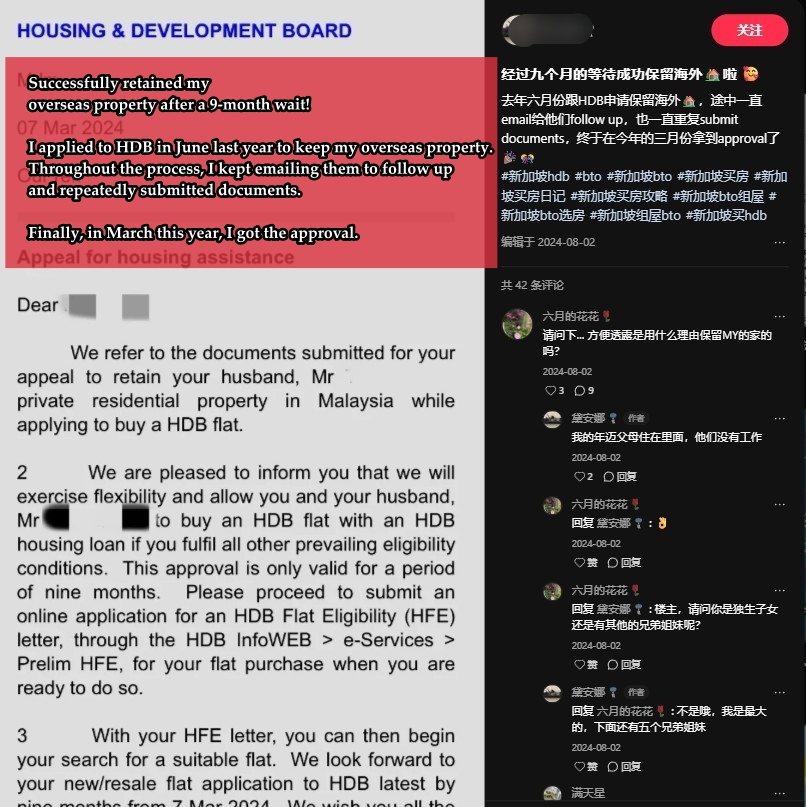
In response to queries in the comment section, the user revealed that her elderly, unemployed parents were residing in the Malaysian property, which may have contributed to HDB's approval of their retention application.

However, the complexities of the policy have led to further questions and debates among users.
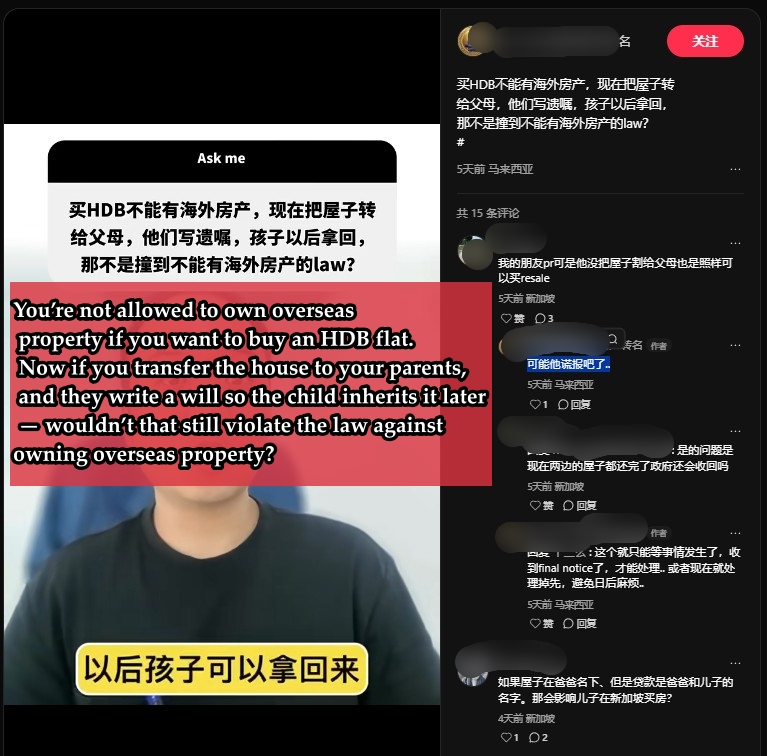
Some raised concerns about potential contradictions with Singapore’s public housing rules if, after transferring ownership to parents, the property is later reclaimed by the original owner.
A property agent on the platform addressed these concerns, stating that after fulfilling the Minimum Occupation Period (MOP) of their HDB flat, the original owners could transfer ownership of the Malaysian property back to themselves.
The agent further promoted his services, offering assistance with ownership transfer processes, will drafting, and legal advice for new citizens regarding their overseas properties.
User reminds strict enforcement of HDB's rules on overseas property ownership
Nonetheless, not all experiences shared on XHS have been positive.
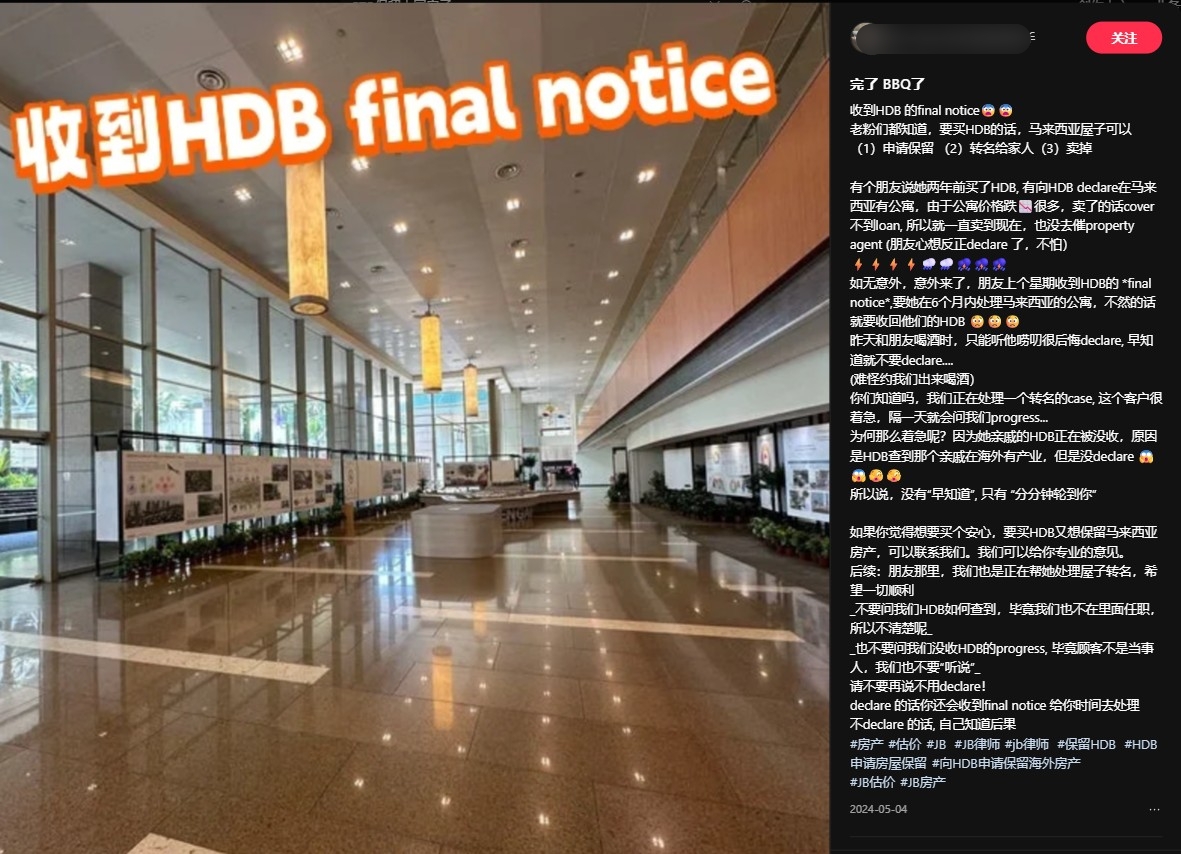
Some users highlighted the strict enforcement of overseas property policies by HDB. One user recounted his friend’s predicament.
According to the user, the friend had declared ownership of a Malaysian apartment during the HDB flat application process two years ago.
Due to a decline in property value, selling the Malaysian apartment would not cover the outstanding loan. The friend delayed selling the property, assuming that declaring it would suffice.
However, HDB later issued a final notice, instructing the friend to dispose of the Malaysian apartment within six months or face repossession of the HDB flat.
The user mentioned that the friend regretted declaring the property initially, as it might have triggered the stringent review.
Further, the same user shared that he was assisting another client with a property ownership transfer, prompted by the client’s relative having their HDB flat confiscated after HDB discovered undeclared overseas property ownership.
In his post, the user cautioned others against assuming that undeclared properties would go unnoticed, emphasising that declaring overseas assets triggers a review period, while failing to declare carries its own risks.
Some comments on the platform advised that it would be more prudent to resolve overseas property ownership matters before converting to Singapore citizenship, to avoid complications during HDB applications.
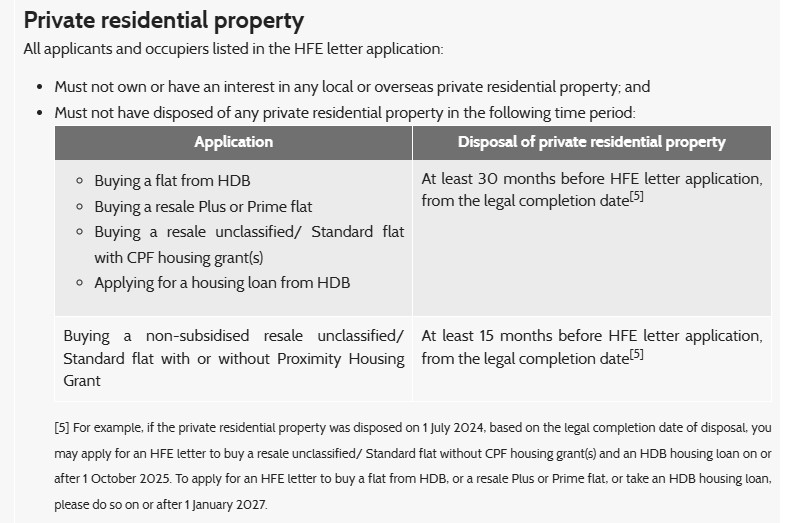
Under existing HDB regulations, applicants for BTO flats, resale Plus or Prime flats with CPF housing grants, or HDB housing loans, must not own private residential property overseas or locally within 30 months before the application for an HDB Flat Eligibility (HFE) letter.
The 30-month period is counted from the legal completion date of the property sale.
Public housing as a fallback? Reddit questions BTO access for new citizens with no long-term plans
Earlier, on 9 June 2025, a Reddit thread reignited public discourse about the accessibility of BTO flats for new citizens.
The original poster alleged that a Malaysian colleague, who had recently become a Singaporean citizen, was applying for a BTO flat with a partner holding PR status.
The couple, both in their late 20s, reportedly admitted that they had no long-term plans to reside in Singapore, instead viewing the BTO flat as an investment or a fallback option.
The Reddit post criticised the lack of policies requiring a minimum citizenship tenure before BTO eligibility and the absence of checks to verify applicants’ intentions to settle in Singapore.
The poster contrasted the situation with that of native Singaporeans who have completed national service, paid taxes, and demonstrated long-term commitment, yet face difficulties securing affordable housing.
While some comments described the couple’s approach as financially astute, others deemed it ethically questionable.
Additional voices pointed out that certain Singaporeans similarly maintain PR status for their Malaysian spouses to optimise housing and tax benefits in both countries.
Several comments proposed policy reforms to tighten BTO eligibility criteria, such as introducing a longer citizenship period before application eligibility and stricter assessments of applicants' long-term settlement intentions.