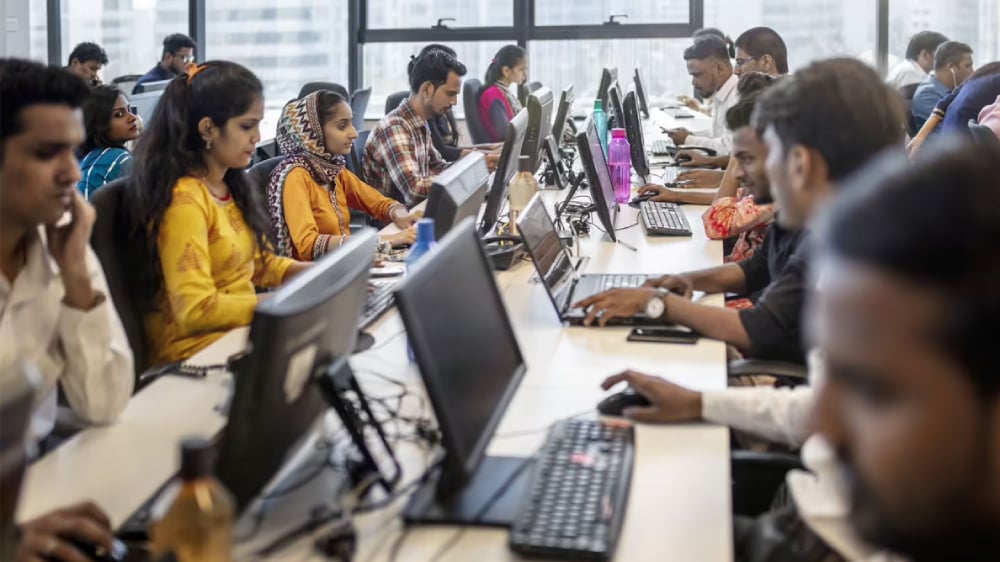
Redditors share Singaporeans losing jobs to neighbouring SEA countries amid offshoring trend
A Reddit thread has sparked discussion over increasing job offshoring from Singapore to cheaper Southeast Asian countries, with users sharing firsthand accounts of roles in IT, finance, and administration shifting to Malaysia, Vietnam, and the Philippines due to rising local costs.


A recent Reddit discussion has brought to light mounting concerns among Singaporeans over the offshoring of local jobs to neighbouring Southeast Asian countries.
On 6 June 2025, a Redditor initiated a thread titled “Is SG losing jobs to neighbouring SEA countries?”, sharing anecdotal evidence of job shifts from Singapore to countries like Malaysia.
The original post described two instances: a cybersecurity company laying off local managers and rehiring in Malaysia, and a firm with a significantly larger overseas workforce than its Singapore base.
These examples prompted the user to question whether this pattern was becoming the norm and to ask how such trends might impact the local job market.
Is SG losing jobs to neighbouring SEA countries?
byu/roflmctofl inaskSingapore
Redditors claim IT, finance, and operations roles increasingly moved abroad
Other Reddit users responded with their own experiences, particularly in technical and operational fields.
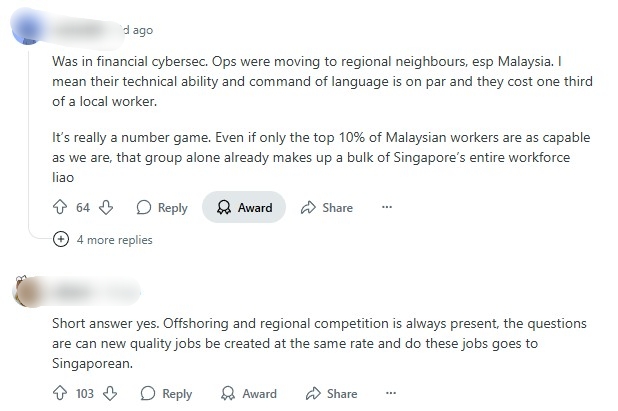
A self-proclaimed professional in financial cybersecurity noted that many operations were being moved to Malaysia.
According to the user, “Their technical ability and command of language is on par and they cost one-third of a local worker.”
He continued, “It’s really a numbers game. Even if only the top 10% of Malaysian workers are as capable as we are, that group alone already makes up a bulk of Singapore’s entire workforce.”
Another Redditor confirmed, “Short answer: yes,” adding that offshoring and regional competition were not new.
They raised concerns about whether new quality jobs were being created quickly enough and whether these jobs were actually going to Singaporeans.

Alleged union member shares direct account of workforce displacement
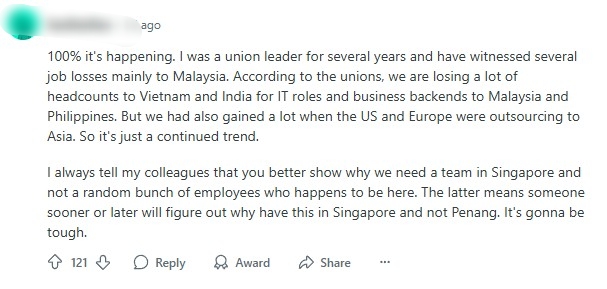
One user, identifying as a former union leader, stated the phenomenon is “100% happening.”
He shared having personally witnessed several cases of job losses, particularly to Malaysia, Vietnam, India, and the Philippines.
“IT roles and business backends are moving out,” the user claimed, while also noting that Singapore had previously benefited from similar offshoring when the US and Europe outsourced to Asia.
He added, “It’s just a continued trend. I always tell my colleagues you better show why we need a team in Singapore and not a random bunch of employees who happen to be here.”
“If not, someone will figure out why have this in Singapore and not Penang. It’s gonna be tough.”
Local job functions cut, quality compromised to save costs
Multiple users commented on direct experiences with job outsourcing within their companies.
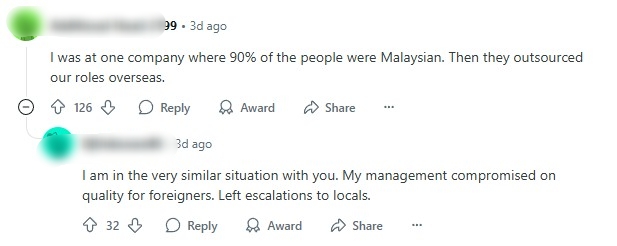
One said he worked in a company where 90% of the workforce were Malaysians, and later, even those roles were outsourced overseas.
Another stated, “My management compromised on quality for foreigners. Left escalations to locals.”
Users also cited past examples, such as European firms setting up base in Singapore with just a handful of executives managing teams in Vietnam and the Philippines remotely.
“These companies value Singapore’s stability and transparency,” one wrote, “but can’t justify the cost of staffing large teams here.”
Administrative functions such as accounting are reportedly being moved out as well.

Cost pressure and evolving tax incentives reshape employment decisions
Several Redditors pointed to broader economic pressures as causes behind the trend.
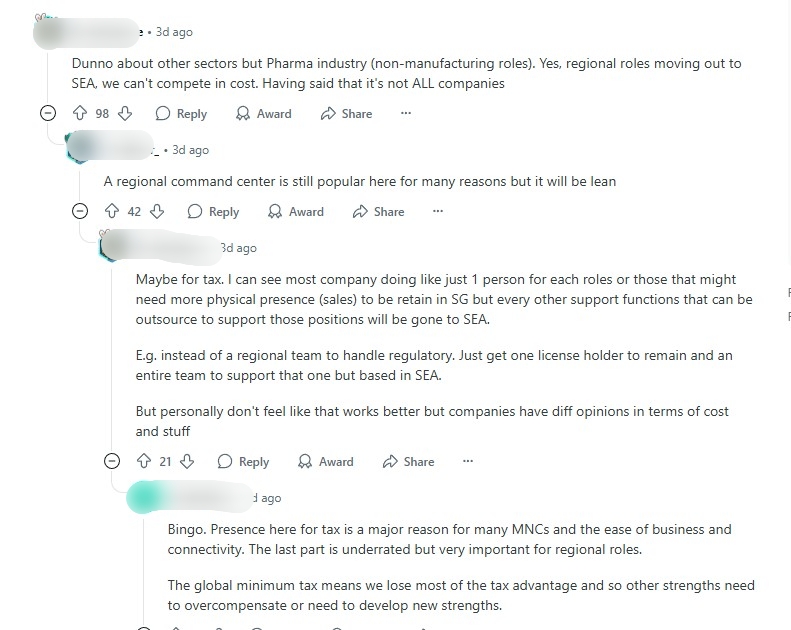
Roles not requiring physical presence or regulatory oversight are more likely to be offshored.
A user explained that the shift is also being influenced by global tax reforms.
With the global minimum tax rules taking effect, Singapore’s corporate tax incentives are less appealing, prompting firms to re-evaluate the need for a physical presence, the user suggested.
Singapore continues to attract regional headquarters, but these are increasingly leaner, as companies try to balance efficiency with compliance.
Locals voice discontent over stagnant wages and increased work stress
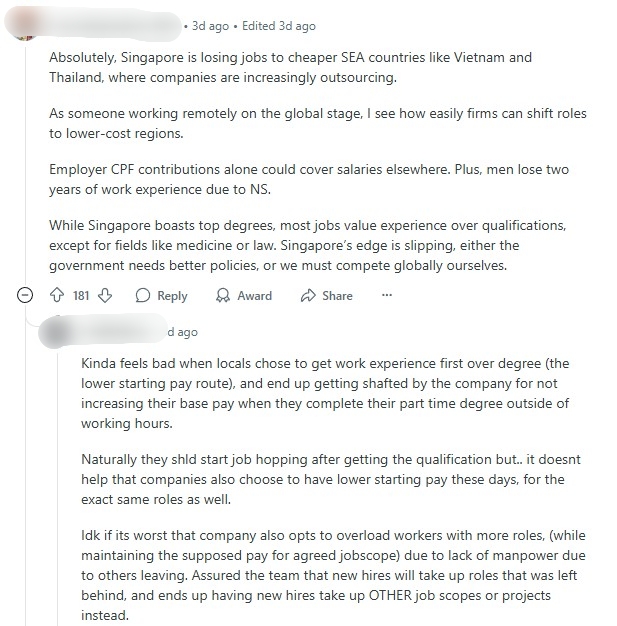
Some comments expressed frustration over stagnant wages despite increasing job responsibilities.
One noted that many Singaporeans, despite holding top academic qualifications, fall short in a global market that values practical experience.
Another user highlighted challenges faced by those pursuing part-time degrees while working, only to find limited career progression.
With workloads rising due to staff shortages, the sentiment is growing that Singaporeans are under pressure to do more for less.
Several users called for stronger government action to support employment, while others emphasised the need for individuals to adapt quickly or risk being left behind.
Debate over complacency, personal responsibility, and government policy
A recurring theme among users was the perception that some Singaporeans may have become complacent.
One Redditor argued that relying too much on government support has led locals to underestimate regional competition.
The user criticised the belief that Singaporean workers are inherently superior, calling such a mindset outdated and unhelpful.
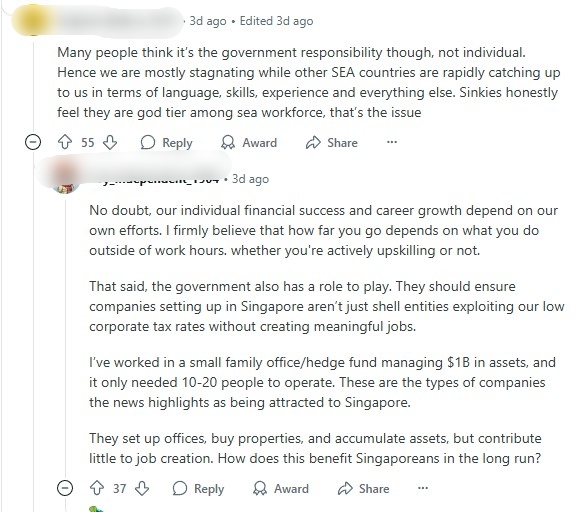
Another user took a more balanced view, urging individuals to take responsibility for upskilling and remaining relevant.
However, the user also highlighted the role of government in regulating companies that exploit low tax rates while offering few jobs to locals.
The user wrote, “I’ve worked in a small family office managing US$1 billion. It only needed 10–20 staff. These are the firms highlighted as success stories, but they don’t generate meaningful employment.”
Mid-level jobs face increasing risk of offshoring
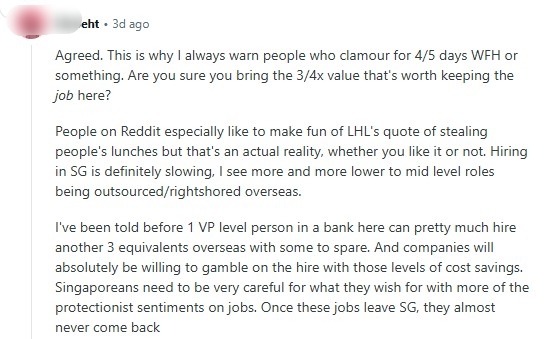
Another user pointed out that it is not just entry-level positions being outsourced.
“More mid-level jobs are going too,” the user warned, citing banking and tech roles.
The Redditor noted that employee demands for flexible work arrangements may further accelerate offshoring if locals fail to provide extra value.
“Companies will move the job,” he added, “and once it’s gone, it doesn’t come back.”
The user urged workers to be more pragmatic and accept that job security now depends on global competitiveness.
Talent shortages and wage gaps behind overseas hiring
One Redditor, likely an employer or HR professional, shared that he had to retrench seven local staff due to financial pressures.
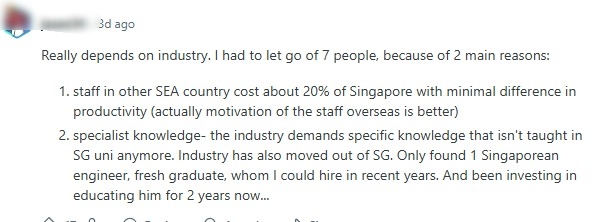
The user explained that overseas hires, at only 20% of the cost, often outperformed locals in motivation and productivity.
The comment also highlighted a growing gap in local talent, noting that certain specialist knowledge is no longer taught in Singapore universities.
"Only found 1 Singaporean engineer, fresh graduate, whom I could hire in recent years. And been investing in educating him for 2 years now..."