SMRT to be fined S$3 million over maintenance and system lapses in 2024 East-West Line disruption
SMRT faces a S$3 million fine after a six-day MRT disruption in September 2024. LTA found the train involved had missed a scheduled overhaul, while TSIB cited weak response protocols to warning systems. The incident affected nine stations, impacting 500,000 daily journeys and requiring extensive repairs.

SMRT will be fined S$3 million following a six-day disruption on the East-West Line in September 2024.
The Land Transport Authority (LTA) announced the penalty on 3 June 2025, citing serious lapses in maintenance practices and system response.
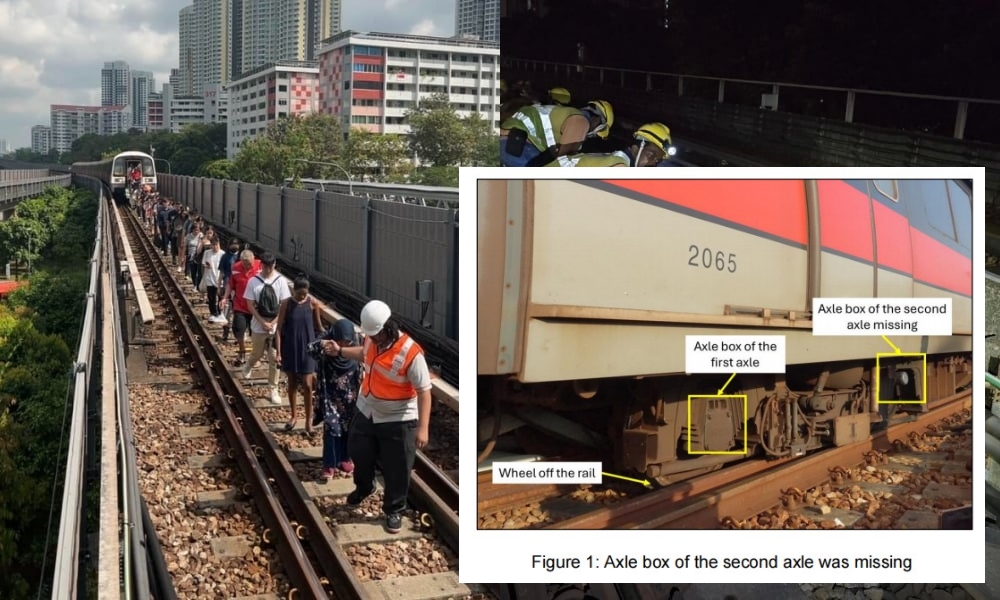
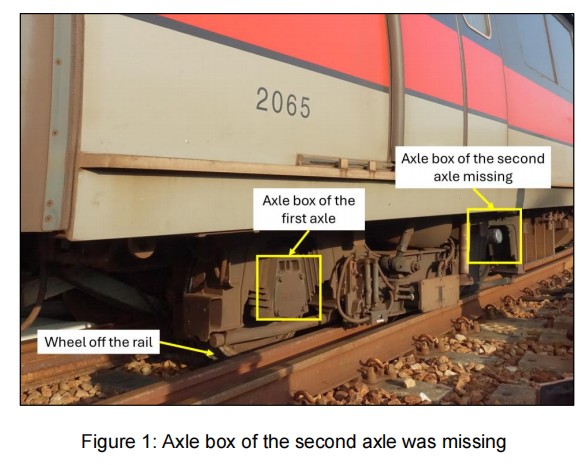
On 25 September 2024, a key component known as an axle box dropped from a train travelling between Dover and Clementi MRT stations.
This dislodgement caused the bogie—an undercarriage structure with wheels—to come off the rail, damaging the tracks and forcing a major service disruption.
Nine stations between Boon Lay and Queenstown were affected, with normal service only resuming six days later on 1 October 2024.
About 500,000 of the 2.8 million daily journeys were disrupted each day.
Ageing fleet and delayed replacement
The train involved was part of SMRT’s first-generation KHI fleet, in operation since the late 1980s.
These trains were due to be replaced by newer Movia models, with full handover originally scheduled by March 2024.
However, due to delays from the COVID-19 pandemic, the first Movia train was only delivered in May 2023, over a year behind schedule.
As a result, SMRT continued to operate some older trains, including the one involved in the incident.
LTA found that the failed train had not undergone a scheduled overhaul despite being overdue.
While overhauls are required every 500,000km, SMRT extended this interval twice—first to 575,000km in August 2022, then to 750,000km in August 2024.
At the time of the incident, the train had clocked 690,000km since its last overhaul in 2018.
By then, only 18 of the 66 KHI trains had been overhauled. The train involved was not among them.
SMRT extended these intervals based on internal analyses and fleet performance data.
However, LTA said no detailed engineering risk assessment was carried out regarding the axle box overhaul interval.
Axle box damage and root cause analysis
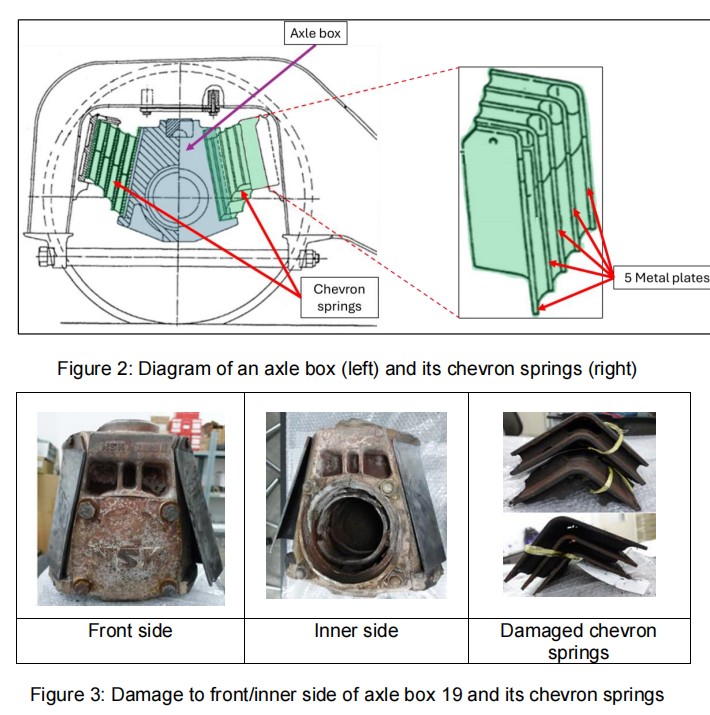
Investigators could not determine the precise cause of the axle box failure as the components were too severely burnt and damaged.
These included the axle box itself, axle bearings, and chevron springs—critical parts within the bogie assembly.
Nonetheless, LTA concluded that the likely cause was degraded grease inside the axle box.
Grease degradation increases friction, which in turn accelerates wear and tear on components, potentially causing overheating.
High heat and burnt materials found along tracks
Burnt rubber and metal fragments from the chevron springs were discovered along the train’s travel path.
This suggests the axle box had overheated to the point of igniting surrounding rubber components.
The degraded grease likely contributed to the axle box becoming dislodged, said LTA.
The train’s third carriage bogie came off the tracks, damaging a 2.55km stretch and causing 46 rail breaks.
Warning system failure contributed to delay in response
On the morning of the incident, SMRT’s Hot Axle Box Detection system recorded a temperature spike—118 degrees Celsius compared to the usual 30–65 degrees Celsius range.
This system uses infrared sensors to detect axle box heat and RFID tags to identify affected trains.
However, due to a system error, the train’s ID was not detected. Instead, a “Null ID” appeared.
The controller overseeing the system mistook the alert for a false warning and did not act on it.
The Transport Safety Investigation Bureau (TSIB) said this issue had occurred previously but was not resolved.
Lapses in procedures and response protocols
TSIB noted that SMRT’s operational procedures regarding the Hotbox system were “not robust enough”.
There was no escalation protocol for unidentified warnings, leading to possible staff desensitisation to repeated false alerts.
Had the warning been addressed, the train could have been withdrawn before the axle box dislodged.
Both LTA and TSIB concluded that the incident could likely have been prevented with proper maintenance and a timely response to the warning.
Cost and consequences of disruption
The six-day disruption required extensive repair and recovery efforts.
SMRT provided free travel for affected passengers, including bridging buses, shuttle train services, and waived fares at Jurong East and Buona Vista stations.
The total cost of SMRT’s service recovery exceeded S$10 million.
Despite the high costs already incurred by SMRT, LTA determined the fine was warranted given the serious operational lapses.
The S$3 million fine will be channelled to the Public Transport Fund, which supports lower-income households with transport costs.
LTA noted that SMRT will have the opportunity to appeal the fine to the Minister for Transport.
The authority said its enforcement action considered both the operational failures and SMRT’s efforts at service recovery.
TSIB and LTA both emphasised the need for stricter adherence to maintenance schedules and more resilient fault detection procedures to prevent future incidents.
SMRT: Pandemic-related delays and ageing assets posed challenges to overhaul and train replacement efforts
SMRT acknowledged LTA’s findings in a Facebook post on Tuesday, affirming its commitment to safety and operational excellence.
The operator emphasised that safety remains its top priority, alongside balancing service reliability and cost-effectiveness.
SMRT cited the COVID-19 pandemic as a major factor in disrupting train and spare part deliveries, which affected overhaul timelines.
Despite continued regular maintenance, these delays hindered the overhaul of first-generation trains post-2018.
SMRT stated it is working closely with LTA to renew assets, improve maintenance, and expedite new train commissioning, aiming to retire all first-generation trains by end-September 2025.
The operator added it remains committed to continuous improvement, guided by Kaizen principles, to strengthen system resilience.