Singapore ranked world’s 3rd happiest city, but netizens challenge claim over cost and stress
Singapore has been named the third happiest city globally in the Happy City Index 2025, but many netizens have criticised the ranking, citing high living costs, mental health strains, and daily pressures. They argue the results do not reflect their lived experiences.
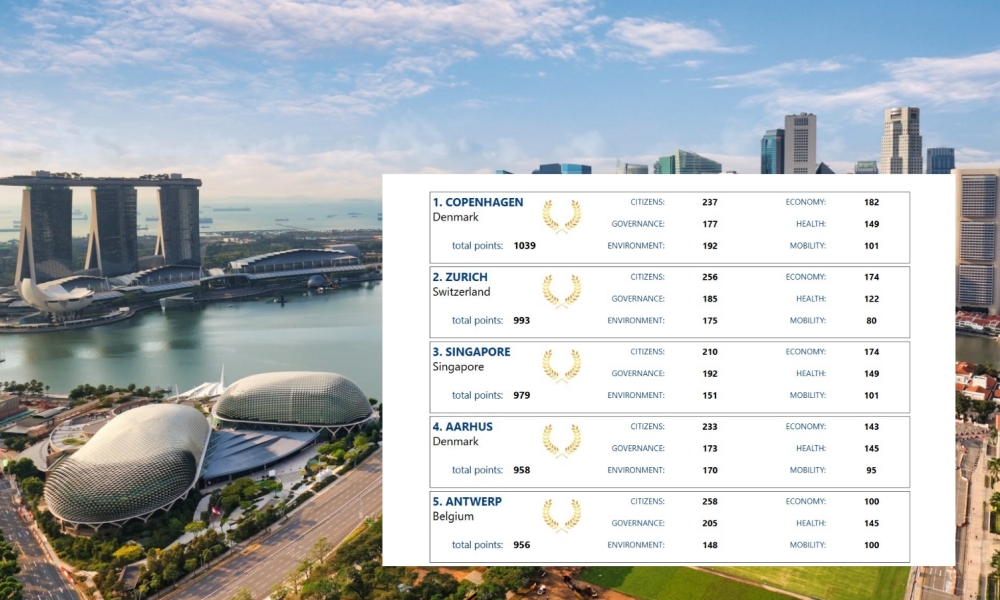

Singapore has been ranked the third happiest city in the world for 2025, according to the Happy City Index by the London-based Institute for the Quality of Life. However, many netizens voiced scepticism online, pointing to cost of living, overwork, and stress. Some questioned whether the study reflects real-life happiness or only technical indicators. Released on 17 May and reported by CNA, the index examined 82 indicators across six categories: citizens, governance, environment, economy, health, and mobility. Copenhagen and Zurich secured the top two positions, while Seoul and Taipei were also in the top ten, at sixth and eighth places respectively.
Singapore praised as “global beacon of economic prosperity, governance & urban innovation”
Singapore earned 979 points and was described as a “global beacon of economic prosperity, governance and urban innovation”. The city-state was lauded for its education system, multilingualism, digitalisation, healthcare accessibility, and infrastructure. Its universities ranked among the world’s top 50, while over 63 percent of residents speak at least one foreign language. Innovation was another strength, with Singapore granting 7.37 patents per 10,000 residents. Governance and transparency were highlighted, with civic engagement and a comprehensive open data ecosystem noted as standouts. More than 8,000 datasets are publicly available, and digital services have become central to everyday interactions with authorities. Healthcare was newly included in the 2025 index. Singapore scored well, with universal medical insurance, a life expectancy of 83 years, and an obesity rate among the lowest globally. The report also noted ongoing improvements in mental health services, with 15 percent of adults receiving coordinated care. Public health campaigns and community outreach programmes were cited for their effectiveness. The city also scored high for safety, reporting only 3.31 incidents of public violence per 1,000 residents. On mobility, Singapore’s traffic and transport systems were recognised as among the most advanced worldwide. Features such as intelligent traffic control, seamless e-payment, and full accessibility for disabled commuters were mentioned. Traffic fatality rates remain low, at just 0.24 per 10,000 residents. Environmental sustainability was another pillar of the index. Singapore was praised for renewable energy use and biodiversity efforts. Waste management remains a challenge, but the report noted improved recycling rates. Among the 31 cities designated “Gold Cities”, Singapore retained its place, having improved significantly from its prior ranking of 34th out of 37 in a past edition.Public scepticism over ‘happiest city’ label highlights disconnect with daily experiences
However, the ranking sparked criticism from Singaporeans online. On social media platforms like Facebook and TikTok, many questioned whether the label “happiest” matched their daily realities. Comments on CNA’s Facebook post included remarks about the rising cost of living, overwork, and emotional strain. Some users questioned, “Since when did we feel happy?” and suggested that the report ignored the lived experiences of average citizens.
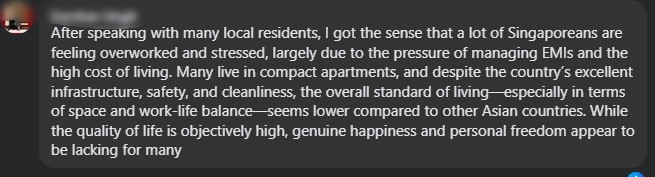 Some ridiculed the survey, speculating whether it had only included wealthy individuals or government ministers.


 Others noted that the index measures infrastructure and institutional quality, not happiness per se.
Indicators such as the number of cultural venues or the efficiency of public transport may correlate with well-being but don’t always translate into felt happiness.
A common critique was that “the human factor” was missing from the index’s methodology.
Others noted that the index measures infrastructure and institutional quality, not happiness per se.
Indicators such as the number of cultural venues or the efficiency of public transport may correlate with well-being but don’t always translate into felt happiness.
A common critique was that “the human factor” was missing from the index’s methodology.
 One viral TikTok post highlighted daily struggles like crowded MRT commutes and long working hours.
The user quipped that he would only be happy “when he could sleep 12 hours, touch CPF, and see his salary rise instead of just GST.”
Others mocked the CNA report as a “false article", arguing that while Singaporeans appreciate safety and order, many still experience high stress and burnout.
They suggested a more fitting description might be “content” or “secure”, rather than “happy”.
One viral TikTok post highlighted daily struggles like crowded MRT commutes and long working hours.
The user quipped that he would only be happy “when he could sleep 12 hours, touch CPF, and see his salary rise instead of just GST.”
Others mocked the CNA report as a “false article", arguing that while Singaporeans appreciate safety and order, many still experience high stress and burnout.
They suggested a more fitting description might be “content” or “secure”, rather than “happy”.