TikTok user questions Singapore’s “cleanest city” reputation with footage of trash in Boat Quay
A TikTok video showing a pile of trash in Boat Quay challenges Singapore’s image as the 'cleanest city in the world.' The video has garnered mixed reactions, with some blaming foreigners for the trash, while others note that being the 'cleanest' doesn’t mean there’s no trash.
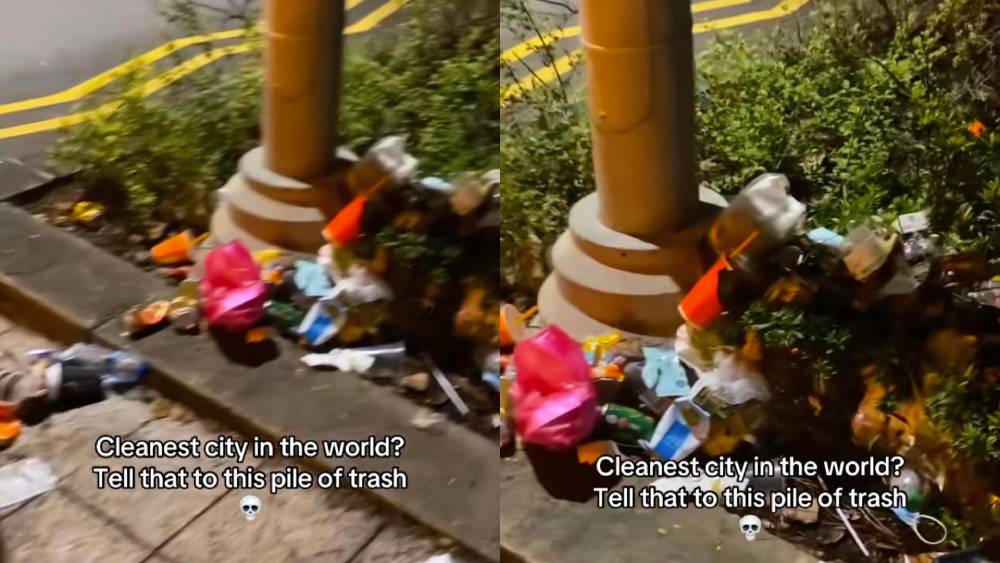

SINGAPORE: Singapore is often praised for its spotless streets and its status as one of the cleanest cities in the world, but one TikTok user is challenging that image. On 8 May, TikTok user izamo69, who goes by Isabelle, uploaded a video showing a pile of rubbish reportedly found in the Boat Quay area. The caption on the video reads, "Cleanest city in the world? Tell that to this pile of trash." Boat Quay is a well-known tourist hotspot, popular for its riverside restaurants and nightlife, particularly among expatriates. In the video, Isabelle, who describes herself as a "local ang moh" in her other TikToks, comments that those who claim Singapore is the cleanest city in the world likely haven’t encountered scenes like this. "People who say that Singapore is the cleanest city on this planet, you guys haven’t seen this. Like, even though it’s Singapore, stuff like this still happens."
Singapore's reputation for cleanliness has been solidified by several surveys and reports. According to the 2021 Time Out Index survey, 62% of respondents voted Singapore as the world’s cleanest and greatest city. The city also ranked 24th on the world’s best cities list, based on responses from 27,000 city dwellers who answered questions about life, culture, dining, nightlife, relationships, community, and local neighbourhoods. In 2025, Singapore was named the world’s cleanest tourist city by a report from Eagle Dumpster Rental, a US-based waste management company. The rankings were based on factors such as street cleanliness, waste management practices, perceptions of public cleanliness, and waste generation per capita. The report drew on data from Numbeo’s quality of life database, Atlas D-Waste’s solid waste management database, and city-specific resources.Mixed Reactions After TikTok Video Shows Trash in Boat Quay
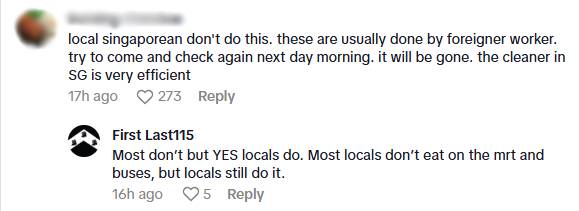
The video, which garnered over 269 thousand views, sparked a flurry of comments from netizens. Many noted that Boat Quay is a tourist hotspot and blamed foreign visitors for the litter, arguing that most locals would not dare to litter due to the hefty fines in Singapore.
 “Most Singaporeans won’t do this, the fine is real if you’re being caught,” one user remarked.
 Under the Environmental Public Health Act, any individual committing a littering offence is liable to a Court fine of up to $2,000 for a first conviction, $4,000 for a second conviction, and $10,000 for subsequent convictions.
However, others pushed back, saying that locals are not entirely blameless.
Under the Environmental Public Health Act, any individual committing a littering offence is liable to a Court fine of up to $2,000 for a first conviction, $4,000 for a second conviction, and $10,000 for subsequent convictions.
However, others pushed back, saying that locals are not entirely blameless.
 Some users reassured others that the trash would likely be cleared quickly.
One commented, “Try to come and check again the next morning. It will be gone.”
Some users reassured others that the trash would likely be cleared quickly.
One commented, “Try to come and check again the next morning. It will be gone.”
 Some users pointed out that Singapore is not alone in facing cleanliness challenges, especially in areas frequented by tourists.
One commenter shared, “Sadly, this happens in Japan as well. Due to tourism, cleaning and clearing efforts can’t keep up with the rising waves of visitors.”
Some users pointed out that Singapore is not alone in facing cleanliness challenges, especially in areas frequented by tourists.
One commenter shared, “Sadly, this happens in Japan as well. Due to tourism, cleaning and clearing efforts can’t keep up with the rising waves of visitors.”

Defending Singapore’s Cleanliness
Many users came to Singapore’s defence, arguing that being the “cleanest city” does not mean there will never be any trash — just as “low crime” does not mean “no crime.”
 One user said, “It happens in every country, even the cleanest ones.”
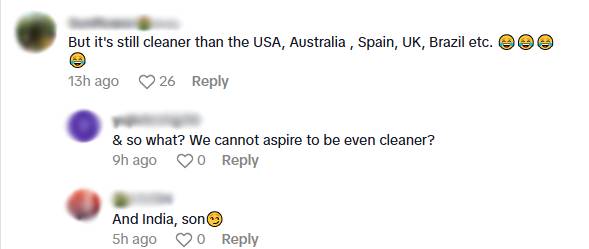
 Some users commented that being the “cleanest city” doesn't mean no rubbish, but it means cleaner when compared to other cities.

 One user stated, “But it’s still cleaner than the USA, Australia, Spain, UK, Brazil, etc.”
Concerns Over Declining Standards
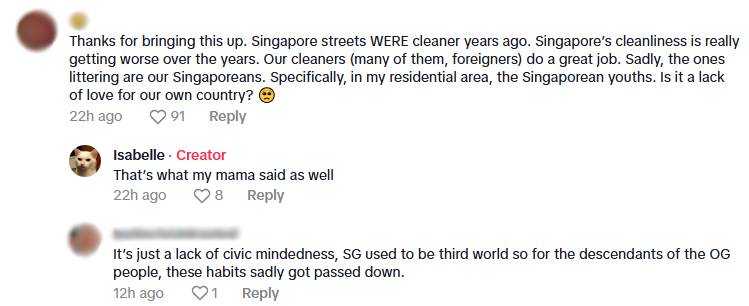
However, not everyone agreed that Singapore’s cleanliness was still on par with its past standards. Some felt the city had become dirtier in recent years. One user wrote, “It used to be the cleanest, but now the focus seems more on construction than cleanliness. You should see the regular HDB blocks — rats everywhere.” Another user added that Singapore’s streets were cleaner in the past, and the cleanliness has noticeably worsened over the years.
They praised the cleaners, many of whom are foreigners, for doing a great job. However, they pointed out that the littering problem is often caused by Singaporeans, especially youths in their residential area.
The user questioned whether this behavior reflects a lack of love for the country.
Another user added that Singapore’s streets were cleaner in the past, and the cleanliness has noticeably worsened over the years.
They praised the cleaners, many of whom are foreigners, for doing a great job. However, they pointed out that the littering problem is often caused by Singaporeans, especially youths in their residential area.
The user questioned whether this behavior reflects a lack of love for the country.