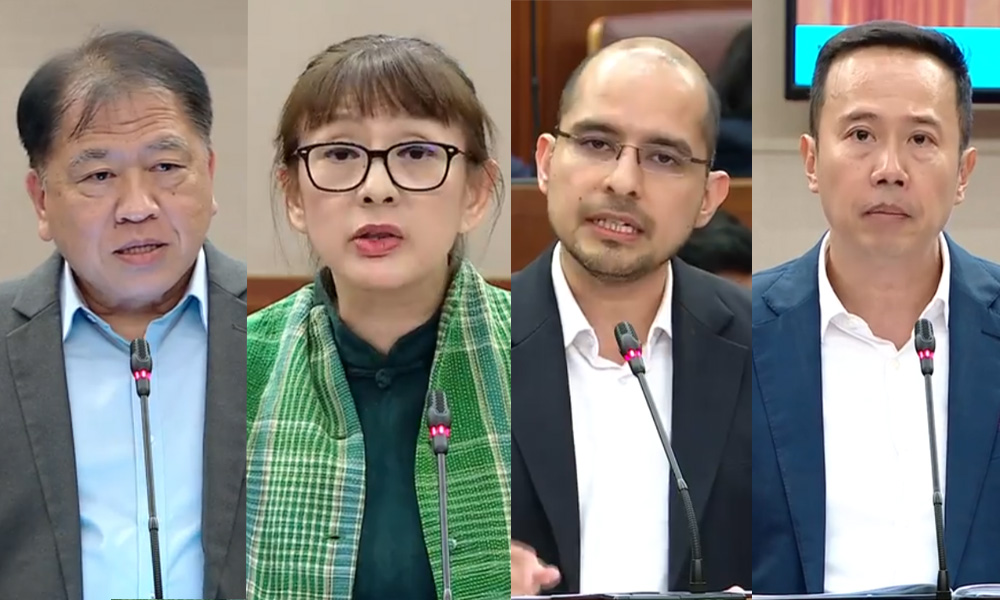
Ravi Philemon to lead Red Dot United team in Nee Soon GRC for GE2025
Red Dot United has finalised its team for Nee Soon GRC in the upcoming general election, with secretary-general Ravi Philemon leading the five-member slate that includes party chairman David Foo and three other candidates.
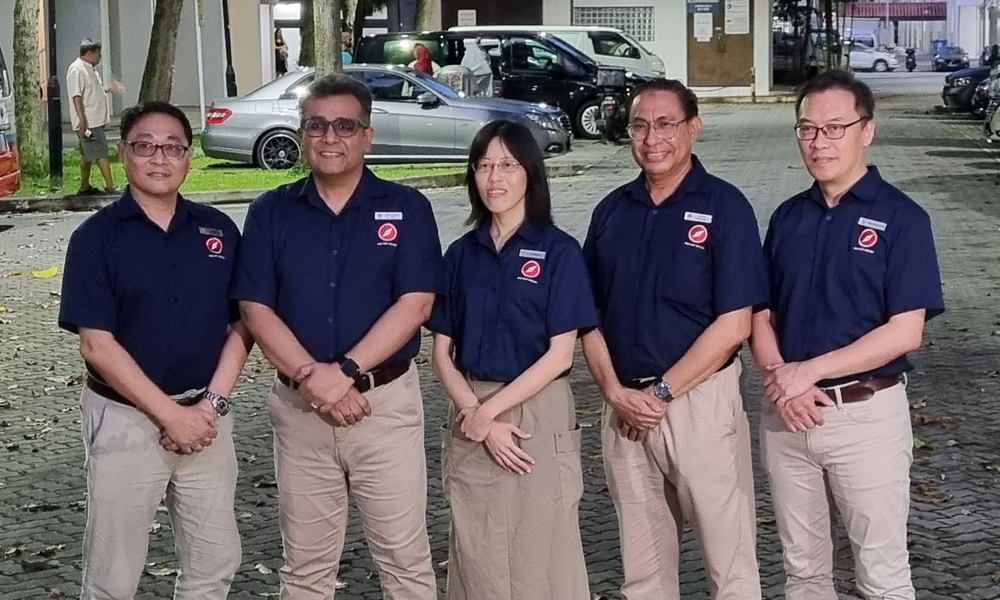

Red Dot United (RDU) secretary-general Ravi Philemon will lead his party’s team in Nee Soon GRC for the general election, which is scheduled for 3 May.
This five-member slate includes party chairman David Foo, and finalises RDU’s line-up ahead of Nomination Day on 23 April.
Philemon, 56, described Nee Soon GRC as the “heart” of RDU’s GE2025 campaign. He is joined by Dr Syed Alwi Ahmad, 57, a private school teacher and RDU’s head of policy and its Malay bureau; Pang Heng Chuan, 56, a tech start-up business director; and Sharon Lin, 40, a senior IT consultant.
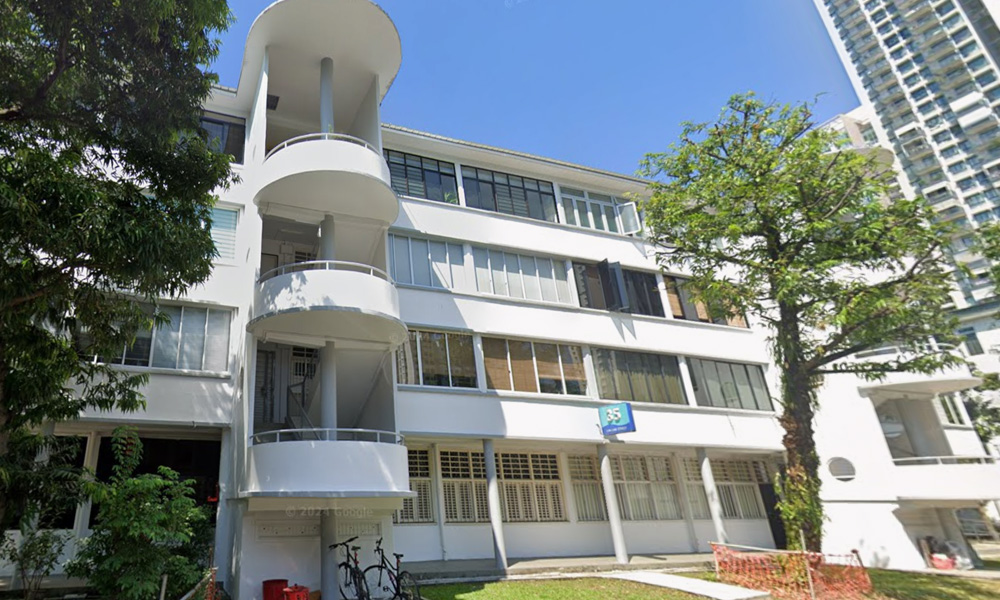
Their candidacies were confirmed on 20 April in a media briefing at Block 701c, Yishun Avenue 5.
Philemon, the managing partner of a media business, is expected to outline campaign plans and policy priorities.
He previously led RDU in Jurong GRC during the 2020 election, where the team was defeated by the People’s Action Party (PAP) led by then-cabinet minister and current President Tharman Shanmugaratnam.
Foo, 60, a chemist, contested in Jurong GRC under the Singaporeans First (SingFirst) party during GE2015. SingFirst was dissolved in 2020.
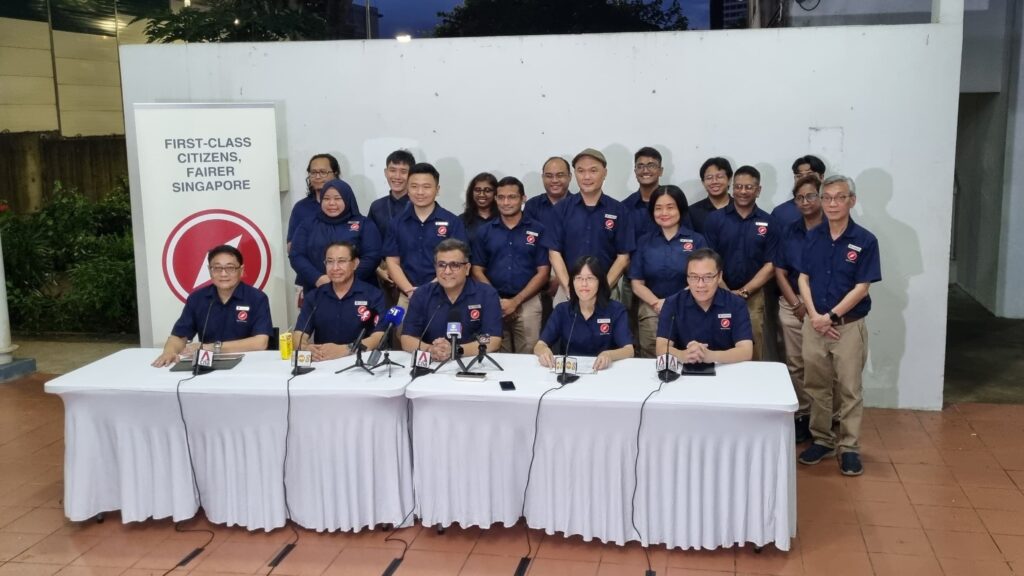
Speaking at the press conference, Philemon said RDU began working the ground in Nee Soon in August 2024 during National Day, but acknowledged the challenges of covering a constituency with over 150,000 voters.
“Honesty builds trust. I don’t want to say we’ve been to every block, but we will make that effort—regardless of how the contest turns out,” said Philemon. “This is the kind of ethos we bring to residents in Nee Soon GRC.”
Philemon noted that while the PAP team, led by Minister for Law and Home Affairs K Shanmugam, holds a strong incumbent presence, “there can only be one Shanmugam—there cannot be five Shanmugams.” He added, “Whereas here at Red Dot United, we are a team. There are no divas.”
Dr Foo said the team’s approach goes beyond slogans, calling the election “a contest of honesty and truth.”
“The biggest problems Singapore faces today are not just technical. They are deeply human,” he said. “We believe in growth, but not growth for growth’s sake. We believe in growth with equity—growth for the people, not just for the numbers.”
Dr Syed Alwi raised concerns over recent developments in energy policy, particularly the government's interest in nuclear energy.
“Fairness doesn’t mean every outcome is equal. It means we don’t leave people behind. It means we don’t design systems that work only for those who already have an advantage. And it means we don’t make high-stakes decisions—like building a nuclear power plant—without involving the people who will have to live with the consequences,” he said, noting the serious risks involved and questioning what Singapore plans to do with the nuclear waste.
Philemon elaborated further during the Q&A session, where he noted, “We’re not saying no to nuclear energy. We’re saying: have a discussion with the public first. Be transparent,” he said.
Pang, who has spent 25 years in business transformation, warned against Singapore becoming a nation reliant on handouts.
“Is this the future we want? Where dignity is replaced by dependency?” he asked. “We need a new social contract—one where growth benefits everyone, not just a privileged few.”
Lin, who spoke candidly about her humble upbringing and early struggles, said she joined the opposition after seeing how policies directly affected ordinary lives.
“I come from an ordinary family. We had to skip meals and survive on instant noodles. But I kept going,” she said. “Leadership isn’t about titles. It’s about having the courage to speak up and offer a different perspective.”
Philemon closed the briefing by framing the election as a fight for values—not vibes.
“This contest is not about whether Mr. Shanmugam is nice or not. It’s about the kind of Singapore we want our children to inherit,” he said. “We work some of the longest hours in the world. Why can’t we have a better quality of life?”
He added that Nee Soon GRC, with its large and diverse population, represents a microcosm of Singapore and is a fitting battleground to articulate RDU’s vision.
RDU had announced on 19 April that it would contest five constituencies: Nee Soon GRC, Holland-Bukit Timah GRC, Jurong East-Bukit Batok GRC, Jurong Central SMC, and Jalan Kayu SMC.
Its 24-page manifesto includes several major policy proposals.
Key among them are an unconditional cash transfer to all Singaporeans; a proposal to make all HDB flats eligible for redevelopment under the Selective En bloc Redevelopment Scheme (SERS); and reforming MediFund to serve as the primary healthcare safety net for all Singaporeans.
At the 2020 general election, the PAP secured Nee Soon GRC with 61.9 per cent of the vote, defeating a team from the Progress Singapore Party.
The PAP slate then included Shanmugam, Minister of State for Home Affairs and National Development Muhammad Faishal Ibrahim, Louis Ng, Derrick Goh, and Carrie Tan.
For GE2025, the PAP line-up is expected to undergo significant changes.
Shanmugam told reporters on 19 April that the new PAP team is likely to include four fresh faces. The official announcement will be made at a press conference on 21 April.
The expected candidates are Syed Harun Alhabsyi, 40, a former Nominated MP; Goh Hanyan, 39, a former director at the Ministry of Digital Development and Information; Jackson Lam, 40, who runs a pest control and cleaning firm; and Lee Hui Ying, 36, who works at Temasek Foundation.