IMF chief warns of global growth hit from tariffs but rules out recession risk
IMF chief Kristalina Georgieva says global growth will slow due to US tariff plans but a recession is not expected. Trade tensions, she warned, are causing uncertainty and eroding productivity, especially for smaller economies dependent on global trade.
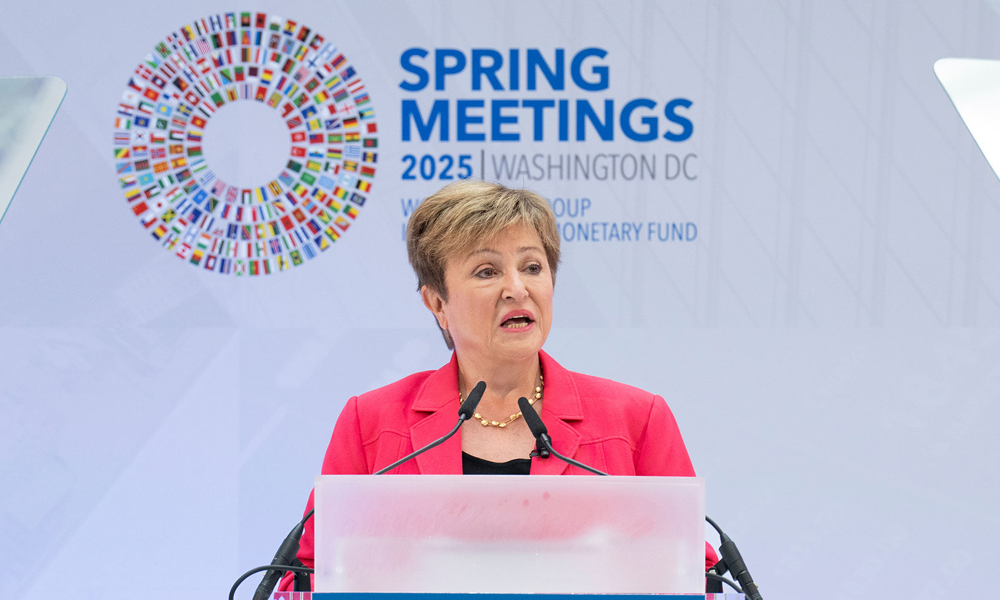

The head of the International Monetary Fund (IMF), Kristalina Georgieva, has said that while global economic growth will likely see "notable" downgrades due to escalating US tariff actions, a recession is not currently on the horizon.
Speaking in Washington on 17 April, ahead of the IMF and World Bank Spring Meetings, Georgieva addressed mounting global concerns about economic fragmentation, warning that protectionism, uncertainty, and market volatility are exerting significant pressure on smaller economies and emerging markets.
The remarks follow the recent rollout of stop-start US tariff plans under President Donald Trump, which have led to market turbulence at levels not seen since the COVID-19 pandemic.
Although the specific tariffs were not detailed, their cumulative effect has triggered a sharp rise in the effective tariff rate in the US, according to IMF data.
Georgieva outlined three principal consequences of heightened trade tensions.
Firstly, she emphasised that uncertainty imposes a substantial cost. The unpredictable nature of shifting tariff regimes makes it difficult for firms to plan investments or manage supply chains. As a result, some companies delay key decisions, which can slow economic momentum.
Secondly, she noted that increasing trade barriers hit economic growth immediately. Tariffs, she explained, raise revenue but at the expense of reducing or diverting economic activity. Consumers and importers often bear the cost through higher prices and reduced profitability.
Thirdly, over the long term, protectionist measures erode productivity, especially in smaller, open economies. By shielding domestic industries from foreign competition, these policies can discourage innovation and reduce efficiency.
"Perceptions matter as much as reality," Georgieva said, urging governments to communicate clearly with their citizens to counter falling consumer confidence, particularly in the United States.
She added that the IMF's forthcoming World Economic Outlook, due to be published on 22 April, will include downward revisions to global growth projections and upward adjustments to inflation forecasts for several countries.
Despite these challenges, Georgieva maintained that the global economy retains its resilience. She cited strong fundamentals and policy agility as critical tools for navigating current volatility and encouraged countries to take coordinated actions to address imbalances and fiscal vulnerabilities.
For example, the IMF has advised China to shift its growth model by boosting private consumption and reducing reliance on exports and state support. This includes strengthening social safety nets and addressing weaknesses in the property sector.
The European Union, according to Georgieva, should deepen its internal market, including banking and capital market integration, while Germany is encouraged to engage in fiscal expansion, particularly in defence and infrastructure.
In the United States, she highlighted the urgent need to bring federal government debt onto a declining trajectory. This would involve significant budget reforms and could enhance economic resilience and reduce the current account deficit.
Georgieva also stressed the importance of monetary policy credibility, fiscal discipline, and structural reform, especially in low-income countries facing severe budget constraints and reduced aid flows. She noted that 48 countries currently rely on IMF support, with Argentina's programme being the largest and most recent.
A key message in her speech was the need to avoid a global drift toward economic division. Instead, she called for a renewed commitment to open trade and cooperation among major economic powers.
"In trade policy, the goal must be to secure a settlement among the largest players that preserves openness and delivers a more level playing field," she said.
This means reducing both tariff and nontariff barriers while providing time for private firms to adapt.
Georgieva concluded by urging all countries to embrace reform and invest in the future rather than attempt to preserve outdated systems.
“The secret to seizing the moment is to focus all energy not on preserving the old, but on building the new—a better balanced and more resilient world economy,” she said.
The IMF’s Spring Meetings, beginning next week, will offer a forum for dialogue among its 191 member countries at a time when multilateral cooperation is viewed as essential to overcoming shared challenges.