Filmed, encircled, and dismissed: Activists push back against Shanmugam’s framing of MPS confrontation
Two sisters who confronted Law and Home Affairs Minister K. Shanmugam at a Meet-the-People Session (MPS) on March 12 have spoken out against what they describe as intimidation and misrepresentation. Their experience, including being filmed against their wishes and facing public backlash, raises questions about the accessibility of political discourse in Singapore.
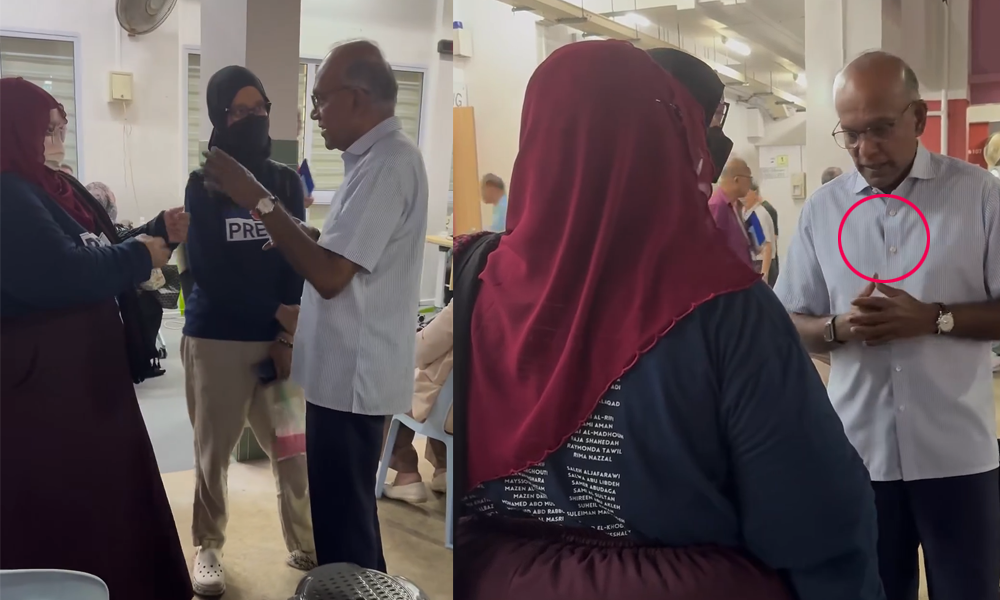

A heated exchange between two sisters and Law and Home Affairs Minister K. Shanmugam at his Meet-the-People Session (MPS) on 12 March has sparked widespread debate.
A seven-minute video posted by Shanmugam on Facebook shows the women, wearing shirts with the word "Press" in front and the names of journalists killed in Gaza on the back, approaching him to discuss the Protection from Online Falsehoods and Manipulation Act (POFMA).
The video shows them questioning the minister in a confrontational tone, while onlookers—including residents and volunteers—observe the exchange.
At one point, they show the middle finger and raise their voices as Shanmugam walks away.
In his Facebook post, Shanmugam said the women were not residents of his constituency and accused them of being part of a group that has attended multiple PAP Meet-the-People Sessions (MPS) in recent months to “deliberately confront, create incidents, and provoke.”
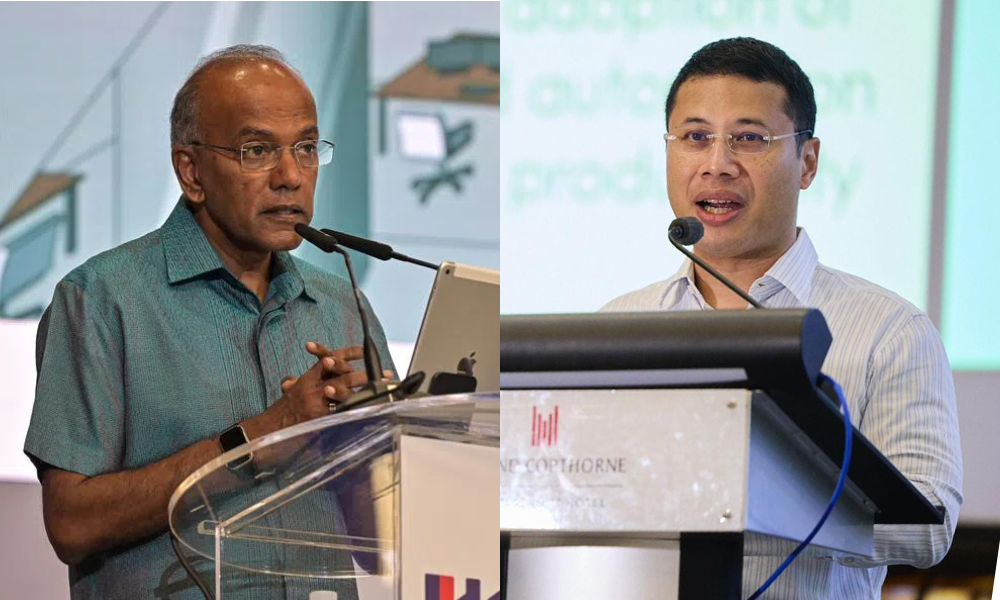
The People’s Action Party (PAP) also issued a statement identifying them as part of Mondays for Palestine Solidarity, a group that has reportedly attended more than 10 MPS sessions across different constituencies, including those of National Development Minister Desmond Lee and Minister for Digital Development and Information Josephine Teo.
The PAP accused the group of disrupting waiting areas, disturbing the queue system, filming, and raising their voices, which affected residents and volunteers.
In response, the two women have released their own account of the events in Friday evening, rejecting the government’s framing of the incident.
View this post on Instagram
Activists: We went in good faith, but were treated with hostility
The two activists stated that they attended the MPS with a clear and specific intention: to discuss their concerns over POFMA.
They emphasised that they were upfront about this from the beginning and had communicated their purpose to every volunteer who screened them before they were allowed into the session.
"We made that clear to every single volunteer that screened us (five of them),” they said.
They also stated that they understood the priority given to residents seeking assistance and assured volunteers that they were willing to wait until all other residents had been attended to before speaking with Shanmugam.
"We also made it clear that while we would like to see Shanmugam, we were okay with waiting until all the other residents had been seen first."
However, they said they were disappointed when Shanmugam left the MPS venue without addressing them. Despite this, they took the initiative to follow up with volunteers, leaving their contact details in hopes of scheduling an appointment.
"When he left, we were disappointed, but we still followed up with two of the volunteers, and we left our email addresses and phone numbers so that they could reach out to us and we could set an appointment," they explained.
They even asked the volunteers whether arranging a separate meeting at another time would be preferable to engaging him during the MPS.
According to them, this demonstrated their willingness to engage in good faith through proper channels. Yet, rather than being met with openness, they felt they were treated with undue suspicion and hostility.
This perception intensified when they saw Shanmugam return to the venue later, engaging with other residents before reaching them.
Though they initially considered leaving, they decided to stay in case he was willing to speak with them.
Allegations of intimidation and selective recording
When Shanmugam returned at around 8.15 pm, they decided to try again, but said the atmosphere changed immediately when they brought up POFMA.
“The situation escalated the moment we said we were there to speak about POFMA,” they said.
“The conversation went fine at first, but then we noticed he was pitching his voice down and standing really close. That’s when we realised he had a mic on his shirt.”
Looking around, they said they realised they had been encircled by security staff and PAP volunteers, some of whom began filming them.
“Anyone would have felt disturbed to be surrounded and filmed by multiple people, but we felt especially vulnerable as women,” they said.
They also questioned why only their interaction was filmed, stating, “We knew they were not residents who had come to see him because they were wearing the PAP lanyard. Why did they crowd around us like that? And what would they do with this video?”
When they asked for the filming to stop, Shanmugam allegedly responded, "They are entitled to record because this is a public space."
“On one hand, he checked to make sure we were not doing any audio/video recording, but yet his people could film us and create a hostile environment for us?” they said.
Shanmugam refuses immediate engagement, cites MPS rules
During their initial exchange outside the MPS venue, Shanmugam questioned the activists on whether they were residents of his constituency.
Upon learning that they were not, he informed them that MPS sessions were primarily meant for residents seeking assistance with their personal issues.
"I meet at Meet-the-People Sessions. Our rules [are that] we see our residents in order to deal with their problems," he told them.
The activists challenged this, stating that they had seen MPs engage with non-residents before.
"I know that for now, and I know it's not true. From different MPs, I've seen people from outside of constituency," one of them argued.
Shanmugam responded that while MPs generally attend to their own constituents, he had the discretion to meet with others. However, he made clear that his priority was seeing residents first.
"MPs are responsible for the residents in their own area… Otherwise, everyone will go and see the Prime Minister. It doesn’t work like that," he said.
Despite this, he told the activists that he would consider setting aside time for them later or arranging a separate meeting.
"If you specifically want to discuss with me, I don’t have any issue. I'll be happy to discuss with you… But if I don't have the time today, I'll give you a timing," he stated.
The activists, however, said that they felt his approach was dismissive, given that they had made their purpose clear to volunteers and had expressed willingness to wait.
Frustration, gestures, and accusations of provocation
As tensions rose, they admitted to reacting out of frustration, including making gestures at the cameras.
“We even made heart shapes with our fingers, but of course, everyone is fixating on the middle finger,” they said.
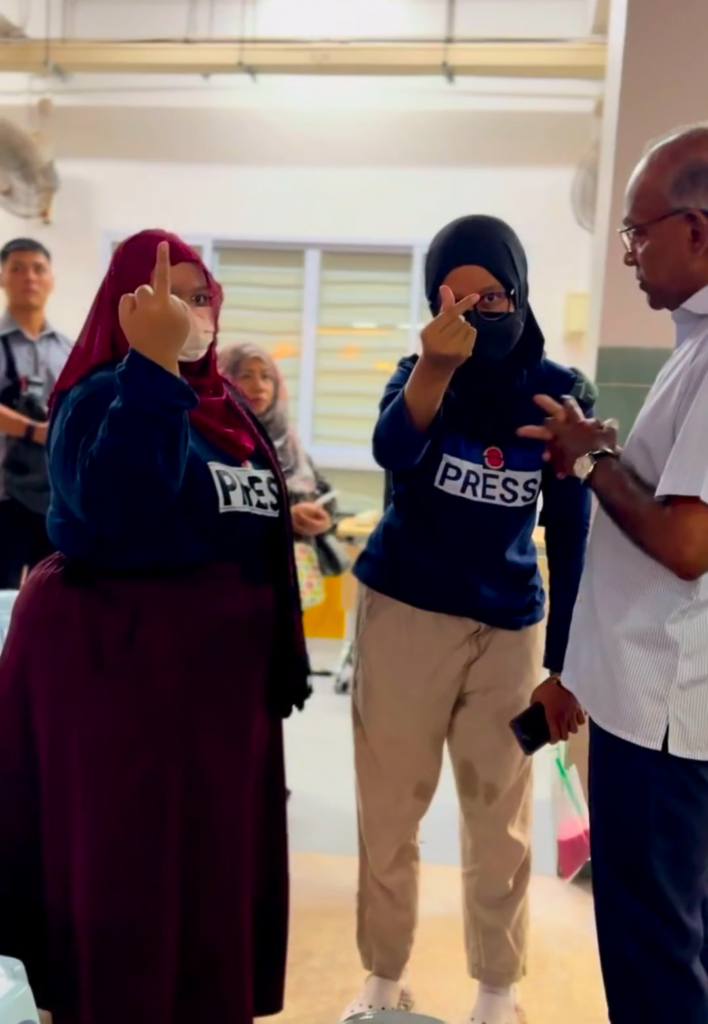
When Shanmugam attempted to leave, they shouted, calling him a "coward."
“We were angry,” they said.
“This is the same man who has been the strongest proponent of the death penalty and insists on continuing the execution of so many people under oppressive drug laws. The same man who is the architect of POFMA, a repressive law that has been used against people who have different views from the government.”
Activists describe meeting as an interrogation, not a conversation
Following the confrontation outside, the activists were eventually allowed into the MPS venue for a discussion with Shanmugam—which TOC understands to have lasted around half an hour.
However, they said the experience felt more like an interrogation than a genuine conversation.
"He had us surrounded by 14 other people, a few of whom were actively filming us and recording the meeting," they said.
Shanmugam allegedly justified this, saying it was "usual practice," which led them to question whether all MPS meetings were recorded in this manner.
Despite being outnumbered, they said they were repeatedly interrupted and unable to fully express their concerns.
"We could barely get a word in," they said. "He bulldozed over our attempts to speak."
According to the activists, Shanmugam dominated the discussion and repeatedly dismissed their concerns about POFMA.
"He told us POFMA is not state censorship and that we should be clear on the facts before attempting to engage him," they recounted.
However, they argued that POFMA has been used against statements that were widely understood to be opinions rather than factual falsehoods.
"We tried to explain that multiple statements, which we understood to be opinions, have been targeted by POFMA. But he refused to engage with that point."
The activists also took issue with Shanmugam’s claim that fighting a POFMA order was "affordable" and that individuals would not need legal representation.
"He even said it was affordable to fight POFMA and people would not need to engage a lawyer! I'm not sure in what world a $50,000 fine is affordable, but maybe it is to him," they said.
They also noted contradictions in his explanation of POFMA’s enforcement.
"He told us that as long as we complied with a Correction Order, there would be no fines or criminal charges. But we pointed out that Transformative Justice Collective (TJC) members were subjected to criminal investigations even after complying with the Correction Order."
According to them, instead of responding to this inconsistency, Shanmugam advised them to consult a lawyer to "read through POFMA properly."
"He said POFMA actually enables freedom of speech because the original post does not have to be taken down, and that more information is a good thing. But we have seen how POFMA orders are weaponised to intimidate and discredit activists, journalists, and critics," they said.
One of the activists became emotional during the meeting, saying the experience felt more like an attempt to corner and discredit them than a meaningful discussion.
"It felt more like an interrogation where Shanmugam was waiting to trip us up—accusing us of not having all our facts together and undermining every point we raised—rather than showing curiosity, respect, and concern for our views," they said.
They described leaving the meeting feeling frustrated, unheard, and disempowered.
Activists challenge PAP and Shanmugam to release full footage
The activists maintain that their intention was to have an open discussion on POFMA and its implications for free speech in Singapore.
They argue that their interaction with Shanmugam has been selectively framed to portray them as disruptive and confrontational.
In the 7 min video, Shanmugam is shown saying, "You come here and demand to speak with me, and I should ignore all these people and talk to you first?"
He then accused them of disrupting the MPS, stating, "Look at these people. They have real issues on the ground… You have come here to disrupt and shout."
The activists pushed back against this characterisation, arguing that they had not interrupted any residents and that they had simply been waiting to speak with him.
In response, Shanmugam accused them of having engaged in similar confrontations at other MPS sessions, saying, "I know you have been going to 10 to 11 places to do the same thing… We have video evidence of them shouting the same way. All you are trying to do is to create a disturbance here."
"Well, in that case, we would like to invite Shanmugam to release the full, unedited videos and audio recordings of us. We truly have a clear conscience," they said.
They emphasised that raising such concerns directly to one of the most powerful ministers in Singapore was not an easy task, particularly given the significant legal and political authority he holds.
"This was not an easy thing to bring up to one of the most powerful Ministers in Singapore, someone trained in the law, and someone with a LOT more political and socioeconomic power than us," they stated.
While they have not been directly subjected to POFMA orders, they said their concern stems from seeing how the law has been applied to others.
"Even though we haven’t been subject to POFMA orders ourselves, we were concerned over the many online posts about how POFMA was being used and wanted to discuss that, because these laws affect all of us who live in Singapore."
TOC understands that the full exchange between the activists and Shanmugam took place between 8:15 PM and 9:45 PM—far longer than the seven-minute clip the minister shared on his Facebook page, which does not reflect the entire discussion.
Shanmugam raises Palestine link, activists dispute claims
During the exchange, Shanmugam supposedly brought up the activists’ alleged involvement in Mondays for Palestine Solidarity, a group that has attended multiple MPS sessions to raise concerns about Singapore’s stance on the Israel-Gaza conflict.
The activists rejected this claim, stating that they were not there to discuss Palestine and had approached Shanmugam in their personal capacity to speak about POFMA.
"We want to make it clear that we were not at Shanmugam’s MPS on behalf of any group, nor did we go there to discuss Palestine," they said.
"We wore PRESS t-shirts with the names of brave journalists because POFMA is about freedom of speech."
They added that while they are members of Mondays for Palestine Solidarity, their visit to the MPS had no connection to the group.
"We tried to explain repeatedly that we did not come as part of Mondays for Palestine Solidarity, but he insisted that we did," they said.
They acknowledged that as part of Mondays for Palestine Solidarity, they had attended previous MPS sessions, including one with their own MP, Sun Xueling, last year.
They also accompanied residents in other constituencies who wanted to raise Palestine-related concerns, but they stated that they did not personally participate in the discussions unless they were residents of that area.
Rejecting allegations that the group had been disruptive, the activists challenged the PAP and Shanmugam to provide evidence to support their claims.
"If Shanmugam and other MPs want to accuse Mondays for Palestine Solidarity of rowdiness, in the interest of transparency, we would also like to see proof of such rowdiness," they said.
They also called on residents who had allegedly been affected by their presence at MPS sessions to come forward.
"If there are residents who were personally affected by our presence at these MPS sessions, we urge them to come forward with accounts of their MPS being disrupted by Mondays for Palestine Solidarity."
At the end of their conversation with Shanmugam, the activists said they did raise a question about Palestine, specifically regarding what they viewed as the selective application of POFMA.
"We asked why CNA was not issued a POFMA correction order for using the term 'Israel-Hamas war', despite the conflict spreading to regions beyond Hamas’s involvement," they said.
They also questioned why the Israeli embassy was not issued a correction order when it used Quranic verses to justify military action.
"Shanmugam said that was not a matter of national interest, funnily enough," they said.
The activists further pressed him on why Singapore sanctioned Russia for its invasion of Ukraine but continued maintaining ties with Israel.
According to them, Shanmugam dismissed the comparison, saying, "That is a separate discussion."
Concerns over political engagement and activism
The two activists said they were disturbed by how the situation played out and the way they were later portrayed in media reports.
“We are exhausted,” they said.
“A CNA reporter, Jeremy Long, suddenly appeared after the MPS to take more unsolicited photos with a DSLR camera. When we asked Shanmugam who this man was, he said that Long was ‘not one of my people.’ Who called the media to take our pictures?”
They asked, "Who called the media to take our pictures? Is this what citizens should expect when we go to see our elected representatives? We asked Long to delete his photos of us, but he refused. Perhaps it's because two angry, Malay-Muslim hijabis make for salacious news. "
They also questioned whether all MPS attendees were treated the same way.
"We came to talk about POFMA and censorship, and we were met with censorship. We came to talk about the disproportionate response to activism in Singapore, and was met with a hugely disproportionate response to what was essentially two ordinary people going to an MPS session. "
“We are not perfect, but we are committed to growing and learning. But we stand firm in our truth, and in our faith,” they said.