Indonesia seeks reciprocal benefits before approving green electricity exports to Singapore
Indonesia is considering the export of renewable electricity to Singapore but seeks reciprocal benefits before granting permits. Singapore’s Energy Market Authority (EMA) has issued conditional licences for 2GW of imports and conditional approvals for an additional 1.4GW. The trade could bring Indonesia US$4.2 billion annually, but the government wants fair terms.
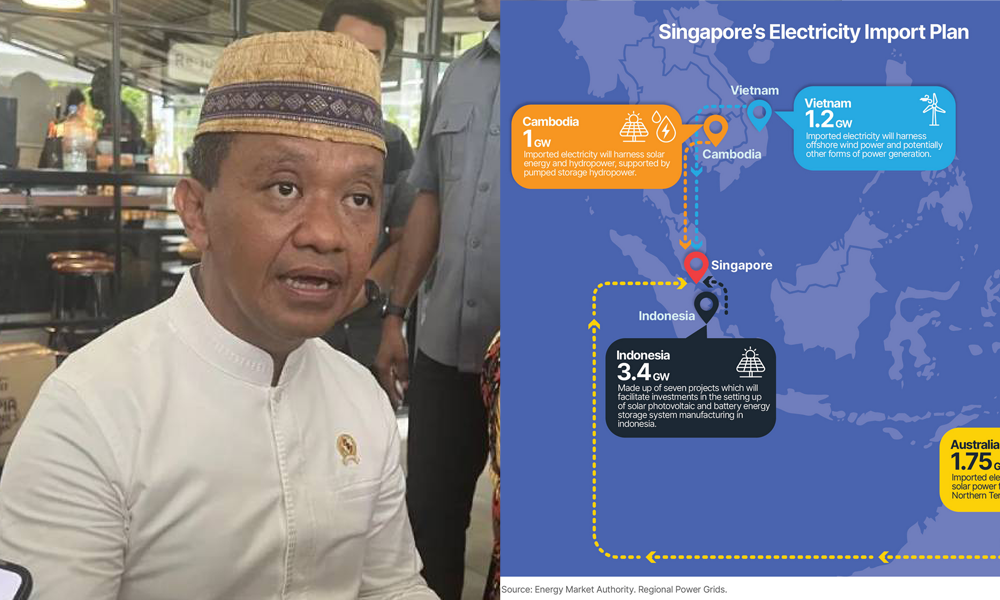

Indonesia has signalled that it will not approve the export of renewable electricity to Singapore unless it receives clear reciprocal benefits. In February 2025, Minister of Energy and Mineral Resources, Bahlil Lahadalia, stated that the government would withhold green electricity export permits until Indonesia’s economic and energy security concerns were addressed. Singapore, which relies on imported energy due to its limited land and renewable resources, has been working towards securing low-carbon electricity imports as part of its decarbonisation strategy. On 5 September 2024, during the Indonesia International Sustainability Forum in Jakarta, Singapore’s Energy Market Authority (EMA) granted Conditional Licences for 2GW of electricity imports from Indonesia and issued Conditional Approvals for an additional 1.4GW. According to the EMA, “Low-carbon electricity imports are part of Singapore’s overall efforts to decarbonise the power sector.” Initially, Singapore had aimed to import 4GW by 2035, but this target has now been increased to 6GW to meet growing demand.
Singapore’s conditional approvals and licences
Singapore has received over 20 proposals from multiple source countries for electricity imports. Of these, five Indonesia-based projects have progressed to receiving Conditional Licences, meaning they are in the advanced stages of technical and commercial viability. The five projects awarded Conditional Licences include:- Pacific Medco Solar Energy Pte Ltd – 0.6GW
- Adaro Solar International Pte Ltd – 0.4GW
- EDP Renewables APAC – 0.4GW
- Vanda RE Pte Ltd – 0.3GW
- Keppel Energy Pte Ltd – 0.3GW
- Singa Renewables Pte Ltd (a joint venture between TotalEnergies and RGE) – 1GW
- Shell Eastern Trading (Pte.) Ltd, in partnership with Vena Energy – 0.4GW
Indonesia’s concerns and potential benefits
Despite Singapore’s progress in securing agreements, Indonesia has raised concerns over domestic energy security, economic benefits, and resource allocation. The Indonesian government does not want renewable energy exports to undermine domestic clean energy supply and is also seeking fair economic returns from its land and resources. According to Mutya Yustika of the Institute for Energy Economics and Financial Analysis (IEEFA), Indonesia stands to gain significantly from this deal. Potential benefits include:- Annual foreign exchange earnings of US$4.2 billion to US$6 billion
- Tax revenue increases of US$210 million to US$600 million per year
- Strengthened renewable energy manufacturing and supply chain industries
- Creation of over 80,000 jobs in solar and battery energy storage sectors
- Capacity quotas to balance domestic and export needs
- Special export tariffs reflecting market value and transmission costs
- Local content requirements (LCRs) to develop domestic manufacturing
- A fair distribution of carbon credit benefits between Indonesia and Singapore
- Strengthening Indonesia-Singapore energy cooperation