Ng Eng Hen: SAF to acquire two more submarines, upgrade land and air assets; MINDEF’s FY2025 budget S$23.4B
The SAF will enhance its defence capabilities with two more submarines, upgraded land and air assets, and a larger budget. Defence Minister Ng Eng Hen announced in Parliament that MINDEF’s FY2025 expenditure is projected at S$23.4 billion (US$17.3 billion), a 12.4% increase from the previous year.
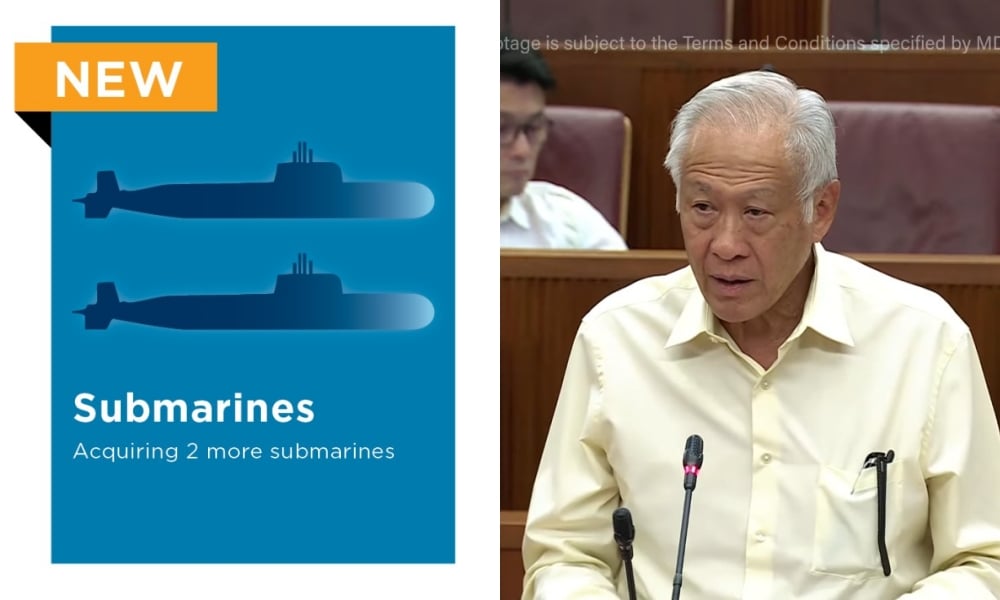

SINGAPORE: The Singapore Armed Forces (SAF) will enhance its defence capabilities by acquiring two additional submarines, upgrading its land and air assets, and increasing its overall defence budget.
Defence Minister Ng Eng Hen announced these plans in Parliament on Monday (3 March) during the Ministry of Defence’s (MINDEF) budget debate.
The two new submarines will add to Singapore’s fleet of four German-made Invincible-class submarines, which have been in development since 2017.
Dr Ng stated that the first two submarines became fully operational in September 2023, and all four are expected to be operational by 2028.
He noted that expanding the fleet to six would ensure greater operational readiness, as most naval forces, including those of Australia, Indonesia, and Vietnam, maintain fleets larger than four.
Land force enhancements: Titan and HIMARS upgrades
The Singapore Army will introduce a new infantry fighting vehicle named Titan, featuring a wheeled design and enhanced firepower through a 30mm remote-controlled cannon.
The Titan will also be equipped with advanced counter-unmanned aerial system (UAS) capabilities.
Additionally, the army’s High Mobility Artillery Rocket System (HIMARS) will be upgraded to more capable rockets.
Dr Ng highlighted the effectiveness of HIMARS in recent conflicts, particularly in Ukraine’s ongoing war with Russia, and stressed its importance to Singapore’s defence.
Naval expansion: Multi-role combat vessels
The Republic of Singapore Navy (RSN) will launch its first multi-role combat vessel (MRCV) later this year, part of a programme to replace six ageing Victory-class missile corvettes that have been in service since 1989.
Dr Ng explained that the MRCVs will have triple the range of the current corvettes and function as motherships for unmanned platforms, significantly strengthening Singapore’s maritime defence capabilities.
Air force modernisation: New maritime patrol aircraft
The Republic of Singapore Air Force (RSAF) is evaluating potential replacements for its ageing Fokker-50 maritime patrol aircraft, which have been in service for over three decades.
The Boeing P-8A Poseidon and Airbus C295 are under consideration, with the former being widely used by the United States Navy, the UK’s Royal Air Force, and the Royal Australian Air Force, while the latter has been adopted by Chile and Spain for anti-submarine warfare missions.
Dr Ng also confirmed that Singapore has expanded its F-35 and F-16 fighter jet training detachment in the United States at Ebbing Air National Guard Base in Arkansas.
Singapore recently increased its F-35A order, securing eight additional jets in 2023.
MINDEF’s defence budget to rise by 12.4% to S$23.4 billion in FY2025
MINDEF’s total defence expenditure for Financial Year (FY) 2025 is projected to be S$23.4 billion (US$17.3 billion), marking a 12.4% increase from the previous year.
Dr Ng attributed the rise to projects delayed by COVID-19 and supply chain disruptions but assured Parliament that defence spending has remained within 3% of Singapore’s GDP over the past decade.
He expects expenditure growth to taper off from FY2026 onwards, barring major conflicts or economic crises.
Preparing for an uncertain future
In his speech, Dr Ng underscored the need for Singapore to remain resilient and prepared in an unpredictable global landscape.
Drawing historical parallels, he referenced the period leading up to World War I, warning against "sleepwalking" into an uncertain future.
He emphasised that Singapore must take control of its own destiny by investing in its defence and maintaining realistic and strategic responses to emerging threats.
"Before 1965, Singapore was not in charge of its own fate, so we could have blamed other countries," Dr Ng said.
"But as an independent and sovereign nation, we Singaporeans have agency and must do all we can to secure our future together."