Bidadari stray dogs: Caretaker disputes NParks’ decision, cites lack of evidence
The controversy over NParks’ decision to remove four stray dogs from Bidadari Park grows as caretaker Jermaine Chua challenges claims of aggression. She questions the reports' validity and urges residents to support the dogs, arguing for coexistence over removal.

SINGAPORE: The controversy over the National Parks Board’s (NParks) decision to trap and remove four stray dogs from Bidadari Park continues to grow, as longtime caretaker Jermaine Chua challenges the agency’s justification for the move.
NParks cited over 60 reports of territorial behaviour as the reason for the removal, with around 20 incidents involving the dogs chasing parkgoers.
While no direct attacks were reported, NParks stated that a young child sustained injuries while running away from the dogs.
However, Chua, who has been feeding and monitoring the dogs since 2017, argues that the removal is unjustified.
She claims the dogs have never shown aggression and warns that the trapping process could cause them extreme stress, potentially leading to their deaths.
Caretaker Challenges Claims of Aggression
On Monday (24 Feb), Chua took to Facebook to voice her concerns, arguing that NParks’ decision was made without proper evidence.
She questioned whether the dogs were truly aggressive, how many of the reported incidents were unique, and why NParks decided to remove them despite what she believes is a lack of verified aggression.
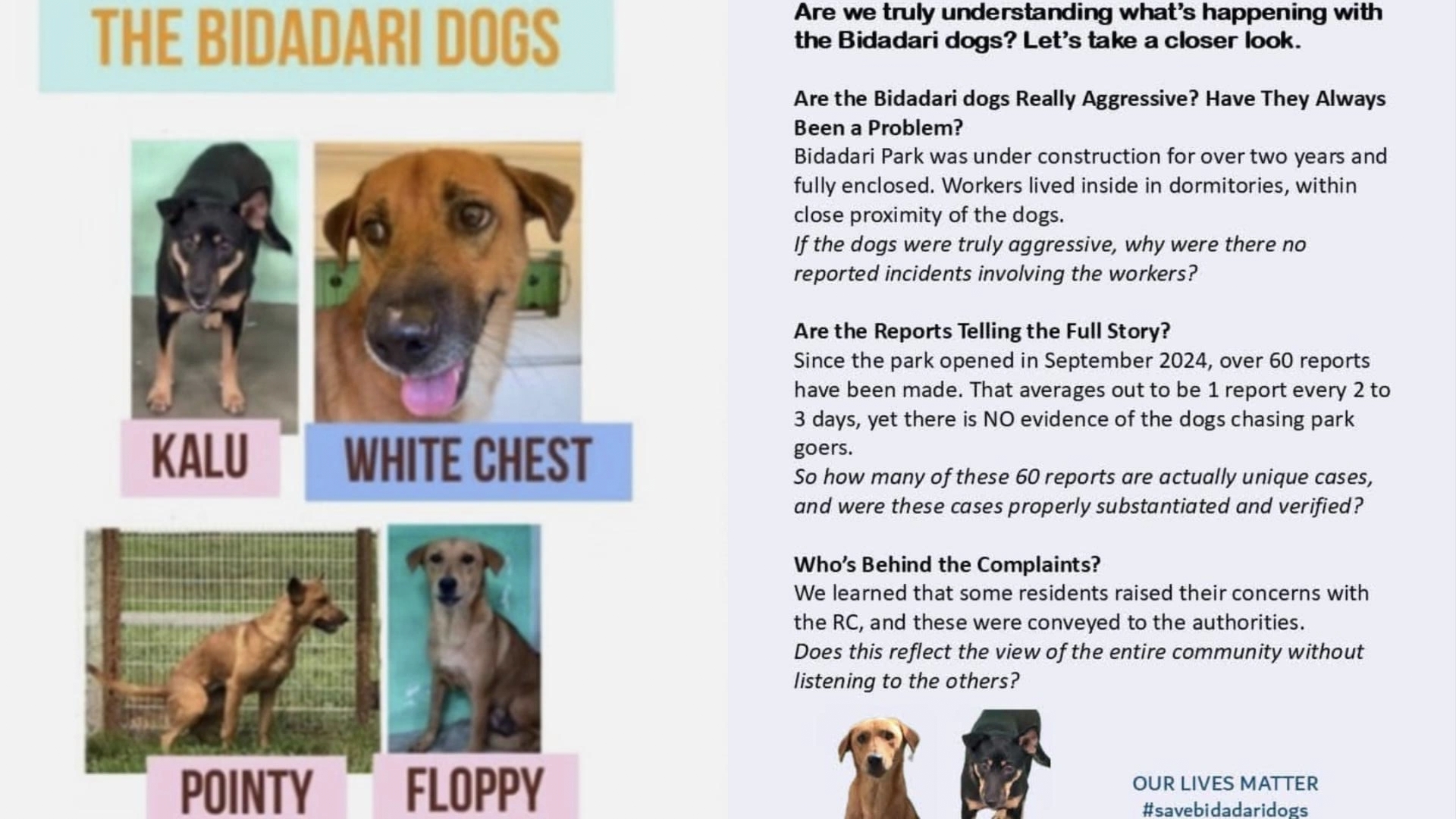
She identified the four dogs—Kalu, White Chest, Pointy, and Floppy—stating that they had lived in the area their entire lives without causing harm.
She expressed concern that the trapping process was putting them under extreme stress, which could ultimately lead to their deaths.
"What have they done to deserve such suffering?" she wrote.
She also questioned whether people could learn to coexist with the dogs and whether their lives were considered less important than wildlife.
Are the Complaints Justified?
Chua pointed out that Bidadari Park was under construction for over two years and was fully enclosed during this period.
Workers lived in dormitories near the dogs, yet there were no reported incidents of aggression.
She argued that if the dogs were truly dangerous, such cases would have emerged earlier.
"If the dogs were truly aggressive, why were there no reported incidents involving the workers?" she asked.
Chua also raised doubts about the complaints submitted to NParks, questioning whether they accurately reflected the situation.
She pointed out that since the park opened in September 2024, 60 reports had been made—an average of one every two to three days.
However, she argued that there was no clear evidence of the dogs chasing parkgoers.
"So how many of these 60 reports are actually unique cases, and were these cases properly substantiated and verified?" she asked.
She noted that some residents had raised concerns with the Residents’ Committee (RC), which then conveyed them to the authorities.
However, she questioned whether this truly reflected the views of the entire community or if only certain voices were being heard while others were ignored.
"Does this reflect the view of the entire community without listening to others?" she asked.
Online Discussions Fuel Fear?
Chua suggested that online discussions might have influenced public perception of the dogs.
She noted that some incidents were discussed in the Woodleigh Residents’ Telegram group and questioned whether these discussions had encouraged more reports based on fear rather than direct encounters with the dogs.
She also highlighted an incident in which a resident who shared the “Save the Bidadari Dogs” petition in the Bidadari residents’ chat was immediately removed from the group.
"What does this say about open discussion in the community?" she asked.
Caretaker Questions If Removal Is the Best Option
In response to complaints, NParks has implemented measures to address concerns about the stray dogs at Bidadari Park.
A visual barrier has been installed, and the agency is in the process of removing the dogs.
NParks previously stated that it would employ internationally recognised humane trapping techniques, similar to those used in its Trap-Neuter-Release-Manage (TNRM) programme.
As part of this effort, a corral resembling a playpen has been set up near the dogs’ feeding area, equipped with kibble, water, and surveillance cameras to help them acclimate.
Additionally, blue canvas hoarding arranged in a U-shape has been placed as a visual barrier to minimise interactions between the dogs and parkgoers.
Despite these measures, Chua remains unconvinced that removal is the best course of action.
She questions whether the decision truly reflects the views of the entire community.
"Does the community really want the dogs gone, or are we only hearing the loudest voices?" she asked.
She emphasises the need for a solution that balances safety with compassion.
Chua has since called on residents of Potong Pasir SMC, including those in Woodleigh, Bidadari, Joo Seng, and MacPherson, to support the strays by filling out a form before Friday (28 Feb).