RDU refutes CNA’s ‘biased’ characterisation, calls for fairer media representation
Red Dot United (RDU) Secretary-General Ravi Philemon has criticised CNA for its 24 February report on smaller opposition parties, calling it a "twisted narrative" that misrepresents RDU’s political efforts. He accused CNA of using the term "fringe" to portray RDU as marginal and mischaracterising its approach to electoral contests.
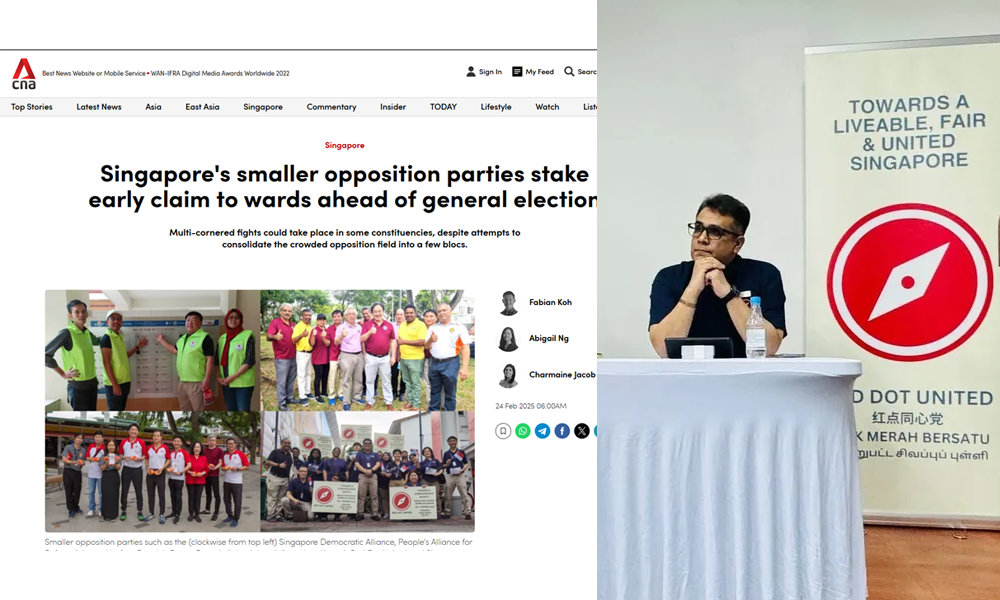

Red Dot United (RDU) Secretary-General Ravi Philemon has strongly criticised CNA’s 24 February report, which he claims misrepresents RDU and other smaller opposition parties. In a Facebook post on Monday, Philemon accused CNA of pushing a "twisted narrative" by labelling RDU as a "fringe" party and framing it as being in conflict with other opposition groups. The CNA article, "Singapore's smaller opposition parties stake early claim to wards ahead of general election," opened with the statement: "Fringe political parties in Singapore have identified constituencies they wish to contest in a coming general election, despite the electoral map still being redrawn and the date of the polls not yet announced." Philemon argued that using the term "fringe" was neither neutral nor factual but an attempt to undermine RDU’s credibility and portray it as extreme or insignificant. The article also stated that "Overlapping claims have set these smaller opposition parties on a potential collision course, even with the crowded field consolidating into a few blocs in an attempt to avoid multi-cornered fights." Philemon contended that this framing falsely suggested that RDU and other smaller parties were preparing for electoral clashes rather than working together to avoid them. He insisted that RDU has always prioritised strategic cooperation within The Coalition—an informal alliance of RDU, the National Solidarity Party (NSP), the Singapore People’s Party (SPP), and the Singapore United Party (SUP).
Philemon revealed that CNA journalist Abigail Ng had contacted RDU on 12 February to request comments for the article. According to Philemon, Ng had initially sought information about The Coalition’s manifesto and election plans, but later clarified that her questions were directed specifically at RDU. In response, RDU’s communications team provided detailed answers, outlining the party’s planned constituencies, candidate selection process, and overall political motivations. They emphasised that RDU’s focus was not on challenging the Workers' Party (WP) or Progress Singapore Party (PSP) but on providing Singaporeans with a credible alternative to the ruling People’s Action Party (PAP). Despite this, Philemon said CNA’s article did not accurately reflect RDU’s responses. Instead, he argued, it reinforced a narrative that smaller parties were in disarray, rather than highlighting their efforts to build a more diverse opposition. He pointed out that CNA’s portrayal of RDU as a "fringe" party disregarded its steady growth over the past five years—from an 11-member team to an organisation with over 200 volunteers actively engaging in constituencies such as Jurong GRC and Nee Soon GRC. Additionally, RDU has consistently walked the ground and issued statements on major political developments, demonstrating its commitment to national discourse beyond just election cycles. Just last Friday, it released its shadow budget in response to Budget 2025, which was announced by Prime Minister Lawrence Wong. In contrast, many of the parties cited in the CNA report have only recently resurfaced in preparation for the upcoming general election, with their activities primarily dating back to GE2020 rather than in recent months. Given this distinction, lumping RDU together with these parties presents an incomplete and arguably unfair picture. By failing to highlight RDU’s sustained efforts, the report did not accurately distinguish between parties with long-term engagement and those re-emerging solely for the election. Philemon also criticised CNA’s emphasis on multi-cornered fights, which he said wrongly implied that RDU was willing to go head-to-head with other opposition parties without considering the impact on the broader opposition movement. He noted that RDU has consistently engaged in negotiations to prevent unnecessary electoral conflicts and that its efforts should not be misconstrued as reckless ambition. He expressed regret that RDU had even responded to CNA’s queries, stating that one of Ng’s questions—on how RDU planned to “break the WP-PSP dominance”—should have indicated that the framing of the article was problematic. According to Philemon, this suggested an attempt to create divisions within the opposition rather than presenting an objective view of RDU’s electoral strategy. Despite his criticisms of CNA’s reporting, Philemon acknowledged a fairer perspective in the article from Singapore University of Social Sciences associate faculty member Kasthuri Prameswaren, who stated: "If opposition parties generally avoid three-cornered fights against one another, then the chances for these small political parties to become electorally significant and slowly establish their presence, at least in future elections, is high." Concluding his post, Philemon reaffirmed RDU’s commitment to grassroots engagement and policy advocacy, highlighting the party’s work in supporting workers’ rights, small businesses, and underprivileged groups through initiatives like the R.O.S.E. (Rice, Oil, Sugar, and Essentials) programme. He urged Singaporeans to judge RDU based on its track record rather than how it is portrayed in mainstream media reports. CNA has not publicly responded to Philemon’s remarks.