Hong Kong’s Democratic Party considers dissolution amid ongoing political crackdown
Hong Kong’s Democratic Party is discussing its potential dissolution amid a political crackdown under national security laws. Party Chairman Lo Kin-hei called the move “inevitable,” citing the challenging political environment. The discussion follows the sentencing of 45 pro-democracy activists for subversion and the disbanding of other opposition groups.
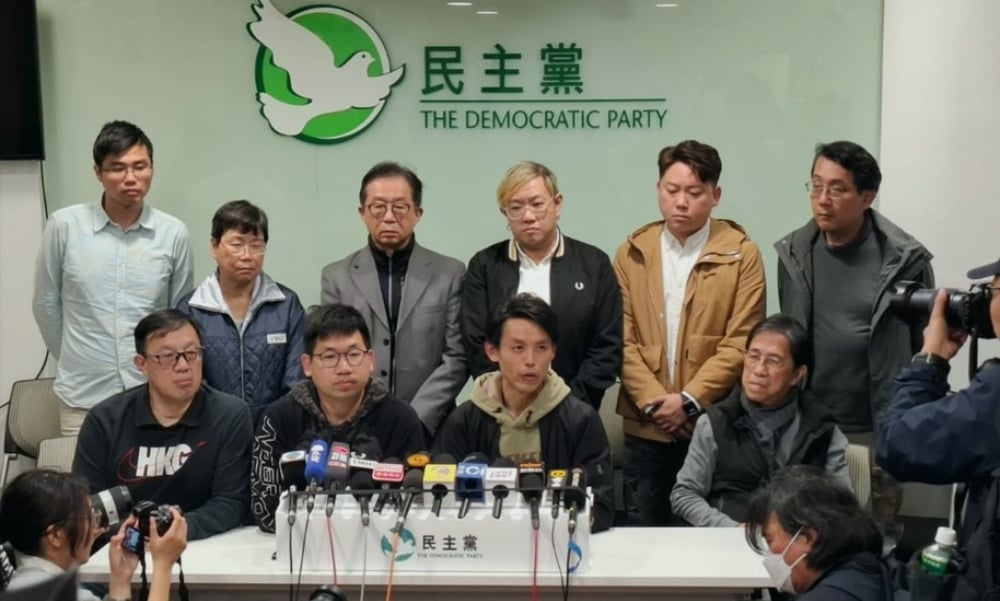

Hong Kong’s Democratic Party has confirmed that it is considering disbanding, as the city’s political opposition continues to face suppression under national security laws.
The decision was discussed during a meeting on Thursday, with Party Chairman Lo Kin-hei acknowledging that dissolution is now an “inevitable” topic.
Speaking at a press conference on Wednesday (19 February) ahead of the meeting, Lo said the party’s central committee would address several issues, including its suggestions for the government’s upcoming budget on 26 February.
However, the focus remained on the party’s future amid a worsening political climate.
Mass sentencing of pro-democracy activists intensifies crackdown on opposition
The discussion comes just weeks after a Hong Kong court sentenced 45 pro-democracy politicians and activists to prison terms of up to 10 years for “subversion.”
The case involved their participation in an unofficial primary election in 2020, which authorities deemed illegal under the National Security Law.
The ongoing political crackdown has already led to the dissolution of several prominent pro-democracy groups.
The Civic Party, once another major opposition force, disbanded in May 2023 after its members were barred from seeking re-election.
The youth activist group Demosisto disbanded in June 2020 following the implementation of the National Security Law.
Lo has previously advocated for the Democratic Party, established in 1994, to continue despite increasing pressure from authorities.
However, he acknowledged that the possibility of disbandment must now be seriously considered.
“I have no baggage here,” Lo told reporters.
“If we really need to , then we will.” He added, “I’ve said publicly many times over the past two or three years that if the day comes, we will just have to face up to it.”
Lo emphasised the broader challenges facing democracy in Hong Kong. “Developing democracy in Hong Kong is always difficult, and it’s especially difficult in the past few years,” he said.
“This is not what we wanted to see.”
While Lo noted that the party’s financial situation remained stable, he said the decision to continue or disband must be based on the broader political environment rather than financial concerns.
Erosion of promised autonomy as national security laws tighten control
Under the “One Country, Two Systems” framework, Hong Kong was promised a high degree of autonomy and civil liberties after its 1997 handover from Britain to China.
However, authorities have increasingly used national security laws to arrest opposition figures and shut down civil society groups and independent media outlets.
A 2021 overhaul of the electoral system ensured that only pro-Beijing “patriots” could govern Hong Kong, effectively excluding pro-democracy politicians from the political process.
This has further marginalised opposition parties, leaving little room for their survival.
The political crackdown in Hong Kong has drawn widespread criticism from international governments, including the United States, the United Kingdom, Australia, and Canada.
These countries have accused China of undermining Hong Kong’s autonomy and violating its commitments under the Sino-British Joint Declaration.
However, both Hong Kong and Chinese officials have defended the national security laws, arguing that they have restored stability to the city.
From political prominence to persecution: The Democratic Party’s uncertain future
The Democratic Party has played a key role in Hong Kong’s political history.
On 1 July 1997, the day of Hong Kong’s handover to China, one of the party’s founders, Martin Lee, stood on the balcony of the Legislative Council building in a symbolic act of defiance.
“We believe that people everywhere share our love of freedom and democracy and that these values will ultimately triumph,” he declared at the time.
Since then, however, Lee has largely withdrawn from public life following his conviction in 2021 for an unauthorised assembly charge.
Several key figures from the Democratic Party have also faced legal action.
Former lawmakers Wu Chi-wai, Lam Cheuk-ting, Helena Wong, and Andrew Wan were convicted in the landmark subversion case involving 47 of the city’s leading pro-democracy figures.
Another party member, Ted Hui, went into exile, with authorities placing a HK$1 million (S$171,429) bounty on his head.
The Civic Party, previously Hong Kong’s second-largest pro-democracy party, was formally dissolved in 2023.
Several of its members, including Alvin Yeung and Jeremy Tam, have also been jailed under the National Security Law.
As the Democratic Party considers its future, the political landscape in Hong Kong remains increasingly hostile to opposition groups.
Lo has indicated that while the party could technically continue for now, its fate ultimately depends on the evolving political environment.