Harsher penalties for speeding from January 2026 amid rising road accidents in Singapore
The Singapore government will increase demerit points and composition fines for speeding offences from 1 January 2026, Home Affairs and Law Minister K. Shanmugam announced. The move follows a significant rise in road accidents, including a 44% spike in speed-related fatal incidents in 2024.
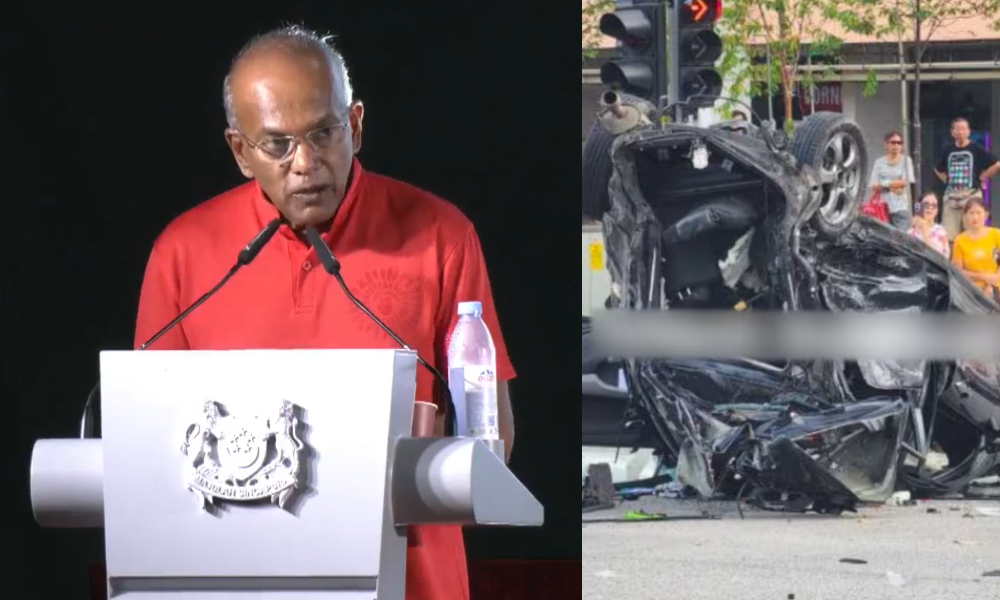

Singapore will impose stricter penalties for speeding from 1 January 2026, including increased demerit points and composition fines, Home Affairs and Law Minister K. Shanmugam announced on 15 February.
The move aims to curb the rising number of road accidents, particularly those caused by speeding.
Shanmugam, speaking at the inaugural Road Safety Day in Chong Pang, highlighted a concerning trend in road safety.
While accident rates remain lower than pre-pandemic levels, the sharp increase in incidents since 2020 is alarming. In 2024, nearly 7,200 road accidents resulted in 142 fatalities, with speed-related fatal incidents rising by 44% from 2023 to 46 cases.
The number of speeding violations detected in 2024—192,000—was the highest in a decade.
To enhance enforcement, the Traffic Police have been progressively activating the speed enforcement function in red-light cameras across the island since 1 April 2024. These cameras have always had the capability, but the function was only activated following a spike in speeding-related fatalities, which rose to 33 cases in 2023, an 80% increase from 18 in 2022.
Shanmugam underscored the severity of the issue, stating, “People are dying and getting injured on our roads. Every vehicle is a potential missile – it’s dangerous if you don’t use it properly.”
While the Traffic Police will step up enforcement, he emphasised that behavioural change is also essential to improving road safety.
More details on the revised penalties will be announced by the Traffic Police in due course. Existing penalties will continue to apply to speeding violations in 2025, but offenders will be reminded of the forthcoming increase in penalties from 2026.
To reinforce road safety education, the Singapore Road Safety Council (SRSC) is collaborating with stakeholders to increase public awareness, including using social media to promote safe driving habits.
Changes to Road Traffic Act spark debate over leniency
The government’s announcement on stricter penalties for speeding contrasts with recent changes to the Road Traffic Act.
On 7 January, Parliament passed amendments that removed mandatory minimum sentences and disqualification periods for first-time dangerous and careless driving offenders.
Under the Road Traffic (Miscellaneous Amendments) Bill, courts now have greater discretion to determine appropriate sentences based on the specific circumstances of each case.
Minister of State for Home Affairs Muhammad Faishal Ibrahim stressed that first-time offenders would still face penalties, considering factors such as the severity of harm caused and the level of culpability.
Additionally, the amendments lowered mandatory minimum sentences for repeat offenders.
For dangerous driving causing death, the minimum sentence was reduced from four years to two, while for causing grievous hurt, it was cut from two years to one. The rationale was to create a more gradual sentencing progression between first-time and repeat offenders.
Faishal maintained that the changes were not intended to signal leniency, noting that repeat offenders would still face mandatory jail terms and disqualification periods, with the possibility of higher sentences. He also reassured that serious offenders, particularly those driving under the influence of alcohol or drugs, would continue to face strict penalties, including maximum sentences such as lifetime imprisonment.
MPs raise concerns over potential leniency
Several Members of Parliament (MPs) voiced concerns over the removal of mandatory minimum penalties for first-time offenders.
Workers’ Party MP Dennis Tan (Hougang SMC), People’s Action Party MP Yip Hon Weng (Yio Chu Kang SMC), and Nominated MP Razwana Begum were among those who cautioned that the amendments might be perceived as a weakening of road safety enforcement.
Yip expressed fears that removing mandatory minimum sentences could erode public trust in road safety measures. Joan Pereira (Tanjong Pagar GRC) argued that harsher penalties were necessary to deter reckless driving, while Razwana Begum suggested a public awareness campaign to clarify the intent behind the changes.
Progress Singapore Party (PSP) Non-Constituency MP Hazel Poa criticised what she termed an “apparent policy U-turn,” pointing to the 2019 Road Traffic Act review that had introduced stricter penalties, including mandatory minimum sentences for serious offences.
PSP opposed the removal of mandatory minimum penalties, particularly amid rising traffic fatalities.
Faishal defended the amendments, explaining that they were part of the government’s periodic review of the Road Traffic Act to strike a balance between deterrence and proportionality.
He stated that the changes allow courts greater flexibility to impose fairer sentences based on case specifics.
Despite these assurances, Poa and PSP NCMP Leong Mun Wai voted against the amendments, formally recording their dissent.
With speeding-related fatalities rising sharply, the upcoming increase in demerit points and fines from 2026 signals a renewed commitment to road safety.
However, the recent amendments to the Road Traffic Act continue to stir debate on whether they provide the right balance between enforcement and judicial discretion.