Singapore train reliability declines over past year despite recent improvements
Train service reliability dropped over the 12 months ending September 2024, according to the LTA's latest report. The East-West Line (EWL) saw the steepest decline after a September disruption. MRT trains ran 1.798 million train-km without significant delays, down from 2.077 million in 2023. During the 11 Nov Parliament session, Minister Chee Hong Tat noted improved reliability by October but did not mention the decline in the LTA report.


SINGAPORE: Train service reliability has worsened over the 12 months ending September 2024, according to a report released by the Land Transport Authority (LTA) on 22 November.
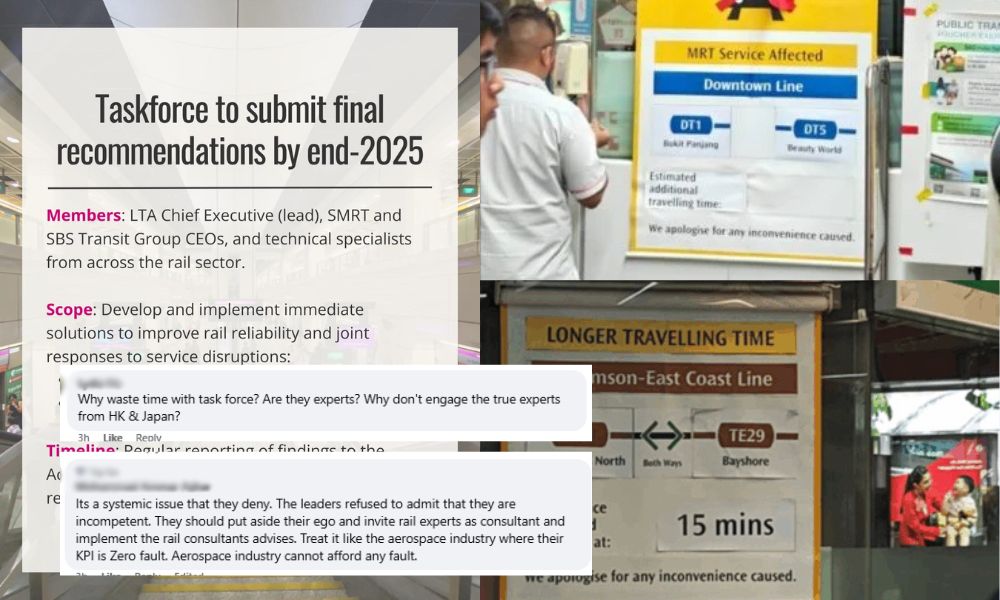
The East-West Line (EWL) saw the steepest decline, following a major disruption in September 2024.
The LTA's Performance of Rail Service Reliability report, based on a 12-month moving average of mean kilometres between failures (MKBF), indicated that MRT trains ran 1.798 million train-km without significant delays (over five minutes) from October 2023 to September 2024.
This is a notable decrease from 2.077 million train-km in 2023, as well as a drop from previous years: 2.089 million train-km in 2022 and 1.994 million train-km in 2021.

Reliability Drops on East-West Line
Among the individual lines, the Downtown Line (DTL) emerged as the best performer, covering 8.112 million train-km between delays.
However, the Circle Line (CCL) experienced the lowest performance, with just 1.04 million train-km between delays, marking a slight dip from 2023.
All lines maintained steady reliability except for the East-West Line, which plummeted to 2.027 million train-km between delays, a significant drop from 3.363 million train-km last year.
This dramatic decline occurred after the EWL experienced a six-day disruption at the end of September, which affected approximately 2.6 million passengers.
The Thomson-East Coast Line was not included in the report, as it is slated for full completion in 2026.

LRT Network Faces Reliability Setback
The LRT network also saw a decline in reliability, with an overall MKBF of 358,000 car-km between delays, down from 546,000 car-km in 2023.
The Sengkang-Punggol LRT performed better but still suffered a sharp decline, falling to 612,000 car-km, compared with 1.217 million car-km in 2023.
Meanwhile, the Bukit Panjang LRT experienced a significant drop, with reliability falling to 189,000 car-km between delays, from 248,000 car-km last year.
A notable incident on the Bukit Panjang LRT occurred in October when a train became immobilised on the track, resulting in a five-hour disruption and an early end to service.

Rising Number of Delays
In addition to the drop in reliability, there has been an increase in the number of service delays across the MRT network.
In the first nine months of 2024, six service delays of over 30 minutes were recorded, compared with five in 2023, seven in 2022, and just three in 2021.
Of the delays in 2024, two occurred on the East-West Line, three on the Circle Line, and one on the Downtown Line.
On the LRT network, delays have remained steady, with three service interruptions reported in the first three quarters of 2024, the same number as for the whole of 2023.

Chee Hong Tat warns raising rail reliability target may increase costs for taxpayers or commuters
During a parliamentary session on 11 November, Transport Minister Chee Hong Tat provided an update on the performance of Singapore's MRT network, announced that the Mean Kilometers Between Failure (MBKF) for the network had improved from 1.8 million train-KM in September to nearly 2 million train-KM by the end of October 2024.
Chee emphasised that all MRT lines have met the target MBKF of at least one million train-KM.
While Chee assured the House that maintaining safety and reliability remains a top priority, he noted that the current MBKF target of one million train-KM, set several years ago, is still a relevant and valid standard for rail operators, citing it as an achievable target for the best rail systems, including those in Taipei and Guangzhou.
However, Leader of the Opposition Pritam Singh challenged the Minister, asking if the Ministry was considering raising the MBKF target given the improvements in reliability.
Chee responded that while the idea had been discussed, raising the target further could incur significant costs, which would ultimately be borne by taxpayers or commuters.
He stressed the need to carefully assess the trade-offs before making any changes to the current MBKF target.
However, in comparison to the latest LTA report on train reliability from October 2023 to September 2024, Chee did not mention the previous drop from 2.077 million train-km in 2023 to approximately 1.8 million train-km by September 2024 during the Parliament sitting on 11 November.
He also omitted any mention of the significant declines in reliability on the Bukit Panjang LRT and Sengkang-Punggol LRT networks, where performance fell sharply compared to 2023.
Instead, he highlighted the improvement in reliability from 1.8 million train-km in September to nearly 2 million train-km by the end of October 2024, which still marked a decrease compared to prior years.