Comments
Workforce consultant challenges ‘upskill’ narrative, urges real answers on Singapore job market gaps
Workforce development consultant Ives Tay has challenged the “upskill and resilience” narrative, arguing that Singapore’s labour market is becoming less willing to absorb its own talent. Citing MOM’s 1Q 2025 data—81,100 vacancies but only 300 new resident jobs—he called for deeper scrutiny into hiring practices and real answers from policymakers.


Singapore’s labour market is becoming less willing to absorb its own talent, warned Ives Tay, a consultant involved in SkillsFuture and workforce development.
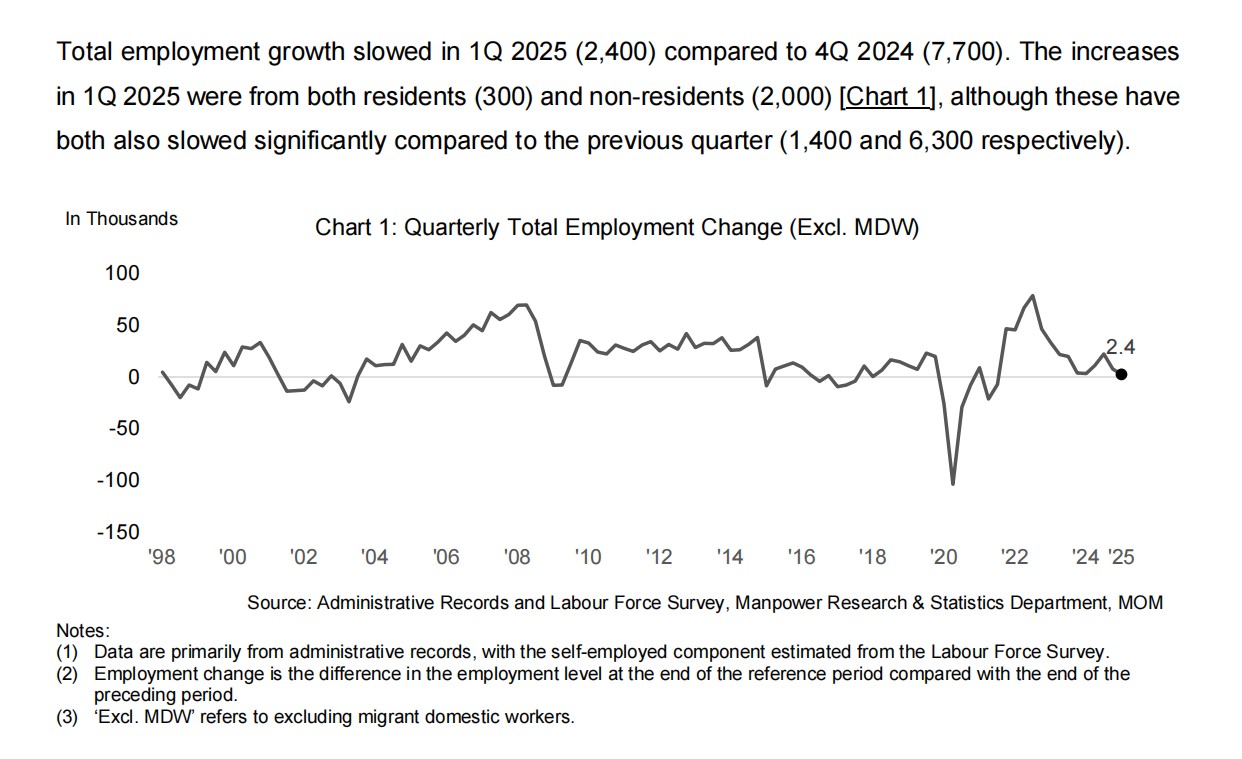
Citing data from the Ministry of Manpower’s (MOM) Labour Market Report for the first quarter of 2025, Tay highlighted that while there were 81,100 job vacancies as of March, only 2,400 new jobs were created in Q1. Of these, just 300 were for Singapore residents.
Tay characterised this situation not as a labour shortage, but a “placement failure.”
He challenged the longstanding focus on “upskilling” and “resilience” as insufficient responses, arguing that Singapore is “optimising for numbers, not people.”
Mismatch between vacancy figures and job creation
In a LinkedIn post published on 28 June 2025, Tay commented on the newly finalised data, noting stark contradictions in public reporting.
He observed that The Straits Times highlighted the increase in job vacancies—81,100 in March, up from 77,500 in December 2024—while CNA focused on a slight rise in unemployment to 2 per cent and the sharp drop in job creation from 7,700 in Q4 2024 to 2,400 in Q1 2025.
“Two very different stories,” he wrote, “and yet, neither fully explains the disconnect that jobseekers feel.”
He pointed out that in Q4 2024, of the 7,700 new jobs, 1,400 went to residents and 6,300 to non-residents.
The plunge to just 300 resident jobs in Q1 2025 was especially concerning in light of ongoing rhetoric around skills development and adaptability.
“Residents” refer to Singapore citizens and permanent residents.
“We don’t have a labour shortage. We have a placement failure”
Despite the seemingly positive rise in vacancies, Tay warned that many were in roles unlikely to go to local jobseekers—such as bus and truck drivers or Employment Pass/S Pass positions.
“You can’t tell jobseekers ‘there are plenty of jobs’ if employers aren’t actually hiring, locals aren’t considered ‘suitable’, or firms prefer the ‘cheaper, faster’ route,” he stated.
Tay raised particular concern over manufacturing, once a stable source of middle-class employment.
He noted that vacancies in the sector are shrinking while retrenchments and short work weeks are on the rise.
“MOM calls it a ‘measured response’. I call it a warning shot,” Tay remarked.
Struggles faced by youth and older workers
Tay also drew attention to demographic-specific challenges.
Youth long-term unemployment rose to 1.2 per cent, and seniors over the age of 50 continue to struggle with re-entry into the workforce.
“And yet we’re still told to ‘upskill and hustle’,” he wrote.
Calling for more serious introspection, Tay urged a shift away from narratives about worker “mindset” and resilience.
Instead, he argued that “Singapore’s labour market is becoming less willing to absorb its own talent.”
“When there are 1.64 job openings for every unemployed person, and people still can’t land jobs, we need to start asking harder questions,” he said.
Online reactions highlight deeper concerns about job market policies
Tay’s post resonated widely on LinkedIn, drawing over 800 likes, 146 comments, and 90 reposts.
Many comments expressed appreciation for voicing what they see as a “painful truth.”
Some users argued that artificial intelligence often takes the blame for job losses, but real issues stem from policy gaps and systemic barriers.


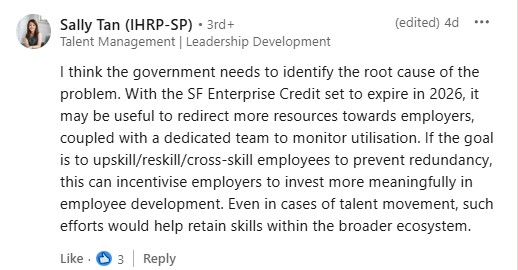
Sally Tan, a senior manager at NTUC LearningHub, suggested the government needs to identify the root cause of these labour mismatches.
She noted that with the SkillsFuture Enterprise Credit set to expire in 2026, it may be timely to redirect resources towards employers, paired with a dedicated monitoring team.
“If the goal is to upskill or reskill employees to prevent redundancy, this can incentivise employers to invest more meaningfully in employee development,” she said.
Challenges hiring locals in SMEs
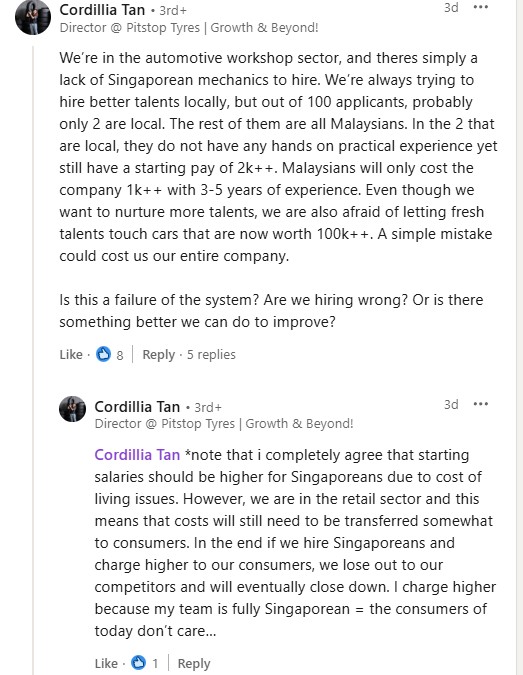
Cordillia Tan, director of Pitstop Tyres, shared her challenges in hiring Singaporean mechanics.
She said most applicants are Malaysian—more experienced and lower-cost—while local hires often lack practical skills and expect higher pay.
Though acknowledging the need to pay Singaporeans more given rising living costs, she expressed concern that doing so would force her to raise prices, jeopardising her competitiveness.
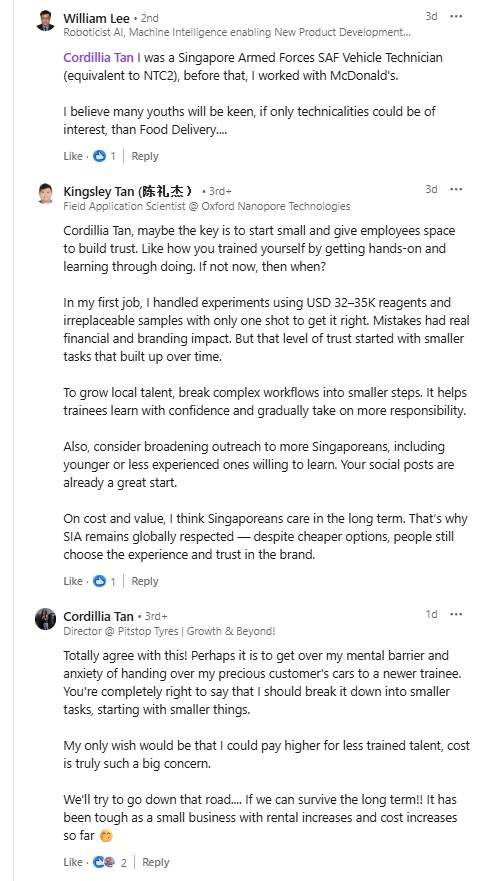
In response, roboticist William Lee suggested that technical trades could appeal more to youth if marketed as engaging alternatives to gig work.
Kingsley Tan, a field application scientist at Oxford Nanopore Technologies, proposed breaking down tasks into smaller modules to help new local hires build confidence. He also recommended exploring government grants to support wage costs.
Cordillia expressed appreciation for the suggestions and openness to explore them, provided her business remains financially viable.
Silent struggles among mature workers
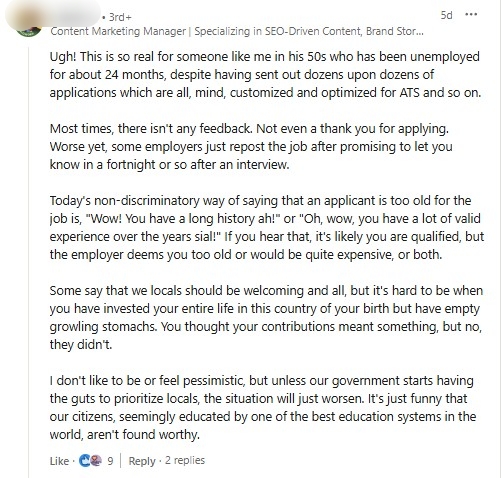
A LinkedIn user, a Singaporean in his 50s, shared his frustration over being unemployed for two years despite frequent job applications and interviews.
He described age discrimination as being disguised through compliments like “you have a lot of experience,” which in practice signal that he is perceived as too old or expensive.
Feeling betrayed, he criticised the government for not prioritising local workers despite their lifelong service and investment in education.
Comment highlights perceived job market mismatch amid contradictory narratives
Another comment voiced confusion over the conflicting narratives—on one hand, talent shortages and high-paying roles; on the other, struggling graduates and mid-career professionals.
The user questioned the discrepancy: if multinational corporations are genuinely creating abundant quality jobs, why does local unemployment persist?
The comment suggested a severe mismatch in Singapore’s labour market that needs urgent examination.

A call for reckoning
Tay concluded his post by calling for deeper accountability and collective action:
“If you’re hiring locals—thank you. If you’re struggling to land a role—you’re not alone. If you think it’s time for tougher conversations—hit like, comment, and share.
Let’s stop managing narratives and start demanding answers.”