Media
Bertha Henson notes ST’s silence on Cheong Yip Seng’s book and questions his global pivot proposal
In a Facebook post, veteran journalist Bertha Henson highlighted The Straits Times’ silence on Cheong Yip Seng’s new book launch. As of 3 July evening, the paper had yet to report on it. Henson also criticised Cheong’s proposal for ST to go global, calling it outdated and out of touch with today’s media realities and internal challenges.

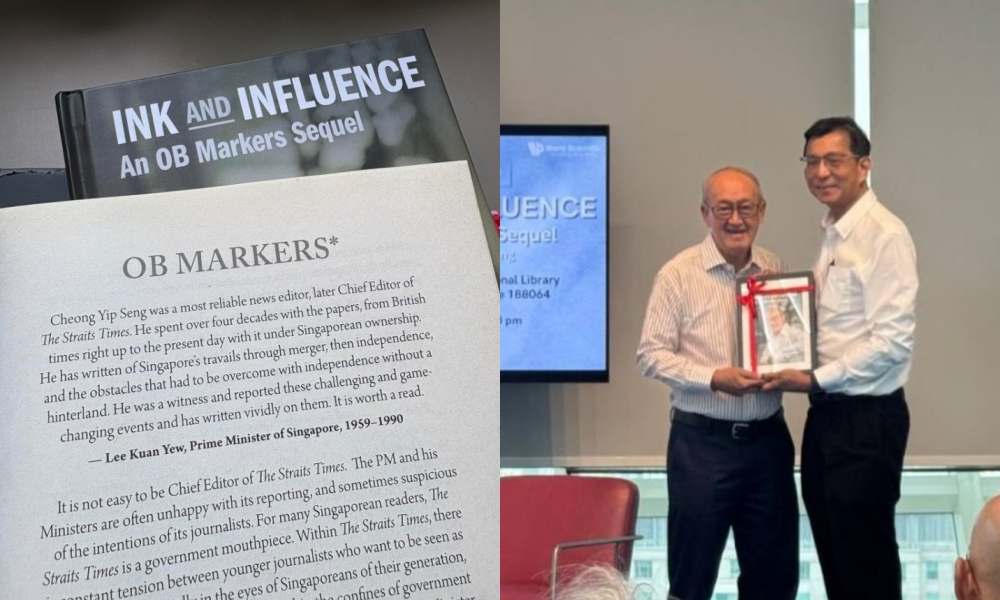
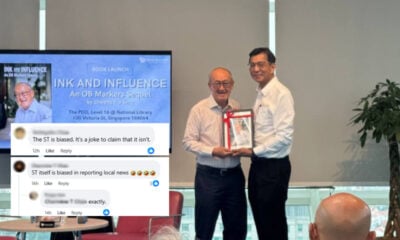
On 2 July 2025, former editor-in-chief of The Straits Times (ST), Cheong Yip Seng, launched his new book Ink and Influence: An OB Markers Sequel.
However, one notable absence at the launch did not go unnoticed—The Straits Times itself. As of the evening of 3 July, The ST has yet to publish any report on Cheong’s new book.
Veteran journalist Bertha Henson, who attended the event, addressed this silence in a Facebook post dated 3 July 2025.
She expressed It is a curious sign that ST, which once published Cheong’s earlier book OB Markers, chose not to cover the launch or review the sequel.
Henson pointed out that it was Channel News Asia, not ST, that eventually reported on the book.
With dry irony, she suggested that ST’s editorial silence could either reflect an assessment that the event was unnewsworthy or a deliberate move to avoid revisiting the controversies surrounding OB Markers.
“Maybe I am just too impatient,” she wrote. “Editors could still be figuring out how they should report the launch… that is basically a proposal on how it can reinvent itself.”
Cheong’s proposal for ST’s global pivot questioned
A key proposal in Cheong’s new book is the transformation of ST into a globally influential publication, to serve as a counterweight to perceived Western media biases.
Henson responded sharply to this idea. In another FB post, She argued that while it might have had potential two decades ago—when Singapore Press Holdings (SPH) was financially strong and ST had well-staffed foreign bureaus—it is no longer viable.
According to her, the media environment has shifted dramatically, and such ambitions lack alignment with the current state of journalism in Singapore.
“Professional standards were much higher then,” she wrote, describing an era of “well-trained journalists unafraid of legwork” and editors who understood the line between “puffery and propaganda.”
Doubts over S$900 million media support
Henson also raised questions about Cheong’s assumption that ST’s proposed global expansion could be justified by the government’s S$900 million funding package.
She challenged the notion that such funds were meant for ST to chase elite international audiences, arguing instead that they were likely intended to shore up ST’s dominance in the domestic media space.
“I don’t think the Government willingly forked out S$900 million for a newspaper to capture the eyes of an upmarket audience,” she said.
“Rather, this was done to retain the local mass market… to ensure that the Government has the biggest voice in Singapore.”
This funding for SPH Media Trust was allocated over five years starting in 2022.
According to the Ministry of Communications and Information, the support is intended to aid digital transformation, build newsroom capabilities, and ensure the long-term sustainability of vernacular media outlets.
Concerns over loss of local journalism
Cheong’s dismissal of community and municipal coverage also drew Henson’s criticism.
She maintained that “good journalism begins with mastering the basics” and warned that ST’s erosion of editorial depth had left it ill-prepared for any global ambition.
Cheong had written that Singapore would “not lose much” if ST abandoned local stories in favour of political and economic coverage for international readers.
He noted that ST was not the country’s most-read outlet, citing Channel News Asia and Mothership instead.
“I was a little confused by his analysis… is he suggesting a way out for ST, which reports local news with such a light touch that it adds little value?”
She insisted that Cheong should have addressed why ST had lost credibility in its core function—local reporting—before proposing a shift that would be “more difficult” and expensive to maintain.
“Overseas bureaus are expensive to maintain. International news (with or without western bias) is accessible. Given the low level of professionalism these days, I would be horrified if it suddenly pitches itself as an upmarket news media comparable to more established global players.”
Book offers limited new insights, says Henson
Reflecting on the content of Ink and Influence, Henson expressed disappointment.
She described it as a compressed version of OB Markers, offering few fresh revelations beyond Cheong’s brief post-SPH roles in diplomacy and consultancy.
Henson revealed that Cheong had tried to publish a revised edition of OB Markers or a full sequel, but was turned down by Straits Times Press.
Legal and copyright barriers prevented him from reusing material from the original book.
“It was a part of the Singapore Story… which many have speculated but no one outside the top editorial leadership knew the truth about,” she wrote.
Revisiting the OB Markers fallout
Henson recounted how OB Markers made headlines upon its release, in part due to its revelations about editorial interactions with political leaders, including Singapore’s founding father late Lee Kuan Yew and second PM Goh Chok Tong.
The initial version included a foreword from Lee Kuan Yew, which was later retracted after government spokesman Janadas Devan claimed Lee had not read the book.
The book went into reprint without the foreword and was never printed again.
“The phone calls from ministers, slap on the wrists, face-to-face meetings were something that we do not talk about in public,” Henson had written on her blog, Bertha Harian, when OB Markers was first released.
Diplomatic fallout from the original book
In Ink and Influence, Cheong sheds more light on this episode. He reproduced an email from Janadas Devan—sent while Cheong was on diplomatic posting in Chile—taking issue with the book.
Cheong noted the “aggressively demanding tone” of the message, particularly surprising given that Janadas had earlier praised him as an editor who had improved professionalism in the newsroom.
Cheong hinted that his early recall from his Chilean posting might have been linked to the controversy generated by OB Markers.
He also cited tensions caused by his request for a foreword from public intellectual Cherian George.
A fragmented sequel, but still relevant
Henson attributed the disjointed structure of Ink and Influence to the constraints Cheong faced—legal, editorial, and political.
These pressures may have shaped the book’s fragmented chronology and less revelatory tone.
Yet she acknowledged the value the book still holds for those interested in understanding Singapore’s media and political landscape.
“If you do get your hands on OB Markers, cherish it,” she urged.