Labour
What kind of employer should be elected?
As voters reflect on workers’ rights this May Day, Bernadette Giam’s track record as an employer raises questions about whether business leaders who make unpopular employment decisions should be elected to represent working-class constituencies like Sengkang.


On this May Day, when workers’ rights and the dignity of labour are at the forefront of public consciousness, the candidacy of Bernadette Giam in the upcoming general election brings a critical question into focus: what kind of employers are we voting into Parliament?
Sengkang MP hopeful Bernadette Giam is an F&B employer of 350 workers. Some unpopular decisions she made include threatening to fire Malaysian-based workers if they did not find accommodation in time during the Covid-19 lockdown and paying her staff below-average salaries.
Bernadette Giam is a People’s Action Party (PAP) candidate standing for elections in Sengkang GRC. She has branded herself as a working mother who believes that supporting mothers can uplift communities, “enabling generations of Singaporeans to thrive”.
On the PAP’s website, she is described as having a passion for service and compassion.
However, aspects of how Giam has carried out her professional role as an employer of 350 workers have drawn attention, and some observers have questioned whether these align fully with her campaign image as pro-women and service-oriented.
According to her Linkedin, for 13 years, Bernadette Giam has been the Corporate Affairs and Human Resources Director of Creative Eateries Pte Ltd, a local food and beverage company that owns an extensive portfolio of restaurants in Singapore including Bangkok Jam, Siam Kitchen, and Suki-Ya.
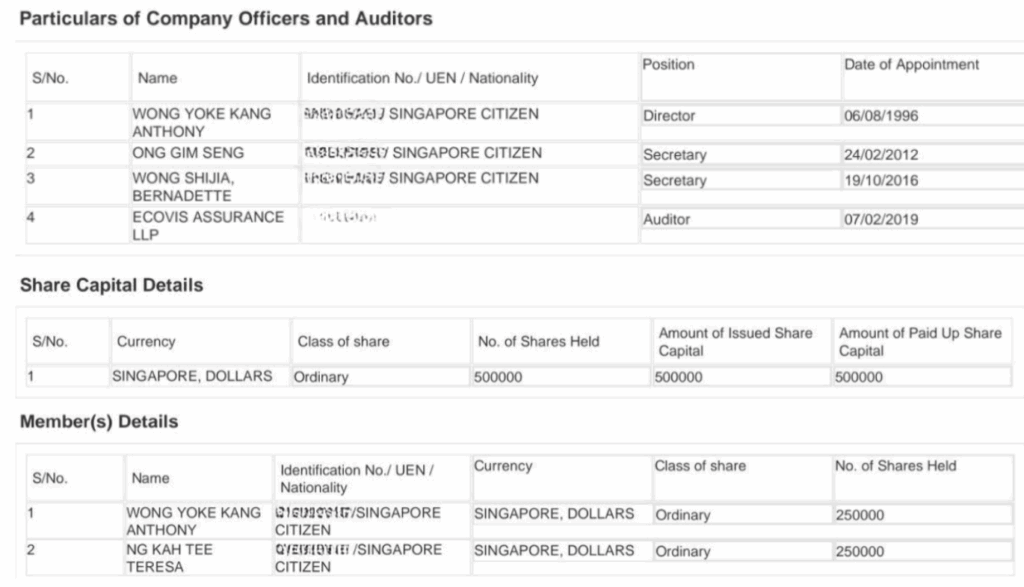
Creative Eateries (CE) is a family business founded by Anthony Wong Yoke Kang, who is Bernadette Giam’s father. Together with Bernadette, Anthony Wong is a director of CE and is one of the two shareholders. The other shareholder is Anthony Wong’s wife Teresa Ng Kah Tee.
As CE’s Corporate Affairs and Human Resources director, it is expected that Bernadette will have to make many decisions concerning the welfare of employees.
These include decisions about wages, hiring and firing, bonuses, and accommodation of migrant workers. These decisions have a significant impact on her workers’ livelihoods. How she makes these decisions may perhaps give us a snapshot of how she would represent her working class Sengkang constituents if she were to be elected into parliament.
Two such decisions she made in her capacity as CE director raised a few eyebrows.
One such decision made by Bernadette happened in 2020.
On 16 March 2020, Malaysia announced a lockdown on its borders due to the Covid-19 outbreak. The measure, aimed at containing the virus, was to last until 31 March 2020. During this period, Malaysians were not allowed to leave the country.
This meant that workers who crossed borders on a daily basis might have found themselves stranded in terms of accommodation.
As an F&B company, CE had a significant number of Malaysia-based employees. On the very date the lockdown was announced, Bernadette signed off on a letter addressed to her Malaysia-based employees. In the letter, Bernadette gave her Malaysia-based employees an ultimatum: either secure accommodation in Singapore by 31 March 2020 or face the possibility of getting fired.
During the pandemic, Giam, in her capacity as Corporate Affairs & Human Resources Director of F&B group Creative Eateries Pte Ltd, issued an ultimatum to Malaysian workers to find accommodation or risk losing their jobs.
Workers were given 2 weeks to secure accommodation. The employees in question were to inform the human resources department (Bernadette’s department) of their decision by 20 March, or the company would immediately find their replacement.
This story was reported by Mothership, but did not include Bernadette Giam’s name in the letter. The letter was signed off as “Director of Corporate Affairs & Human Resources”.
According to Bernadette’s LinkedIn, she held that position during that time. Giam has not publicly responded to concerns about her employment practices, and she was not named in the initial reporting of the 2020 letter.
However, public records and her LinkedIn profile indicate that she held the relevant role at the time.
The incident grabbed so much attention that in response, the Ministry of Manpower released a statement on the working arrangements of Malaysians in Singapore. MOM said that employers had several options to consider for their workers, including work-from-home, no-pay-leave, and finding accommodation for them.
CE publicly responded to the Mothership article. They said that Bernadette’s letter was not in response to the lockdown in Malaysia and that the letter was prepared before the announcement of the lockdown.
According to CE, Malaysian staff had been consulted since early February and they had also “successfully transitioned” to Singapore and were unaffected by the sudden lockdown.
Although CE’s response might sound assuring, it is not clear in the statement what the Malaysian staff were consulted on since early February and whether CE only assisted workers to find accommodation after MOM’s statement in response to the incident.
MOM also articulated the following in its statement, “If the affected workers remain in Singapore to continue working, employers should assist them in finding suitable accommodations given the short notice.
By and large, employers have been able to do so”. It is therefore concerning that despite helming an established company that would have been able to offer support to their employees to find accommodation on such short notice, Bernadette decided to issue a threat to fire her employees if they do not find accommodation.
Her decision has raised questions about how she values employee welfare.
More recently, a former employee (J) shared her past experience working under Bernadette Giam via Instagram. J was an employee with CE for slightly over a year. She was first employed in 2017.

J shared a series of Instagram stories detailing her experiences. Some parts could not be independently verified.
J’s first job after graduating from university was at CE, where she worked as an accounts assistant with a starting salary of S$2,100 per month. She shared that, despite Bernadette’s public support for working mothers, some of her colleagues—including a Singaporean single mother and a Filipina permanent resident who had each worked at CE for over a decade—were paid less than S$3,000.
Another colleague, also a single mother, had to take on a second job at a call centre to make ends meet. J felt these wages were inadequate given their years of service and family responsibilities.
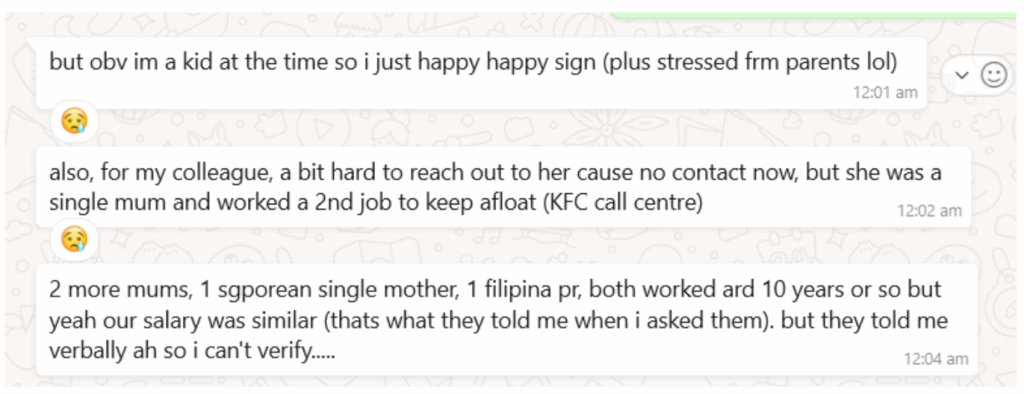
Our checks with J via whatsapp
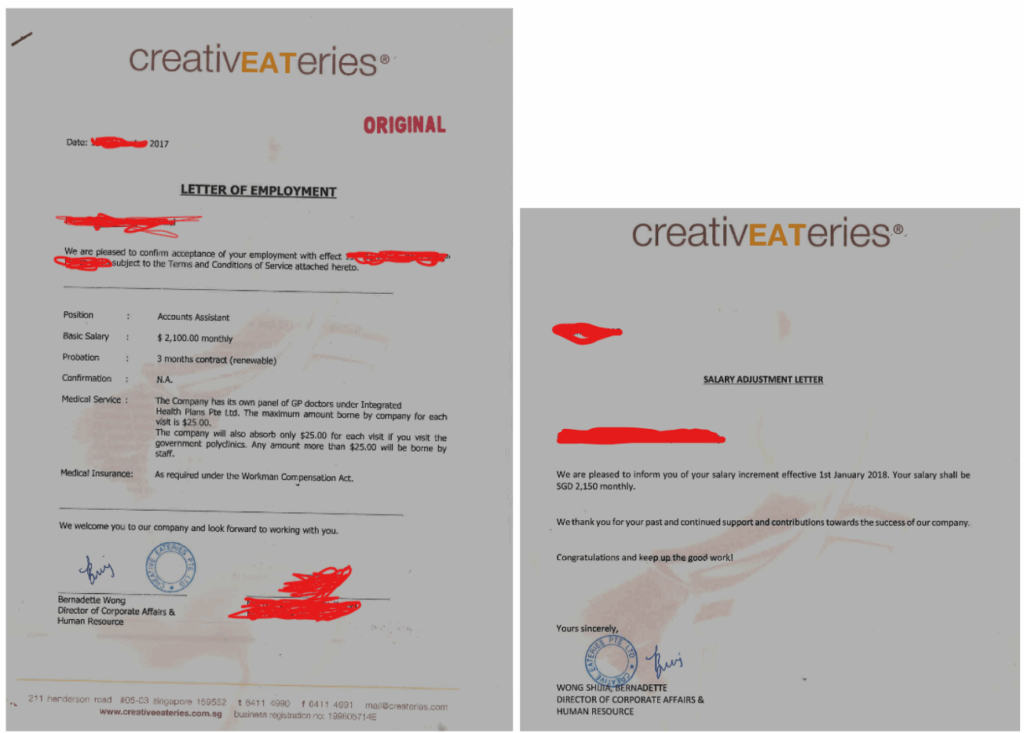
J’s letter of employment and salary adjustment letter. Employed for about 14 months, her starting pay was $2,100 per month.
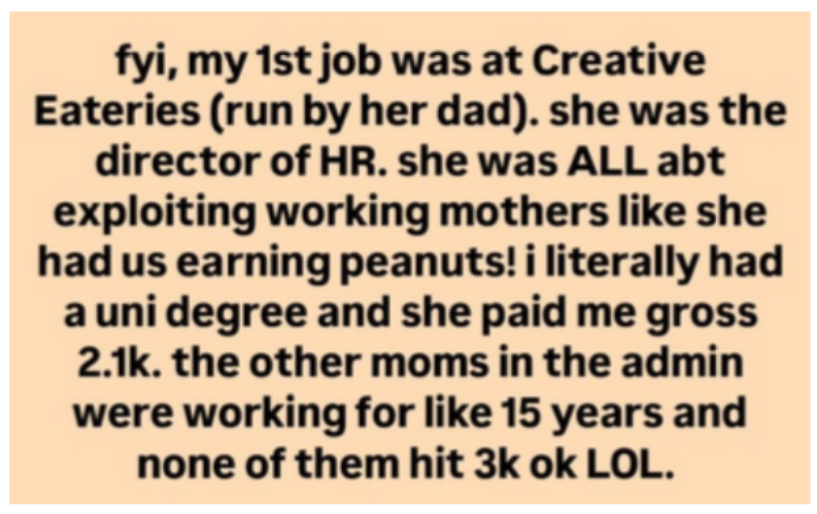
From J’s instagram stories
J also shared that when she resigned from CE after 14 months with them, she was told to refund the bonus she was paid ($470). J shared that this bonus was for the preceding year (2018), since she did not work more than 6 months in 2019. She felt that clawing back her bonus, which was already quite small, was unfair since it was for work done in 2018, when she worked the whole year.

- J was told to refund her bonus + employer’s CPF contribution once she resigned
However, according to CE’s employment contract for J, if the worker tenders their resignation before 1st July, they have to refund the full amount of their Annual Wage Supplement and/or bonus and the relevant portion of employer’s CPF contribution to the company.
This is what is known as an AWS or bonus clawback clause. In Singapore, it is not legal for a company to claw back the AWS or bonus from an employee once it has been paid unless there’s a contractual clause allowing for it.

AWS clawback clause in J’s contract with CE
While the employment terms were contractually legal, questions remain about their fairness and alignment with Giam’s stated advocacy for working parents.
In an interview with Business Times, Bernadette Giam claims that if elected, she would speak up for women entrepreneurs and businesses, as well as working parents. What about the working parents who work for her?
As the boss of a successful family-run business, there is no doubt that Bernadette Giam is a great fit for the People’s Action Party. This raises questions among voters about how she might represent working-class constituents.
Editor’s note: This article reflects observations based on publicly accessible records, media reports, and individual accounts. It does not make any allegations against Bernadette Giam, nor does it seek to pass judgment on her character or conduct. The aim is to examine the relationship between professional leadership and political representation in the public interest.