Comments
Netizens criticise PM Lawrence Wong’s election remarks as fear-based and call for focus on domestic issues
Prime Minister Lawrence Wong has warned that “much is at stake” in the upcoming general election, citing global instability and the need for national unity. His remarks, however, have drawn online backlash from netizens accusing him of fear-based politicking and calling for stronger opposition.

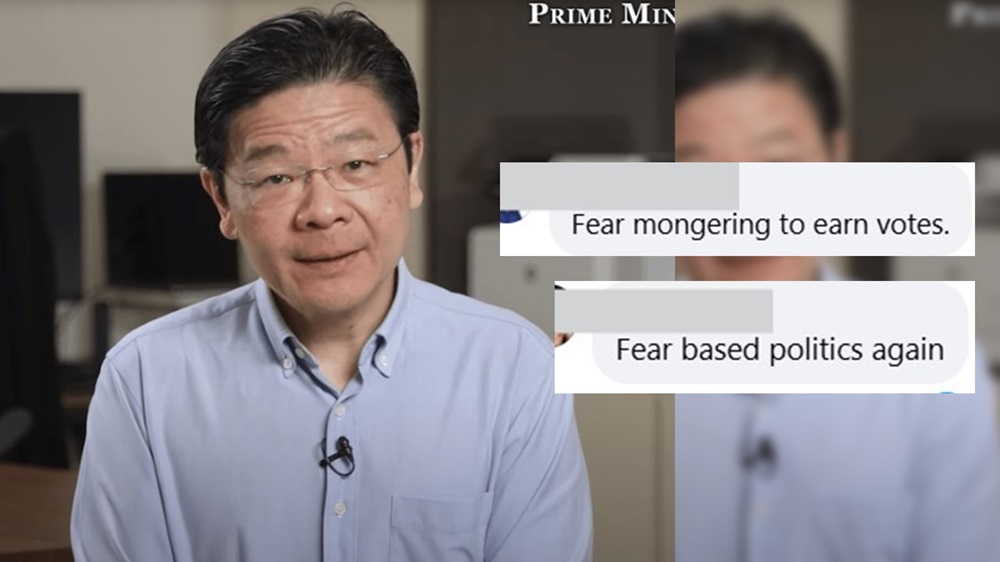
Netizens have accused Prime Minister Lawrence Wong of using “fearmongering” tactics to rally support for the People’s Action Party (PAP) after he warned that “much is at stake” in the upcoming general election.
Speaking to Singaporean reporters in Hanoi on 26 March, Wong said the upcoming GE is not only about securing a strong mandate for the PAP but also about Singaporeans recognising the stakes involved in the face of an increasingly challenging global environment.
“In order to survive, in order to thrive, in order for us to navigate a very challenging global environment, we will need a strong and united Singapore,” he said. “So there is much at stake in the elections.”
Wong, who recently undertook introductory visits to several ASEAN countries, said he has observed a “profound change in the global order.”
He said that geopolitical competition has been intensifying, with major powers vying for influence, and trade barriers are going up, posing significant challenges for smaller nations.
“All of us in ASEAN [the Association of Southeast Asian Nations] can see the changes happening in the world,” he told reporters.
“Great power rivalry is increasing and, more and more, it feels like we are entering a world where it’s every country for itself, and stronger countries will use aggression or even coercion to get what they want at the expense of smaller countries,” Wong continued.
Wong went on to say that “even within ASEAN itself, the large countries on their own will feel that this is a very difficult, inhospitable global environment.”
He emphasized the need for ASEAN nations to unite to strengthen their resilience against geopolitical challenges.
During the exchange with reporters, Wong said that he hopes Singaporeans will entrust him with the chance to serve the nation.
“And when the elections come, I will present my case for the PAP, for me and my team, and I hope Singaporeans will give me the chance to serve them and to serve Singapore,” he said.
Wong also reiterated his commitment to leadership renewal within the party, noting his ongoing efforts to recruit fresh candidates from across public service, academia, and the private sector. He argued that political continuity must be matched with generational renewal to secure Singapore’s long-term future.
Netizens pushed back against ‘fear-based politics’
However, following the publication of his comments, some netizens responded critically, accusing Wong of employing fear-based political messaging.
A handful of netizens commenting on The Straits Times’ Facebook post expressed skepticism about Wong’s emphasis on the global environment, viewing it as an attempt to instill fear and dissuade voters from supporting opposition parties.

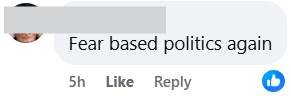
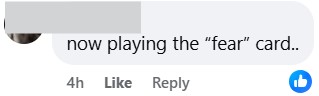

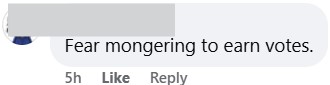


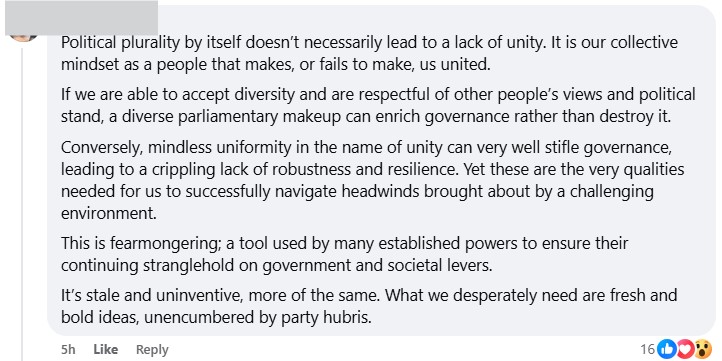
One commenter wrote that political plurality does not necessarily lead to a lack of unity, noting that unity depends on the collective mindset of the people.
The user suggested that Wong’s remarks were a form of “fearmongering” aimed at reinforcing the PAP’s political dominance in Singapore.
“This is fearmongering; a tool used by many established powers to ensure their continuing stranglehold on government and societal levers,” the user stated.
One netizen suggested that this is likely Wong’s “most threatening” statement since becoming prime minister, raising speculations that Wong may be anticipated a possible political shift against him.

Growing demand for opposition MPs
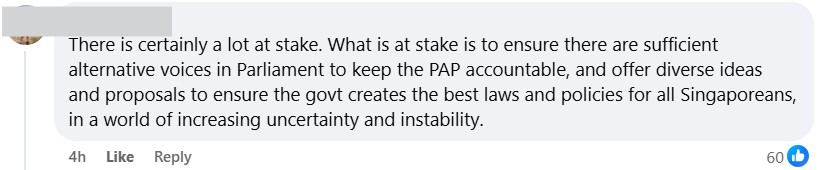
Several netizens agreed that “much is at stake” in the upcoming GE, which they said reinforces the need for a stronger opposition presence in Parliament to ensure government accountability.

One netizen commented that what is truly at stake is ensuring a strong opposition presence in Parliament to hold the PAP accountable and create policies that best serve all Singaporeans amid “increasing uncertainty and instability.”
One netizen commented that opposition parties could provide better ideas and proposals than “the current tax increasing team.” The user dismissed Wong’s warning by saying, “Save your threat.”

Another commenter called on voters to unite to elect more opposition members into Parliament to ensure their voices are heard.

Some commenters said that people want a robust government with MPs who prioritise the people’s needs rather than a “yes man” Parliament that blindly follows directives from the ruling party.


One netizen emphasised the need for a strong opposition presence in Parliament, comparing it to a “co-pilot” that helps navigate challenges and ensures checks and balances, in order to prevent a dominant party from having “unchecked power.”

One netizen wrote that true unity comes from having a strong opposition to provide checks and balances, aiming to prevent “senseless policies” from being pushed through without scrutiny.

Calls for focus on domestic concerns
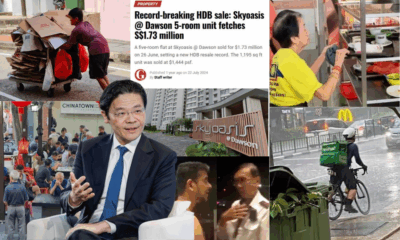
Some commenters argued that the government should prioritise domestic issues over global challenges. They highlighted key concerns such as the rising cost of living and housing affordability.
One netizen called on the government to “feel the ground and understand the sufferings of the people,” noting that many are struggling with the rising cost of living and GST hike.

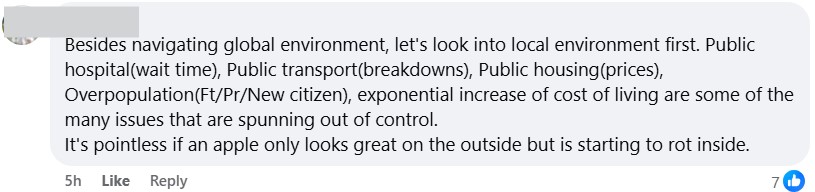
One netizen urged the government to address domestic issues such as long wait times in public hospitals, public transport breakdowns, rising housing prices, overpopulation of permanent residents, and the soaring cost of living, which they said have been spiralling out of control.
“Besides navigating global environment, let’s look into local environment first,” the user wrote. “It’s pointless if an apple only looks great on the outside but is starting to rot inside.”
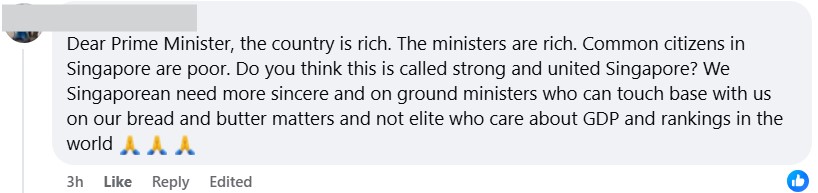
One netizen said that Singaporeans need “sincere and on ground ministers who can touch base” with them on essential issues, such as the cost of living, rather than elites who prioritise GDP growth and international rankings.