Opinion
For Singapore’s sake, no more activisim please
A middle finger captured national attention, but why? Two sisters challenged Shanmugam, sparking debate. Critics say they should apologize, yet their activism stems from community work, not provocation. Should only elites engage in politics? This moment questions who gets to shape Singapore’s future.

By Suraendher Kumarr, founder of workers’ rights group Workers Make Possible
This weekend, a middle finger has captured an entire nation’s consciousness.
The last time I remember a middle finger capturing the nation was in 2017, when a 15-year-old boy flipped off the camera.
When I tried to do some research on middle fingers in Singapore history, I saw a bunch of Stomp articles about road users flipping each other off.
Another was a photograph of metalheads at a Watain concert. Shanmugam had announced a ban against Watain.
You see a bunch of men, very racially diverse all pointing the middle finger to the camera. People flip the bird so often, it makes one wonder if it’s somewhat of a national sport.
But I digress.
Fast forward to a few days ago when two Malay-Muslim hijab sisters did the unthinkable. Some would say, foolish.
They went to confront arguably the most powerful man in Singapore, Shanmugam, about a law he has been very proud to call his legacy, the Protection from Online Falsehoods and Manipulation Act (POFMA).
I don’t need to repeat what you already know about what happened.
Just remember that there are two parts to what happened. Shanmugam’s version and the “parts he left out” (the sisters’ side).
Most people will only see the former’s side, because it has been reported on all the mainstream media and social media platforms.
As a community worker who works with many diverse communities of people, I was quite shocked at how everyone in the communities I work with knew about this incident.
From Singaporeans to migrant workers. From school-going youths to 80-year-old seniors.
I compared it to how more uplifting news about how delivery riders, through their own efforts and no organisation, managed to do something to increase their incomes, received no such national attention.
On the matter of POFMA, there have been attempts to communicate the process of being investigated for it, some things that are very surprising.
But again, minimal traction. Why did this middle finger receive national attention and the rest did not?
And we know how the public reacted to both sides of the middle finger.
One side was an edited 7-minute clip with precise audio, while the other was a 5-page Google document unpacking the video and explaining the parts that were left out.
You can make an educated guess on which side will reach more people.
But I want to talk about a particular response to both sides of the middle finger.
What both the Muslims and parts of what some call civil society activists and intellectuals (the activists) have in common is their call for the sisters to apologise.
This response ranges from one extreme to a more moderate position. The extreme is that the sisters, with one finger, undid all the gains the pro-Palestine movement has made in Singapore.
In other words, they say that they have set the movement back.
The Muslims say the sisters should have “adab”. I work with many Muslims through community work and am loosely familiar with some of these things, but I will not comment on the religious aspects of it.
The more moderate position of both Muslim and activist critics, is that Shanmugam was in the wrong but simply put, the sisters should have still carried themselves with grace and respect or their cause is ultimately what will be hurt.
I 100% understand where the activists and Muslim critics are coming from.
In fact, when I first saw the video, I resonated with the moderate position. I thought, if the sisters wanted to survive this, there is no other way but to apologise and then explain the parts Shanmugam might have left out.
But then, I remembered what I learned from my few years in community work.
Do not react, listen. Do not form judgements, listen. But to be able to listen, we must first be connected with each other.
I am fortunate enough to be connected with the sisters (S and A) prior to all this.
Most people active in the pro-Palestine movement on the ground in Singapore will know them both.
I first heard of A 1 year ago. A crane operator I knew from my community work told me there was a care worker organising reading groups about the Palestine issue.
She had built a multi-racial community concerned about Palestine through these reading groups.
She would simply carry her picnic mat and set up shop in a heartland area and then quietly read with whoever would show up.
I then met her sister, S. Through nature walks, kites, and other activities, S and A were a big part of building a multi-racial community of people concerned about Palestine.
This is not an easy feat, given how this cause has been racialised. I remember hearing Muslims say that they are very pleased to see Chinese and Indian people publicly speaking up about Palestine because if they do, as Muslims, they get more scrutiny from the surveillance state.
This community A and S helped to build has been instrumental for so many of us to have a safe space to discuss what has been happening in Gaza.
Many had shared how exasperated they felt donating to fundraiser after fundraiser, only for the Singapore government to continue to deepen its ties with Israel, the perpetrator of the genocide.
Hong Lim Park was closed off for talking about Palestine. And soon, safe spaces were simply not enough.
From these spaces, people began to suggest ideas on what more they can do to help end the genocide.
This included creating an outlet for ordinary Singaporeans to see their MP about Palestine. The idea was to support residents to speak to their MP about Palestine. This way, people can feel empowered to do more.
I also knew A from some community work I was doing with rental flat communities.
Many people in our rental flat network have issues with getting assistance from the government though the Social Service Office (SSO).
Waiting times are sometimes very long and some say they do not get enough to match up to the rising cost of living. We encourage residents to see their MP to appeal.
However, the appeals do not always work. In those moments, we would organise very quick fundraisers for them through a network of allies. One of them who regularly contributes a portion of her income is A.
From the one year I’ve known them, S and A are inseparable.
The two sisters are deeply protective of each other. As a community worker, another lesson I learned is to look for strengths in people.
Everyone might be pointing out the weaknesses or deficits in a person or community, but the role of the community worker is to look at the strengths as well. Their bond, as sisters, is a deep strength of theirs.
So, I was able to listen to the sisters’ accounts. And listen, I did.
Knowing A and S, and trusting them, I let my guard down as I listened. I suspended my views on what I thought should be the proper way to engage the most powerful man in Singapore.
As a community worker, we are taught not to make judgements and instead make observations.
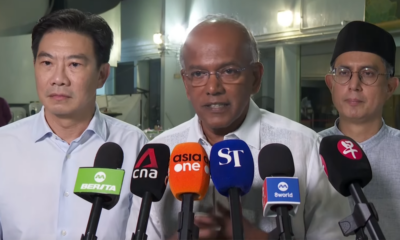
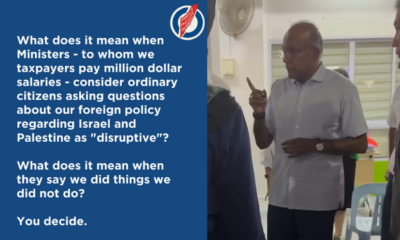
If we put Shanmugam and the sisters’ accounts together, we get a fuller picture. Shanmugam’s initial post, with 188k followers called the girls’ behaviour “deliberate rowdyism”, he also described what they did as “disruptive”.
These are judgements. A list of unbiased observations would be, for example:
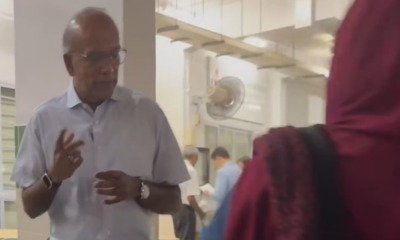
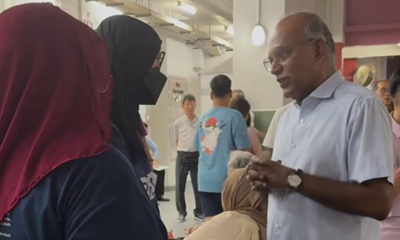
- Two sisters, who were not residents at Nee Soon registered to queue at Shanmugam’s MPS.
- The sisters were screened by 5 volunteers and they told each of them that they were willing to see the minister after he had seen all residents.
- Shanmugam had security personnel and volunteers following him around.
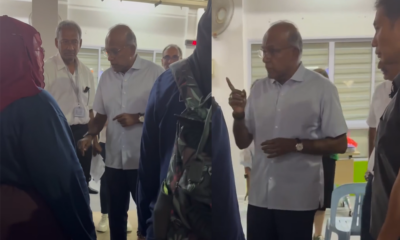
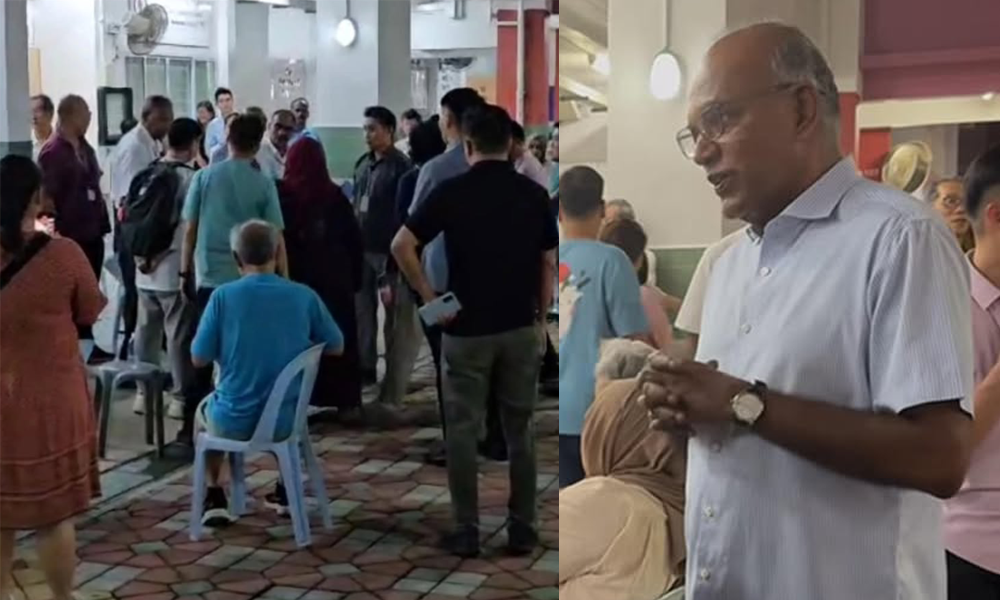
- In the zoomed-out photo of the sisters’ statement, more than 10 people can be seen crowded around the sisters as Shanmugam engages them.
I am not going to list down all the observations here, but you get the idea.
Another thing we learn to do as community workers when dealing with conflicts is non-violent communication.
We do this by prompting one another to state their own feelings attached to the observation. No judgements.
When I listened to the sisters, what I understood was that they felt intimidated by the many people filming and recording them.
When they asked them to stop filming, they were ignored and in fact, more cameras appeared. A CNA journalist arrived at the scene with a DSLR camera.
Shanmugam even said that it is a public place, and his volunteers were entitled to record but when the sisters asked if they can record, he said he was not allowing it.
Having what they deemed reasonable requests ignored and rejected made them feel disrespected.
And having it rejected but allowed to another party would also make one understandably feel inferior and discriminated against.
The middle finger appeared in response. So did the heart-shaped fingers.
And it was directed at the person, probably the journalist, who they felt disrespected by.
Some comments say they pointed the middle finger at a resident. This is false.
But why did S’s middle finger go viral and not A’s heart-shaped fingers?
One could say both went viral, but even more so, why then is the attention more on the middle finger? Well, that’s for another time.
But Shanmugam’s post labelled them as rowdies, disruptors and commenters called them all kinds of awful and nasty things.
Some even called them terrorists. But I actually know these sisters.
This is not my experience of them at all. And I think this is the power of connection and community.
If I was not in community/in connection with the sisters I don’t think I’d have spent much time thinking about this and wrestling with my own thoughts, and reserving judgement.
So I thought about it. And I’ve heard the arguments about why the middle finger is a mistake in this context.
I think that the argument on why it’s a mistake is strongest in only one context (I’ll refrain from the discussion about them being hijabis and what it means to Islam). It is only considered a mistake because the sisters were labelled as activists.
To further entrench the activist identity, Shanmugam linked them to the group they are members of, which supports ordinary people seeing their MP to discuss Palestine.
And the media lapped this up, and somehow, because of an unnamed PAP spokesperson, the sisters’ engagement with Shanmugam was also associated as an initiative from the same group.
In community work, we work with communities, right? Communities are made of people, and people are human beings.
Human beings are fallible, they make mistakes and more often than not, forgivable.
But Shanmugam and the media did not describe the sisters as voters, Singaporeans, or people.
He described them as activists. And in this country, activists, like opposition politicians, are meant to be infallible.
Whiter than white they say. They must know everything, be calm amidst immense stress, and must be almost like a messiah.
The moment an activist makes a mistake, all hell breaks loose on them.
And that’s what happened.
The moderate position, which I subscribed to initially, was to admit that the middle finger is wrong.
S should not have done that, no matter what.
It is giving ammo to Shanmugam and the people who are on the other side of the fence, to attack the cause they are supporting.
But if we removed that label, who are the sisters?
They are ordinary people who feel deeply about this country and the direction it is headed. And they also feel a deep sense of duty of care to the people they know and are in community with.
Their actions are motivated by this.
The problem with calling people activists in this country is almost akin to people being called communists during the Cold War.
You become stripped of all humanity and you completely represent the cause you claim to support. Every move you make that has the public eye is seen as representative of the cause you claim to support.
If the sisters were just described as ordinary people, not attached to any group, I don’t think they would have received such judgement and hate.
In community work, we talk about how to be in service of people’s efforts. A lot of this means shifting power away from the top filled with experts and to ordinary people.
Why? Because we believe everyone has a gift, everyone has a strength.
And in the political sense, everyone can and should be an active citizen engaged about how Singapore should be governed.
What message are we sending if we say that only skilled experts have the right to engage the most powerful man in Singapore?
That they should know what was in store for them before they thought of approaching him?
What does it mean to say that they should apologise because they should not have acted that way?
Another thing I learned about community is to let my curiosity, not judgment, lead me.
My curiosity made me reflect: what if the middle finger is a valid response to the intimidation and disrespect that one would feel in that situation with the most powerful man in the country?
I think it is only a mistake to lose our cool in such a situation if there is that expectation to keep calm even when there’s a fire in front of you. Or when you’re under attack. This expectation is, in my view, reserved for activists and opposition politicians in Singapore.
In 2019, when former minister Lam Pin Min announced the ban on PMDs overnight, hundreds of delivery riders stormed the MPS and demanded to speak to their MP.
If you watch the videos, they were anything but calm or cool. And why should they be? Their rice bowls were destroyed overnight by the minister’s actions.
But they were not described as activists. They were described as riders, or ordinary people. Why wasn’t that described as a disruption or rowdy behaviour?
Why didn’t he film them?
Fun fact, there are trade unionists who credit the current platform workers’ act to that moment in 2019.
In short, this expectation to be calm in the middle of a fire is reserved for activists and opposition politicians, not ordinary people, workers.
To really build a democratic society, I don’t think we should be demanding ordinary people to be flawless.
To do that would be elitist and undemocratic. If all acts of confrontation or engagement with people in power are only to be done by activists who are very skilled, we are saying that ordinary people cannot participate in everyday politics of this country.
It is no surprise that in a country that favours top grades and paper qualifications over lived experience and hard manual work on the ground, some reproduce the same elitism when it comes to local politics.
There was a time for professionalised elite activism in the 1990s, led by NGOs and academic intellectuals.
They played an important role in progressing a lot of issues on migrant labour, gender and so on.
But many of these NGOs are becoming increasingly co-opted by the state. Academic intellectuals are also being co-opted. Many of them have closed-door meetings with people in power and see this as the primary way to make change.
Some of these people say that the two sisters set the movement back. Maybe.
But then the same question has to be asked of activists/NGOs and intellectuals, too.
Have your closer connections to the state, having closed-door discussions and making deals behind closed doors, and obeying orders to be silent on certain issues set the movement back?
It is understandable that many from this sphere will identify with what A and S did and expect the sisters to abide by the same standards they feel have been imposed on them.
However, I think if we really want to progress as a nation, it is time to return power to the people, not activists.
Ordinary people are feeling more empowered, speaking up in their own terms and engaging authorities in very creative and counter-intuitive ways.
I have learned a lot from many of these working-class people. In some meetings with them, some often say that because I have a university degree, more of the workers will listen to me and not them.
They say it’s because “nee padicheve” (in Tamil-you are educated). I think this is a very sad reality of the elitist society we live in. I use this “privileged” position I have to platform the workers’ ideas. Slowly but surely, I hope we counter this culture of elitism internalised by many.
A and S are both ordinary workers. Both of them pay rent, bills, and pay taxes like all of us working class people do.
I’m curious why some are so quick to judge that they are “privileged” without even knowing them. They only recently got involved in more organisations to help various causes.
But let’s stop calling people who are politically engaged “activists”.
To build a democratic society, I think we don’t need more “activists”. We need a more empowered People.
Empowerment does not mean making people into professionalised activists. It means developing their confidence and self-esteem to express themselves. In my view activists have more to learn from ordinary people than the other way round. But that, again, is another topic for another time.
It may seem like we as a society are not ready for such a populace.
But I think these discussions, engaging in the discourse of what has happened and allowing ourselves to have our minds changed, is a healthy sign that our political culture is maturing.
The ground is shifting. The question is whether we will let it shift us.
For Singapore’s sake, no more activism.
Please 🙏